Ties That Bound: Founding First Ladies and Slaves
- By Marie Jenkins Schwartz
- University of Chicago Press
- 416 pp.
- Reviewed by Vivian Bruce Conger
- October 24, 2017
A fascinating look at the complex relationships between enslaved women and their high-powered owners.
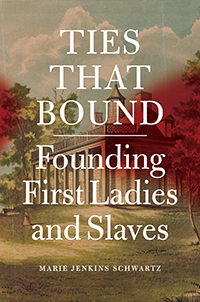
To bring some balance to the flood of books on the Founding Fathers and their political lives, Marie Jenkins Schwartz turns her lens on the wives of the Virginia presidents: Martha Washington, Martha Jefferson (who complicated her narrative because she died so young that her daughter stepped in as surrogate first lady for several months), and Dolley Madison — women who were born into slaveholding families and married slaveholding men.
Ties That Bound, the resulting well-researched history of the relationships that developed between these first ladies and their slaves, makes for compelling reading.
The author’s approach, by definition, unfortunately allows her to essentially ignore Abigail Adams, who is mentioned only in passing and whose omission is explained briefly in a footnote. Schwartz promises not to write hagiography of so-called “good mistresses,” but instead to explore “the relationships that developed between the First Ladies and their slaves, making visible the domestic spaces where the ladies lived with their help.”
Indeed, as the book reveals, slaveholder and enslaved lives intertwined in many complicated ways. In recognizing the agency of both slave owner and enslaved, she hopes to reveal what she sees as the “human relationships that were negotiated between” them.
Although admitting that the relationships were not equal, she claims that both “made choices in circumstance that constrained both groups of women.” In Schwartz’s telling, Martha Washington and Dolley Madison represent two extremes of age and background and thus are perfect foils for one another, as well as for Martha Jefferson.
Ultimately, Schwartz boldly claims that “responding to one another, slaveholding and enslaved women created a unique, imperfect union of their own that helped shape the nation.”
There is much to be learned in this fascinating book; too much, in fact, for me to examine here at length. Schwartz grounds her study by explaining the extent to which all three first ladies throughout their lives (as single women, married women, and widows) depended on the enslaved for their economic, social, and political stature.
They embraced the institution and what it could do for them and their families, and she convincingly demonstrates this throughout by making good use of copious letters and diaries (most of them written by men) and account books (of the first ladies) at her disposal.
As Schwartz admits, on the other side of the biographical ledger, “sparse records make the task of recreating the world of [the enslaved] difficult, but not impossible.” Indeed, there are glimpses throughout of slave agency, albeit understandably constrained.
Both slaveholding and enslaved women forged interdependent but often fraught relationships in the domestic spaces of bedroom, dressing room, parlor, and kitchen. Schwartz sets up these relations by asserting that “enslaved women…struggled to find time and energy to meet their own needs and those of their families. Getting enslaved maids to complete tasks was in some way like a dance, but each partner had her own idea of how quickly the steps should be taken, and neither could control entirely the resulting performance.”
Although owners possessed most of the power, they also relied on their slaves to carry out chores and to “demonstrate through their behavior the gentility of the family.”
We can see evidence of this power struggle at play when the enslaved intervened to prevent owners from separating families and communities, refused to work, engaged in willful disobedience, pursued legal disputes, and ran away. Because they lived their lives in the intimate sphere, the close quarters of the household, all three first ladies experienced this give-and-take on a regular basis. As Schwartz explains, their worlds were dominated by issues of race and gender, and they all reacted to these situations in very different ways.
Readers fascinated with Sally Hemings will not be disappointed, for Patsy Jefferson Randolph’s often hostile and complicated relationship with Hemings’ family takes center stage. Even more enlightening was Dolley Madison’s enthusiastic embrace of slavery even though she was raised in a Quaker, non-slaveholding family and was living in an age of growing abolitionism, even in Virginia.
Indeed, as Schwartz suggests, “some criticism, less scandalous to her contemporaries perhaps, called out her reliance on slaves.” Her lavish and much-celebrated social affairs both in the White House and later at Montpelier seemed to demand it.
One complaint I have with this captivating and necessarily complicated study is the extent to which the first ladies’ more famous slaveholding husbands intrude into the story, often overshadowing the women themselves. I am writing an intergenerational study of Deborah Read Franklin and Sally Franklin Bache without letting the larger-than-life Benjamin Franklin interfere, so I understand the difficulties the author faced. But in a book devoted to the wives of presidents, the husbands’ presence should be minimal.
Ultimately, however, this is a thought-provoking exploration into the thorny relationships between slaveholding and enslaved women that turns our focus from the political to the personal. Schwartz’s determination to portray “slaveholding and enslavement as a lived experience rather than a tableau frozen in time” shines through.
Vivian Bruce Conger is an associate professor in the history department at Ithaca College. She is the author of The Widows’ Might: Widowhood and Gender in Early British America.