Tiodora’s Letters: An Enslaved Woman’s Fight for Family and Freedom
- By Marcelo D’Salete; translated by Andrea Rosenberg
- Fantagraphics Books
- 204 pp.
- Reviewed by William Schwartz
- May 29, 2026
In 1860s Brazil, a slave attempts to find her loved ones.
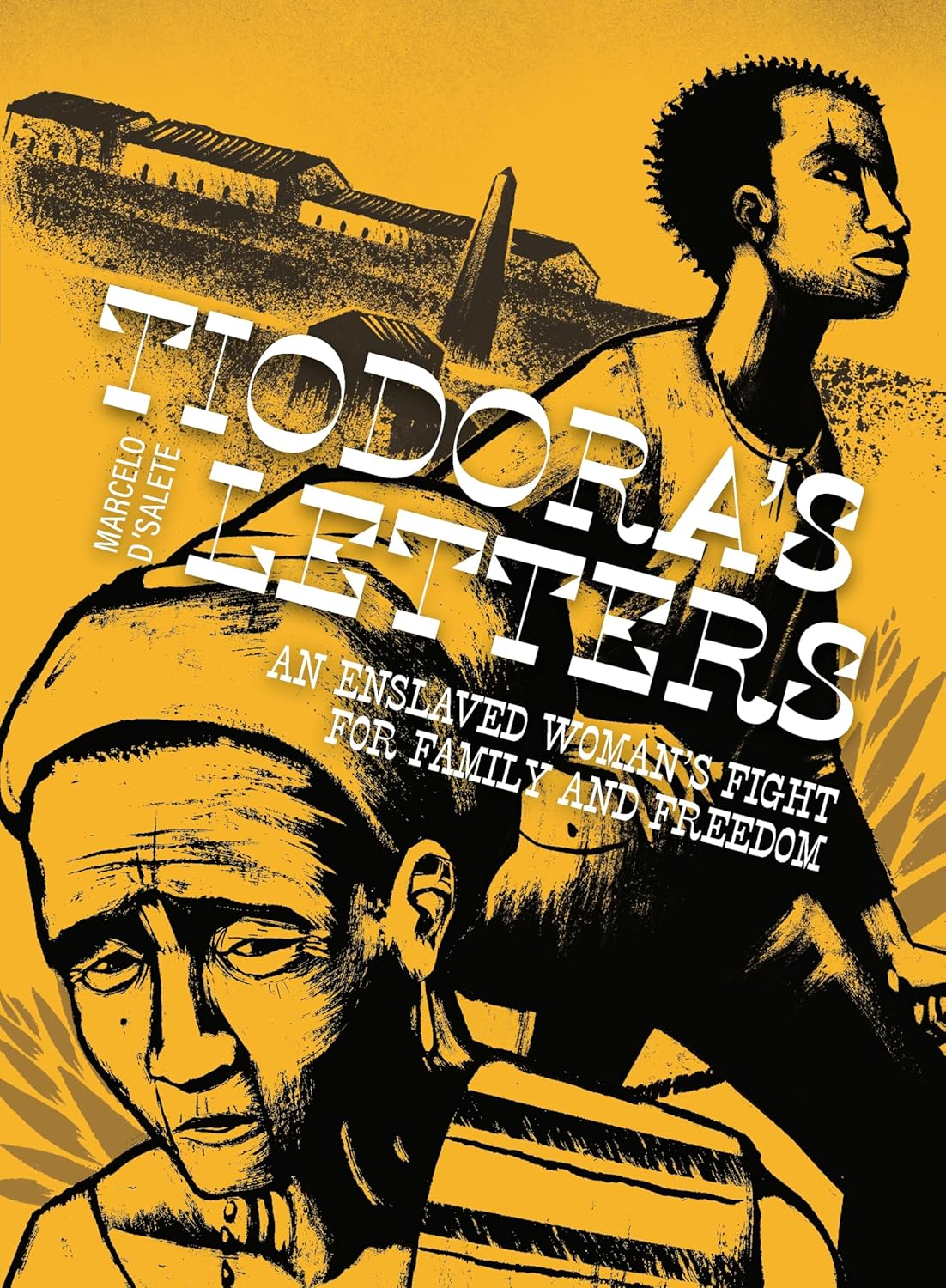
In English, writing about slavery tends to focus on the peculiar institution in the Unites States. However, with its translation of Tiodora’s Letters, Fantagraphics Books seeks to do broader justice to the subject by delving into a Brazilian slavery narrative. Author Marcelo D’Salete is Brazilian himself, and this translation from the Portuguese of his award-winning 2022 graphic novel is an exceptional synthesis of grim charcoal drawing with the historical record, dramatizing the 19th-century world where the elderly slave Tiadora tried and failed to correspond with her loved ones.
The main character is not Tiadora but Benê, a teenage boy who takes it upon himself to try and get one of her letters to its intended recipient. He feels that he owes Tiadora a debt for showing him kindness. In this modern age of instantaneous communication, Tiadora’s Letters reminds us of a time when relaying even the simplest of messages required a great deal of proxies and footwork. What’s worse, a sender would often have no way to tell whether a letter ever reached its destination.
The book eschews a bombastic, action-filled plot; the backdrop’s oppressive air exudes all the tension necessary as Benê travels through his environment. Dashing from cities to jungles to a plantation, he tries to avoid detection. While Tiadora’s Letters features a plea for freedom made entirely within the existing legal processes of the day, the slave-owning system harbors a deep paranoia that enslaved people will send letters in order to foment a revolt. As a result, Benê’s quest takes on an illicit air.
He lives in a country where life is cheap and murder cheaper, particularly if the victim is someone beneath the notice of the law. Thus, his willful, headstrong determination to deliver the letter seems more foolhardy than brave.
The drawings alone effectively communicate the horror of slavery, leaving translator Andrea Rosenberg little dialogue to convey. (A core irony of the story is that enslaved people aren’t supposed to communicate with each other in the first place.) Tiadora da Cunha Dias’ own real-life story, outlined in the extensive historical notes that serve as a postscript to the fictionalized narrative, revolves around her inability to locate the family she’s desperate to reunite with.
It’s the casual inhumanity of Tiadora’s Letters that strikes the reader, even as the characters seem oblivious to it; for the most part, this horrible world represents their normal, daily life. Benê has learned not to be scared because — despite the oppressive nature of his reality — fear would prevent him from ever getting anything done.
In its conjuring of this impossible (though widely accepted) system, Tiadora’s Letters exerts a quiet power. The story never feels entirely hopeless, although, by any reasonable measure, that’s exactly what the enslaved characters are. Benê isn’t sure the situation will improve — whether the perversion that is slavery will end — but he copes nonetheless, giving a sublime strength to his plight.
William Schwartz is a freelance writer living in Southern Illinois. He has reviewed wide varieties of media, including South Korean dramas, upscale graphic novels, vintage videogame media, and much more.