Transformed by India: A Life
- By Stephen P. Huyler
- Pippa Rann Books & Media
- 408 pp.
- Reviewed by Raima Larter
- September 17, 2025
An anthropologist celebrates the country that reshaped him.
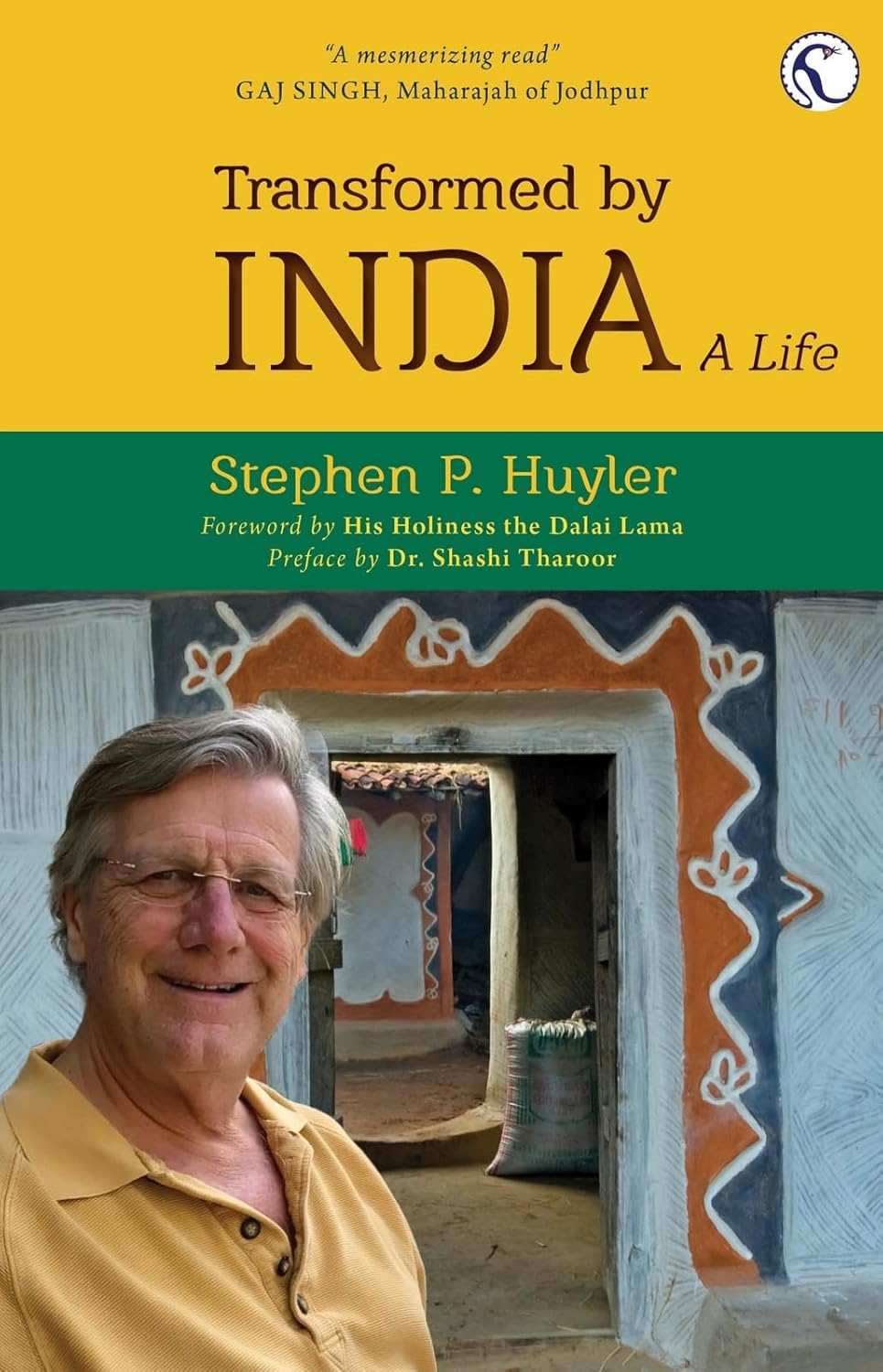
In Transformed by India, a book that is simultaneously a travelogue and memoir, Stephen P. Huyler shares with us his colorful and vibrant reminiscences about a country he first ventured to as a 20-year-old college student in the 1970s. That initial trip was followed by many others as Huyler embarked on a doctoral program in anthropology that required him to return repeatedly for field research. Later, he would go as an art collector and tour guide, drawn back to a place that seems to have, as the title says, transformed his life.
We are taken along on these trips, and Huyler reveals his descriptive skill as a knowledgeable guide, a role he eventually took on with the Smithsonian Associates, leading groups through India. In the book, introduced with a special foreword by the Dalai Lama, we’re treated to many examples of what I imagine it must’ve been like to explore the country with Huyler. Consider this passage from an early chapter depicting the backwaters of Kerala:
“Abundant fruit-bearing trees hugged the shores of the wide river and canals. Flowers accented waterside houses: some, traditional thatched huts; others, fanciful cement and stucco homes. Women wearing saris in a full spectrum of colors washed themselves, their cookware, and even their animals in the moving stream.”
After this initial glimpse of the area, Huyler catches a bus and then hires a boat to take him to a lake formed by damming the Periyar River. There, he sees a herd of elephants “swimming across the lake in front of us; nine grey backs rising and falling like dolphins, heads underwater, but trunks held up to breathe like a series of periscopes.”
This delightful voyage through a fascinating land continues as he recounts his time as a graduate student in an anthropology program based in London. He tries to carve out a research project, eventually settling on an exploration of the traditional art of Indian tribal peoples known generically as Adivasis. This art, largely created by women as part of their daily puja, or worship, had been dismissed by more modernized Indians as crude and uninteresting, but Huyler saw value in the women’s creations.
He draws a connection between the way the Indigenous people of India were (and are) treated and the way Native Americans in the U.S. have also been subjugated and ignored. As part of his project, he collected Adivasi pots and other worship objects, many of which were destined for the landfill. He brought them back to London and, eventually, to the U.S., where they made their way into museums.
After Huyler earned his Ph.D., he continued with art collection and curation and was asked to organize an exhibit for the Arthur M. Sackler Gallery at the Smithsonian in Washington, DC. The result was an exhibit entitled “Puja” that debuted in 1996 and remained open to the public for four years.
Huyler organized another exhibit for the American Museum of Natural History (AMNH) in New York City. This exhibit was entitled “Meeting God,” an English translation of the Sanskrit term “darshan,” which refers to the experience of meditating on a figurine in order to see, and be seen by, the deity it represents. He describes its remarkable opening:
“The words emblazoned across [the museum] stated emphatically: ‘Meeting God!’ It was to have an irony no one foresaw. The next day the museum was closed, and Tuesday was the official opening to the public — plus a scheduled press conference where Time, Newsweek, and other magazines and papers would interview me. Those two events never occurred. Tuesday was September 11, 2001.”
A month later, the museum reopened, and the exhibit became, remarkably, something like a chapel. “Visitors sat or kneeled in silent reverence,” he writes, “hundreds of praying and meditating grievers.” The AMNH guards explained to Huyler that every day was like this, people bringing offerings of flowers, fruit, and coins, just as they might do at a temple in India.
Although the travelogue aspects of this work shine, it is, as the subtitle says, mainly a memoir. Huyler has published several other books focusing on the art and women of India, so this one was his chance to tell his own story. Despite an ending that wanders into a lot of personal reminiscences unrelated to the events recounted earlier, Transformed by India was, even for someone like me who doesn’t often read memoirs, a delight. And, although I’ve never made it to the Subcontinent, now I want to go.
Before moving to Colorado, Raima Larter was a chemistry professor who secretly wrote fiction and poetry and tucked it away in drawers. She has published four novels, two story collections, and numerous short pieces in places such as Whale Road Review, Cleaver, Gargoyle, and others. Her nonfiction book, Spiritual Insights from the New Science: Complex Systems and Life, was published in 2021 by World Scientific Publishers. She also serves as nonfiction editor for Utopia Science Fiction Magazine.