Triage
- By Claudia Rankine
- Graywolf Press
- 192 pp.
- Reviewed by Sullivan Summer
- August 10, 2026
A keenly observed, challenging exploration of where we are right now.
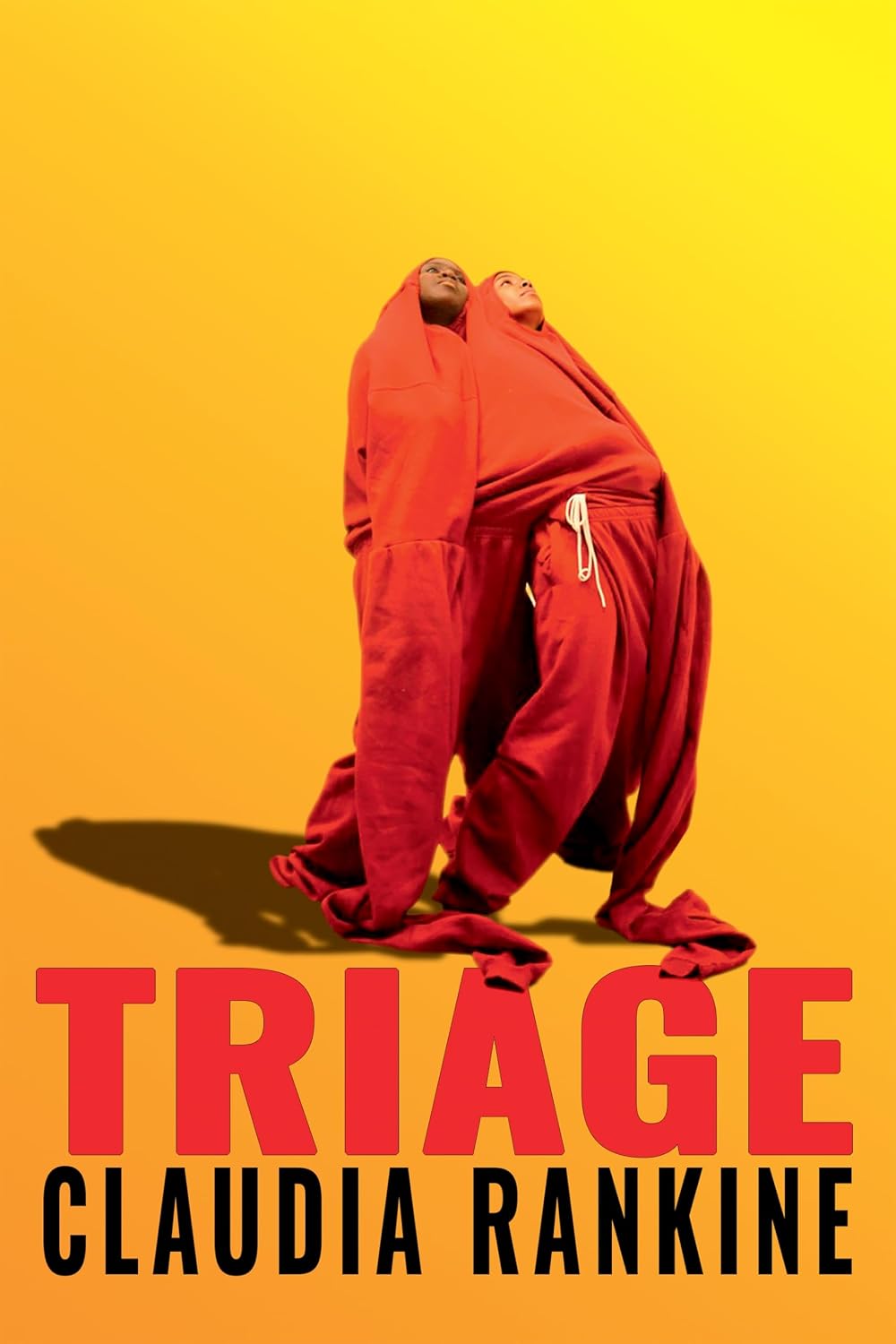
It’s been six years since Claudia Rankin’s last book. Readers familiar with her oeuvre, including her celebrated American Trilogy (Don’t Let Me Be Lonely: An American Lyric, Citizen: An American Lyric, and Just Us: An American Conversation) will have known implicitly that she’s kept busy contemplating our trauma. If, however, Triage is your introduction to Rankine — an award-winning poet, essayist, playwright, and critic — you should know that its back-cover description (“the turbulent friendship between two composite characters…struggling to define their wounded histories and their shared but separate lives”) is an oversimplification. For inside Triage’s pages is a deliberatively unfolding metaphor for a particular, middle-age stage of American personhood in the first quarter-century of a new millennium where outrage and apathy make uncomfortable bedfellows.
The lens Rankine turned so effectively in the past on questions of whiteness she now turns on questions of witness:
“Anyone can say anything while doing nothing and pointing.”
Triage’s two characters are nameless, known only as “the theorist” and “the narrator.” It is the latter’s head we occupy — her equivocations and her childhood memories of violence, including the pressure of a hand “over this mouth full of ‘no.’” Of the theorist, we know little aside from their pronouns (they/them) and nation of origin: Palestine. The two meet in college, where they devise a game of “collapse,” the joining together in a single descent to the ground that is a literal expression of the “toomuchness” of their young lives.
Over time, this game becomes something else altogether; its origin is lost beyond the nostalgia: “Memory is a shield.” As the acts and discussions of physical collapse fade, they are replaced by couches and photographs of artists’ installations (by Kaari Upson, Dozie Kanu, and others) in a Rankinesque mashup of high-minded design, over-intellectualization, philosophical aggrandizement, and literalism.
The narrator makes a living writing about artists’ couches; she is, in adulthood, still looking for a surface upon which to collapse. “It’s like living in a state of non sequitur, where the logic exists in the brutal, illogical worldmaking of supremacy within a lying structure,” she says. “How can a situation remain this alarming for years?”
How indeed.
References to Antigone, Saidiya Hartman, Omar El Akkad, Audre Lorde, Justice Ketanji Brown Jackson, and others demand a level of dot-connecting from the reader that makes idle consumption of the text nearly impossible. But why should it be? If the theorist and the narrator can invoke in a single exchange the contemporary historian Robin D.G. Kelley, mid-20th-century senator Joseph McCarthy, and an unattributed 1971 quote from poet/musician Gil Scott-Heron, then surely it’s not too much to ask the reader to carry our share of the analytical load.
We are promised “a book for those complicated but beautiful friendships that we come to rely on to unsettle us, to make us better.” Perhaps. But Rankine has always been difficult to reduce to marketing copy. And another articulation of “complicated but beautiful friendships” could be “merism,” as in two contrasting parts that form a whole.
The theorist observes as much and, upon doing so, makes it impossible to unsee merisms abundant in the text: “near and far, high and low, here and there, now and then.” At this point, we realize that Triage is not actually concerned with a landing place after collapse — all those couches — but with the collapse in progress, the in-between state, the suspension, the breath. What if we, always collapsing, never land? Writes Rankine:
“Keep on searching for a savior until your maybes murder you.”
As if to drive this articulation home, the book’s final pages are a contrapuntal, a visual and textual manifestation of the in-between. “Indecision is how a short road becomes a long one. Indecision is also a way to hold one’s breath.” Once we’ve reached the end, Triage, like Rankine’s previous works, remains on the brain, a blur between brilliant observation and elevation of the obvious. Perhaps this is the merism of our existence in 2026.
“Guilt rhymes with built,” the narrator tells us. “We built this.”
Sullivan Summer is an independent scholar, critic, essayist, poet, host of “Additions to the Archive with Sullivan Summer,” a New Books Network podcast, and creator of the Black Lit Crit newsletter on Substack.