True Color: The Strange and Spectacular Quest to Define Color — from Azure to Zinc Pink
- By Kory Stamper
- Knopf
- 320 pp.
- Reviewed by Michael Howard
- April 2, 2026
Is a rose by any other name still a shade of red?
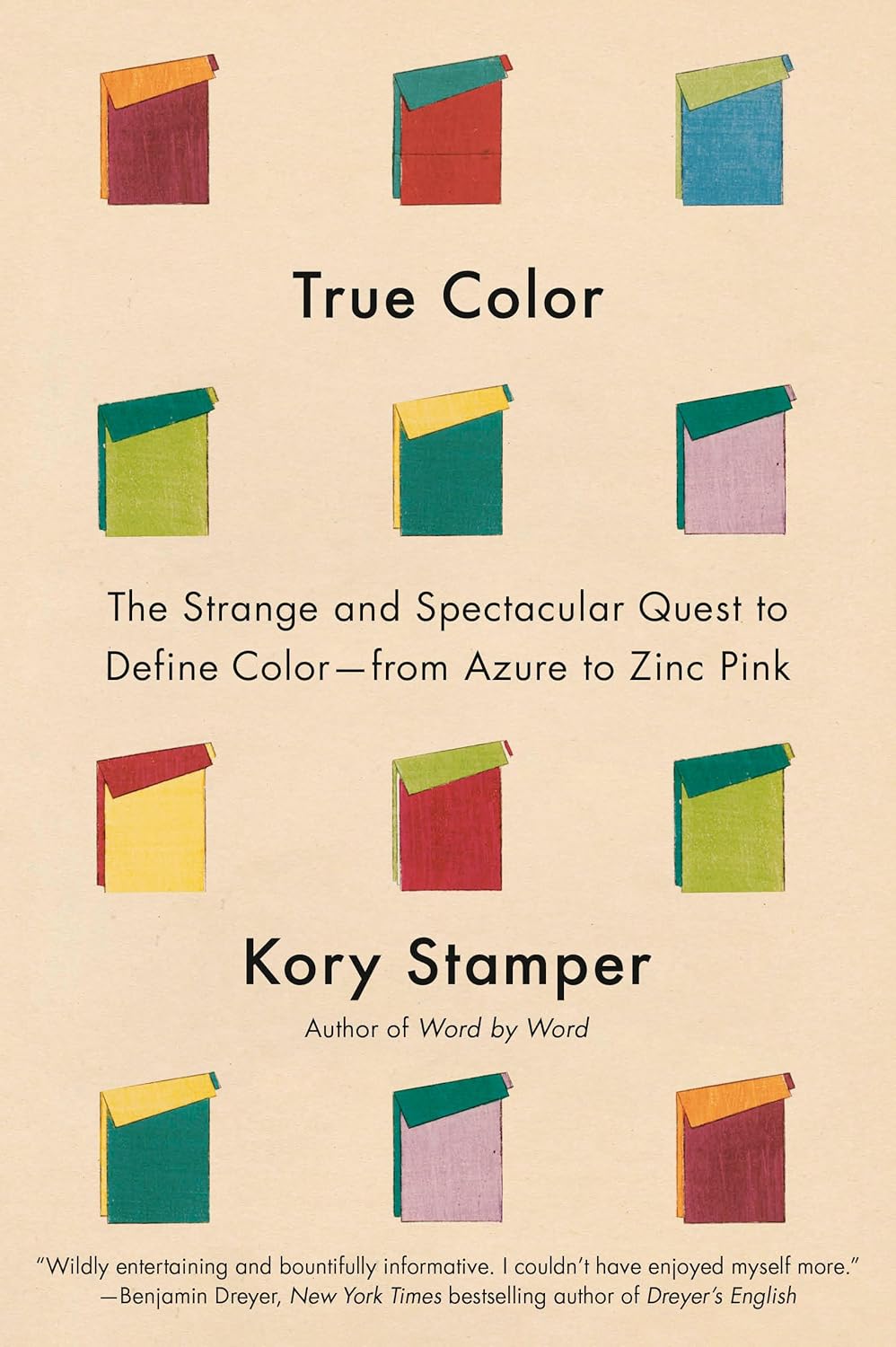
How does one define color? It sounds easy enough until you really think about it, at which point it seems daunting, if not downright impossible. Were you to consult Webster’s Third New International Dictionary, you’d find the following head-spinning sentence under “color”:
“[T]he characteristic of light by means of which two areas of identical size and shape that are juxtaposed, structure-free, and steadily and uniformly illuminated may be distinguished by a human observer and which is commonly identified for spectral colors by dominant wavelength, luminance, and purity and for nonspectral colors (as purples) by complementary wavelength, luminance, and purity…”
Yes, it goes on from there — for another 33 words. That was how the color people (or colorimetrists, as they’re called) hired by Merriam-Webster for what was supposed to be the mother of all English-language dictionaries saw fit to explain the concept of color to the public. But the real undertaking was attempting to define, and in many cases coin names for, the innumerable variations of color that pass through our perception every day. The fruit of that labor can be seen in color definitions for “begonia,” “fiesta,” “duckling,” and “mermaid,” to take a few examples.
It was these peculiar hues’ names and definitions that inspired lexicographer Kory Stamper to write True Color: The Strange and Spectacular Quest to Define Color — from Azure to Zinc Pink. In it, she documents the evolution of color science from the early 20th century, when Germany had a corner on the synthetic-dye market, to the publication of Webster’s much-anticipated third edition in the 1960s, and beyond.
Along the way, we meet the men — and, later, women — responsible for color’s modern nomenclature. The first and (if I may be allowed a low-hanging pun) most colorful of these personalities to enter the stage was Irwin Priest. It was not yet 1930, and Merriam-Webster was laying the groundwork for its second edition, which was to include an innovative list of color definitions. Priest, a physicist specializing in the fledgling discipline of colorimetry, seemed the man for the job.
The professional relationship that ensued was amusingly dysfunctional. Priest was prickly, conceited, and impossible to work with. He exasperated editor Paul Carhart with a series of combative and self-absorbed missives, sometimes capitalizing entire sentences to express his irritation. “For Carhart’s ‘we,’” Stamper writes, “Priest responds with ‘I’; in answer to Carhart’s dictum that all definitions must ‘convey some definite and intelligible meaning to the reader,’ Priest unfurls phrases like ‘a unified exposition of the fundamental nomenclature of colorimetrics’ and ‘Maxwellian trilinear coordinates.’” Later, he informs Carhart that “deadlines upset his ‘equanimity and continuity of thought,’ so he’s going to ignore them and advises Carhart never to bring them up again.”
Some of the passages in True Color read like scenes out of a comic novel. Priest’s successor (Priest eventually quit in a huff), Isaac Hanh Godlove, is equally funny at times, though for different reasons. Stamper’s sense of humor and flippant lightness of tone — on display throughout the book — belie the earnestness with which she approaches her subject. She doesn’t allow her passion for lexicography and dictionaries to blind her to the fact that most people don’t really care about such things. By creating a character-based narrative and exploiting its inherent comedy, Stamper lends appeal to what, in the hands of a grim-faced academic, would be a very dry book.
Which is not to say that True Color doesn’t contain its share of mind-numbing technical minutiae; inevitably it does, as in:
“He [Godlove] found…twenty-five different color chips called ‘turquoise green’; he had to measure each chip and then give that chip its Munsell notation, which involved juggling about 150 numbers…Are all the colors bunched close enough together in the color space that one definition would suffice? If not, how many clusters of turquoise green are there, and if you made definitions for each one…”
And so on. The point is that, occasional dreariness notwithstanding, Stamper’s prose and ability to spin a yarn make the history of color definition a fun, accessible story.
Alas, the story ends imperfectly (this is real life, after all) but with a twist. Godlove, who ultimately failed at his work on the dictionary’s second edition, was summoned again for the third but died before completing his definitions. (True Color is not without pathos: Carhart committed suicide in 1933, a year before the second edition came out.) Godlove’s wife, Margaret, who’d been actively involved in his work for years, took up the reins for a time, before another woman, Dorothy Nickerson, helped put the finishing touches on the third edition’s color entries.
That edition, released in 1961 to a hostile reception, has not been supplanted by a fourth, so Godlove’s definitions, as revised by his widow and Nickerson, stand. Meanwhile, debates over color — how to describe it, how to teach it, why we perceive it as we do — rage on because “nerds,” Stamper writes, “are nerds.” We have her own nerdiness to thank for a book on colorimetry and lexicography that manages to simultaneously educate and entertain.
Michael Howard’s journalism, essays, reviews, and fiction have appeared in a wide variety of print and digital publications. He lives in Vietnam.