Twenty Minutes of Silence
- By Hélène Bessette; translated by Kate Briggs
- New Directions
- 160 pp.
- Reviewed by Samantha Neugebauer
- September 16, 2026
This provocative whodunit denies readers easy answers.
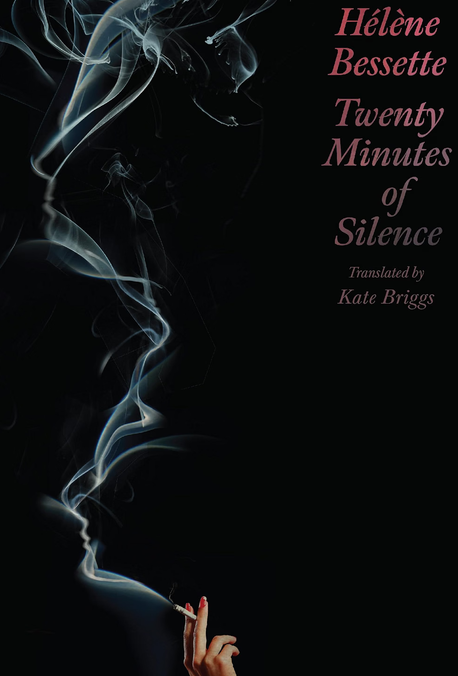
Twenty Minutes of Silence is the second of Hélène Bessette’s books to be translated by Kate Briggs in recent years. The first, Lili Is Crying, blew me away. Lili is a recursive story about a co-dependent mother and daughter in 1940s Provence, full of strangeness and cruel moments: friends wishing their friend’s unhappiness and unkindness toward a foreigner who survived Dachau. The story manages to be lush like the work of Jean Rhys, or like that of Bessette’s compatriot Marguerite Duras, and yet Bessette’s prose itself is angular, mainly due to its habit of column-like lineation and white space.
Unlike Lili Is Crying, Twenty Minutes of Silence is a whodunit, albeit a stripped-down, experimental one. The premise is that a man — a father, a husband — has been killed during the night at his home in the north of France. His wife and 15-year-old son were home and, consequently, are the lead suspects. Their maid was also present, though she doesn’t provide anyone — the reader, the detective — any real clarity.
Bessette, who died in 2000, made up a word for her genre: the roman poétique, or the poetic novel. And it’s interesting to read these two short, poetic novels together. The experience is akin to meeting cousins and clocking the similarities in their features and mannerisms, while simultaneously noting their differences. Both books, despite their petite size, can be claustrophobic. They are (to their credit, perhaps) un-bingeable. When I tried to devour them in one sitting, it was like eating too much fudge — dense in its pleasure, identical in its bite.
During a book-festival panel last year, several novelists, including Joyce Carol Oates, were asked what had inspired their latest works. One by one, they answered by referencing a real, corresponding event from their life, but when it came to Oates, who was wearing a giant, witchy black hat, she said that she got the idea for Fox when walking in the woods. After coming upon a dead animal, she recalled imagining, What if I had come upon a dead person instead?
In similar fashion, according to the book’s introduction, the impetus for Bessette’s novel came from her twisting the details of an actual murder into fiction. Apparently, while on holiday with her children, they heard gunshots in their hotel. The next day, she read in the newspaper that a boy had killed his father.
But what if he hadn’t? her story asks. What if someone else did it? What if his mother made him do it? What if his father had — directly or indirectly — made him do it? Should we ever hold children responsible for their crimes? Stated or implied, questions like this spill from page to page with bon mots and cryptic subtitles scattered between:
Shouting
SHOUTING
before
THE UNIQUE CERTAINTY.
Before the grandiose, the gigantic, the luminous, the perfect cer-
tainty,
of
DEATH.
That is to say, death is the only perfect certainty; all other certainties we think we know — say, the identity of the killer in a murder mystery — can only ever be imperfect. Thus, the larger gesture of her text is to integrate perfect certainty, thereby making it imperfect.
She does this through employing different voices to tell the same story. In particular, Bessette interrogates the 20 minutes between the father’s death and the arrival of help. She also plays with repetition, pronouns, and prop rearrangement. In one section, the gun is declared to have been in one place; in the next, it is said with full confidence to be somewhere else. As a reader, I craved perfect certainty, but the author refused to indulge me.
Early on, the text asks, “How many infamous uncertainties have caused others to fall into a swoon, into delirium, into madness?” foreshadowing the kinds of associations the book called to my mind as I read, such as those murders that defined my childhood — the O.J. Simpson trial and the killing of JonBenét Ramsey — along with more recent unresolved questions (like, why did President Trump win again?). In each case, I’ve always been awed by people’s ability to drain an uncertainty of all its imperfections in order to get to an answer that makes perfect sense to themselves.
With the notion in mind that a novel’s form is a type of content and communicates meaning, I was also thinking a lot about omniscience while reading. The omniscient narrator, with its all-knowing, god-like voice, is not as popular a device as it once was. (At least, that’s what we often hear.) Yet, through stealthy switches between “I” and “my” into a nameless narrator or into “we,” Bessette shows that even when we believe we have outgrown omniscient thinking, we can and do use words, including collective nouns, to disguise our personal assumptions.
For example, during one retelling of the murder night, Bessette writes:
“We know this: why women lie awake in their beds in the dead of night. We know all about the light sleeping habits of nervous, dissatisfied, irritated, belligerent, preoccupied, troubled, querulous, unhappy women.”
If you’re anything like me, you might find yourself susceptible to this statement, its stacking of adjectives seeming like evidence. But wait. Who is we? And how does this particular we know? Twenty Minutes of Silence won’t tell us, that’s for certain.
Samantha Neugebauer is a global lecturer at NYU Washington, DC, and the author of the forthcoming story collection Villains. She is also a senior editor at Painted Bride Quarterly and co-host of the review channel Short Story Boudoir on YouTube.