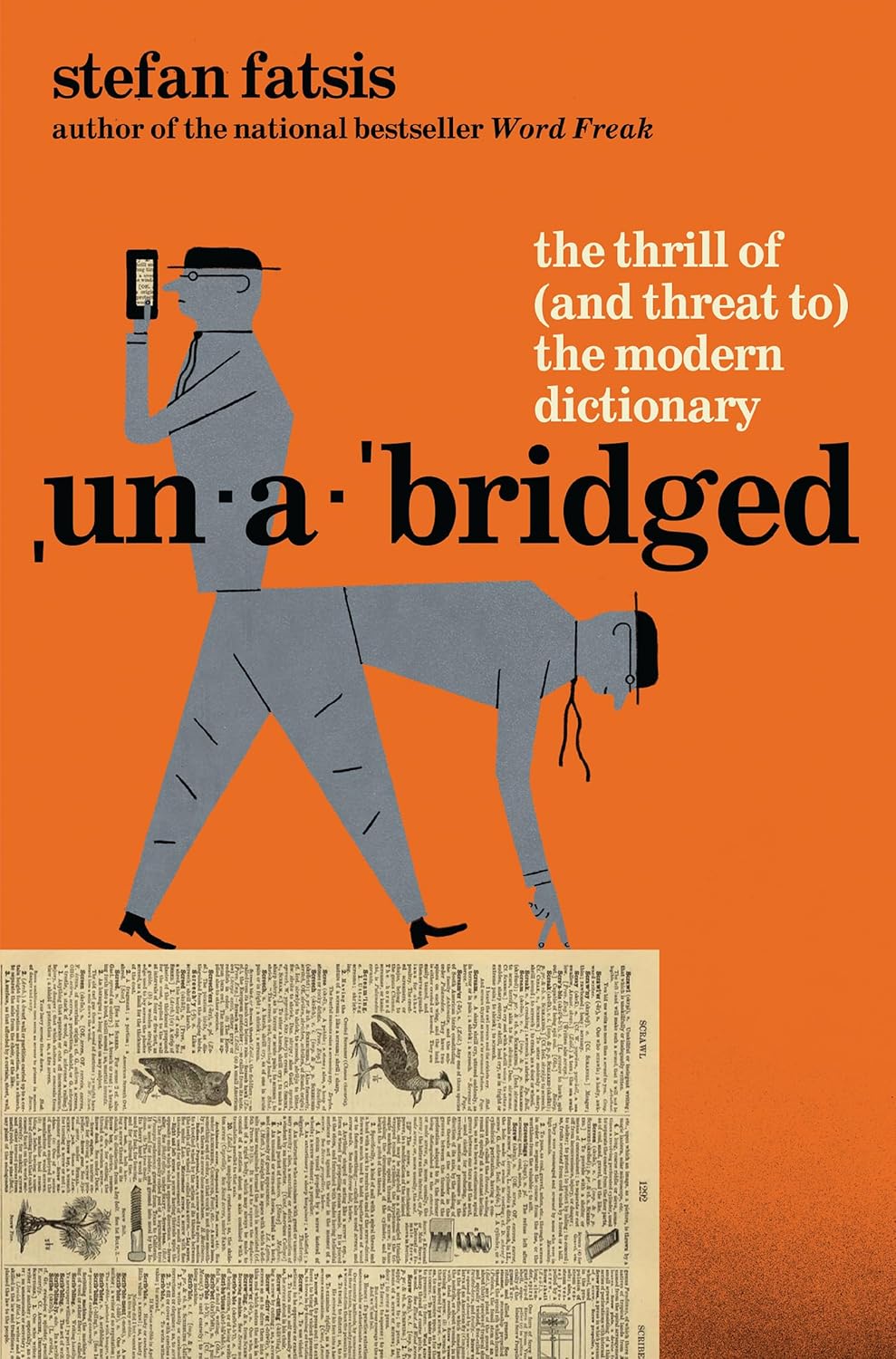
Unabridged: The Thrill of (and Threat to) the Modern Dictionary
- By Stefan Fatsis
- Atlantic Monthly Press
- 416 pp.
- Reviewed by Randy Cepuch
- November 3, 2025
An exceedingly cromulent story about defining words.
It just doesn’t seem fair that someone ranked as an expert by the National Scrabble Association has pull with the people who decide what words are, well, words. Haven’t we all, when faced with a tray of unpromising tiles, wanted to amend the dictionary?
Any apparent conflict of interest be damned. Unabridged: The Thrill of (and Threat to) the Modern Dictionary is an exhaustively researched, highly entertaining, and often hilarious look at author Stefan Fatsis’ experiences when he embedded himself at Merriam-Webster. There, he helped add words and definitions to the source we turn to when we look up words (such as, oh, “cromulent,” which means “fine” or “acceptable” and which was first used on an episode of “The Simpsons”).
Fatsis, a self-described “word dork” and former Wall Street Journal sportswriter, clearly enjoys participatory challenges. One of his earlier books was A Few Seconds of Panic: A Sportwriter Plays in the NFL, following in the footsteps of George Plimpton’s Paper Lion. Later came Word Freak: Heartbreak, Triumph, Genius, and Obsession in the World of Competitve Scrabble Players, featuring his successful efforts to master that somewhat gentler game.
His lifelong love of dictionaries led him to do a story for Slate about how rapidly things were changing in lexicography (noun: “the process of writing, editing, or compiling a dictionary”). Historically, it took many years to produce new editions, and they were almost always somewhat outdated upon arrival because new words are perpetually entering common use, existing words taking on new meanings, and old ones becoming obsolete.
But then the internet came along, making it possible for online editions to be updated much more quickly. The big books with tiny type disappeared from nearly every desk when it became easier to look up words on your phone. The transition was still underway when the people at Merriam-Webster gave Fatsis a key to the company’s building in Springfield, Massachusetts, and access to the files documenting where words came from and how they’ve been defined.
In Unabridged, he makes the most of the opportunity, spinning colorful tales of how definitions have changed over time and considering when certain words peaked: “chad” was the American Dialect Society’s “Word of the Year” in 2000, and “bailout” got the nod in 2008. For 2023, when Fatsis participated in the selection, the winner was “enshittification” (which officially refers to the degradation of online services over time to maximize a company’s profits but seems likely to have other applications).
He explores how slurs and sensitive terms have evolved and discovers that “the n word” first appeared in the dictionary in 1864, defined then as “a Negro” and characterized as a derision. As usages have changed (notably in hip-hop culture), the word has remained in the dictionary ever since, although Fatsis notes that definers have consistently “tinker(ed) with the entry as if defusing a bomb.” Defining “the f word” has involved similar delicacy.
In recent years, the pressure to add new pronouns has also been challenging:
“Merriam would be on the receiving end of frothing emails, causing unwanted hassle inside the old brick building in Springfield. But so what. While dictionaries are in the business of validating words, not social change, sometimes the act of validating words validates change, too.”
Such complaints, he observes, are typically the result of “an abject, though completely understandable, failure to comprehend the function and operation of a dictionary, that is, to cull from carefully edited publications evidence of the way words are actually used in written and spoken English.”
Throughout the book, Fatsis introduces some of the dedicated writers and editors of dictionaries who have gone to great lengths to objectively reflect words’ usages. (They don’t simply make up those obscure words that Scrabble players find delightful.) Their numbers are dwindling rapidly: One of his dictionary-making colleagues notes that there were about 200 full-time lexicographers two decades ago, and now there are roughly 30. Some of the decline represents consolidation, endemic in the publishing industry. Meanwhile, artificial intelligence looms as an existential threat, although, at least for now, AI’s penchant to hallucinate means human oversight still matters.
But Fatsis wasn’t there just to write about the history and current state of dictionaries. He wanted to make his own contributions, and in Unabridged, he chronicles researching, writing, and arguing for dozens of entries — sometimes successfully satisfying the strict editorial guidelines for updates. By the beginning of this year, more than a dozen of his definitions had made the cut.
The book’s format nicely reflects its content, with each chapter title consisting of a word or a term accompanied by its relevant definition. Sprinkled through the text are playful uses of slang, like “uey” for “U-turn.” There are also a few words (“tatterdemolian,” for instance) that the average reader might normally need to look up but whose definitions are invariably found nearby.
All in all, Unabridged is bound to make you a more thoughtful writer and a better Scrabble player.
[Editor’s note: Stefan Fatsis will appear at the Gaithersburg Book Festival in Gaithersburg, MD, on Saturday, May 16th. Learn more here.]
Randy Cepuch is a member of the Independent’s board of directors and a frequent reviewer whose favorite word game is Boggle.