Under the Full and Crescent Moon
- By Aamir Hussain
- Dundurn Press
- 288 pp.
- Reviewed by Mike Maggio
- December 9, 2025
Fundamentalist men bring discord to a matriarchal Muslim society.
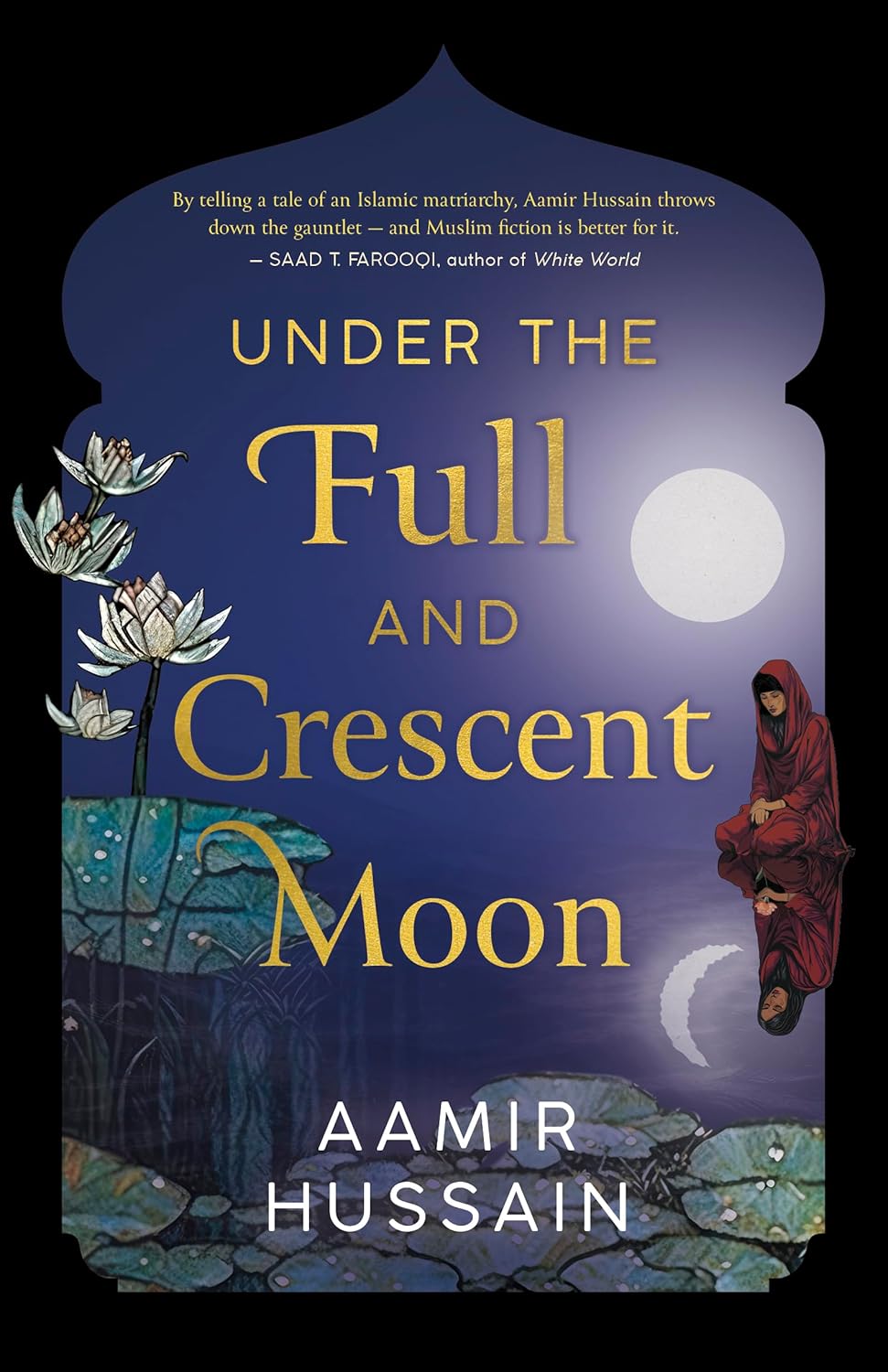
Like Judaism and Christianity, Islam is based on a patriarchal system. Lineage is traced through the father, imams are always male, and society in general is ruled by men. In some very rare cases, however, there are matriarchal Islamic societies, notably in Minangkabau in Indonesia and in some parts of Malaysia, Sri Lanka, and Mozambique, where lineage is traced through the mother and women hold significant influence. And while it may shock many — including mainstream Muslims — who are unfamiliar with such an anomaly, matriarchal Islamic societies have been well documented.
Thus, Under the Full and Crescent Moon will surprise most readers, although debut author Aamir Hussain claims not to have known about the existence of Islamic matriarchies and was, therefore, working from his imagination.
Hussain’s story takes places in a mythical city called Medina’tul-Agham and involves Khadija, the daughter of Fazlur, the leading mufti (interestingly, a man) in a place where women rule and the town imam, Fatima, is a woman. Khadija is a shy girl who shuns attention and who spends much of her time transcribing her father’s fatwas, becoming well-versed in Sharia law.
Eventually, Fazlur convinces her to formally work for him, and she is offered a job right beside him in the Grand Mosque. Soon, though, Fazlur dies, and a new mufti is selected, an outsider who, it turns out, is diametrically opposed to the liberal views of Medina’tul-Agham. This conflict, the only real one in the novel, doesn’t arise until halfway through; until then, the reader is left with a tale filled with incidental descriptions, flat characters, and quite a few Islamic niceties.
Nonetheless, this conflict is essential to the narrative, for the new mufti, Wasaf, is a fundamentalist, relying not only on the Quran for issuing his fatwas but on the hadith, or sayings of the Prophet Mohammed. Wasaf is an orthodox interpreter of religion and is opposed to the culture of Medina’tul-Agham, which he sees as antithetical to the teachings of Islam. Instead, he wishes to impose a strict version of religion on a people who, for historical reasons, are not receptive to such interpretations.
In many ways, Hussain, who lives in Canada but grew up in Saudi Arabia, seems intent on making a point. On one hand, he portrays a much more mainstream vision of Islam, an admirable task given that Islamophobia runs rampant in the world today. On the other, he apparently wants to distinguish between Sunni Muslims, which Wasaf represents, and Shia Islam, which the residents of Medina’tul-Agham represent. While this distinction isn’t outwardly stated, it will come across clearly to any Muslim, Shia or Sunni, who reads the book.
Unfortunately, writing an entire novel in order to make a point often leads to failure. And for all its pleasant descriptions of Medina’tul-Agham, Under the Full and Crescent Moon fails on many levels. The tale lacks tension, at least for the first half of the book, and when conflict does arise, it’s quickly dealt with or remains unresolved, such as in a plot thread about which of Khadija’s suitors will win out. The result is a reliance on exposition, the absence of a traditional story arc, and a rushed resolution.
In addition, the writing is prosaic and filled with poorly chosen words and phrases, as in these excerpts from chapter 19 (italics are mine):
Nabil sketched a courtly bow as he rose to greet her and gracefully took Khadija’s hand to plant a kiss on it…
“Ayesha has regaled me of your brilliance in every way,” Nabil said.
They stared daggers at each other across the rug for a good half minute before Nabil laughed.
Ayesha, well versed in the art of flattery aimed at closing a deal, snorted derisively but could not but smile herself.
For all its attempts at good storytelling, Under the Full and Crescent Moon is overstuffed with language that is trite and, at times, banal. And yet, one needs to applaud Hussain, for this is his first novel, and he has presented in it a positive vision of Islam, something the West sorely needs.
Mike Maggio’s novel, Woman in the Abbey, won the Literary Titan Gold Book Award and is available from his website or through Amazon and other book outlets.