Undercity: A Novel
- By Monte Schulz
- Fantagraphics Books
- 696 pp.
- Reviewed by William Schwartz
- April 24, 2026
Dystopian forces wreak havoc above — and below — ground.
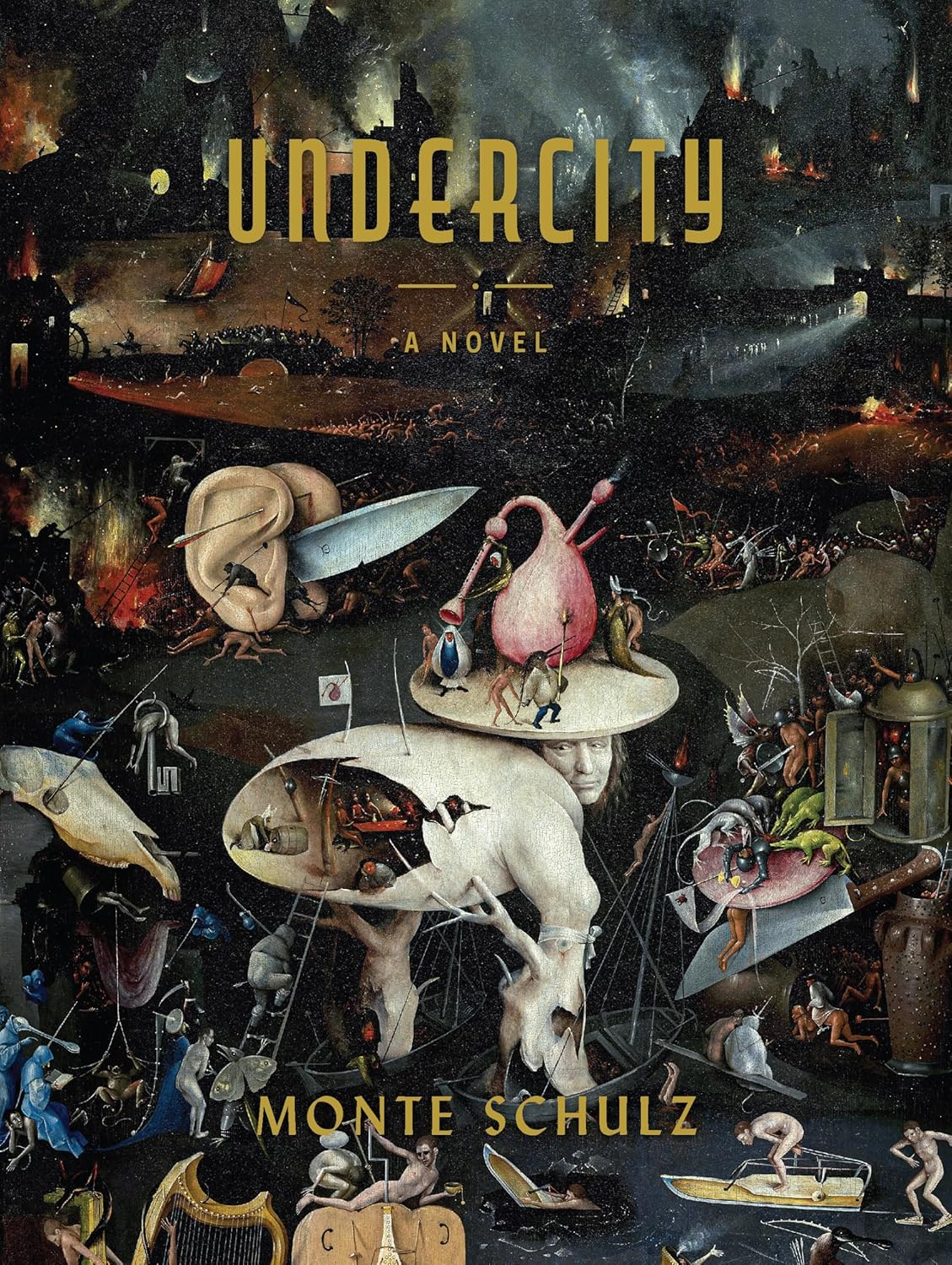
The YA subgenre featuring plucky young people mired in dystopia may be played out, but Monte Schulz’s Undercity is a bold argument that there remain unexplored literary dimensions to this category. In this massive tome numbering nearly 700 pages, Schulz — the son of late cartoonist Charles M. Schulz — sketches a world thematically similar to “The Garden of Earthly Delights” by Hieronymus Bosch, which graces its cover.
The story follows Marco and three of his friends — residents of the titular city — who rise to the surface and have a notorious reputation for killing people, some more evil than others. The ethical questions posed by Undercity are deeply uncomfortable. Is Marco justified in murdering so many agents and collaborators of this oppressive state, whose pseudoscientific eugenicist crusade has driven huge numbers of people underground? Marco himself isn’t even sure.
But he isn’t the only narrator. Part of what makes Undercity so long is that Marco’s story is regularly broken up by tales of other characters who, in one way or another, have fallen afoul of the corrupt overworld’s forces. These vignettes are all grim in their own way; the devastation ranges from the gratuitous — such as people being mutilated for petty crimes — to the mundane (e.g., an outbreak of disease).
While there isn’t quite enough tonal variation in the prose given the novel’s numerous characters, its variety of delivery is illuminating. For instance, one chapter consists of a soldier’s extended diary, while others comprise snippets of an in-novel book about two lovers sequestered as humanity’s sole survivors.
For the most part, characters in Undercity mind their own business until a wrong word or action leads them to a grisly end. Luckily, there are just enough happy endings scattered about that individual narrative threads’ conclusions are unpredictable.
Still, for all its exhaustive detail, Schulz’s worldbuilding isn’t entirely convincing. The sheer scale of the genocide — both the one committed by the brutal powers-that-be and the one unleashed by Marco and his terrorist friends — seems unsustainable. And the Undercity itself is far from uniform; at times, Marco is forced to trudge through its more arcane parts, where light doesn’t reach. Yet, save for one chapter, there aren’t any real science-fiction elements in Undercity, which depicts a largely parallel above- and below-ground world.
There might be a Marxist critique to be made here about how there isn’t much economic logic to this world. The ruling class engages in cruelty for its own sake, rather than in service of exploitation, and the eugenicist ideology it embraces is poorly defined in terms of its actual — or even rhetorical — goals. It’s a bit incredible, for example, how in some vignettes, citizens are portrayed as being genuinely unaware of the government’s eugenics campaign, whereas in another, a bookseller is punished for refusing to stock popular eugenicist tracts.
But these flaws are outweighed by the fact that Undercity openly and unapologetically conjures a world where violence committed by the state has gotten so bad, the only answer is to commit violence against it. Marco may hurt people — and may, in fact, be mentally ill — but he’s almost certainly correct in believing the only alternative is to be hurt by them. The characters in Undercity aren’t fighting a mere culture war. It’s a straight-up war.
William Schwartz is a freelance writer living in Southern Illinois. He has reviewed wide varieties of media, including South Korean dramas, upscale graphic novels, vintage videogame media, and much more.