Up All Night: A World History of Nightlife
- By Imogen Willetts
- Grove Press
- 384 pp.
- Reviewed by Karen Heller
- August 3, 2026
The cool kids have always known where best to be seen.
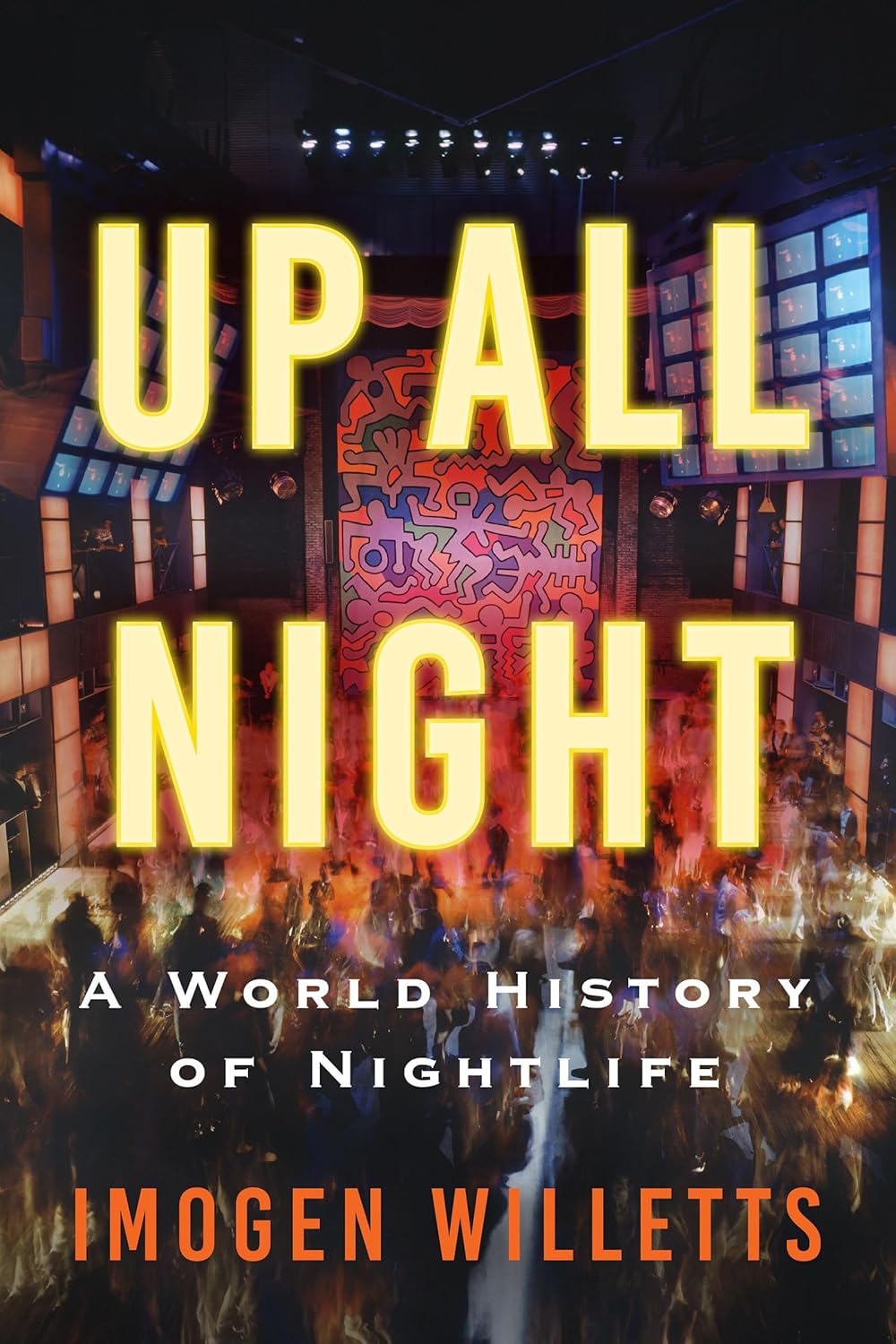
First off, inspired subject. Up All Night: A World History of Nightlife is precisely what the summer ordered, a cool, tall gin-and-tonic of a book. British cultural historian Imogen Willetts, who defines nightlife as “a commercial and secular environment designed to offer a variety of pleasures at night,” is a passionate, informed student of historical nocturnal gatherings.
A former producer of events programming at the Royal Academy of Arts in London, Willetts begins with the intriguing and costly evening delights of Yoshiwara, “a flashy pleasure quarter” in 17th-century Edo (now Tokyo), then the world’s most populous city. The journey ends with that seismic 2006 moment in L.A. club history ruled by, according to the New York Post, “the Three Bimbos of the Apocalypse.” (If you know, you know: Paris Hilton, Britney Spears, and Lindsay Lohan.)
In between, there are fine takes on London’s Pleasure Gardens (which inspired Walt Disney’s amusement parks); the birth of jazz in New Orleans; “transgressive nocturnal experiences” in Paris’ Montmartre; the louche cabaret that was Weimar Germany; the Harlem Renaissance; the Jazz Age; Studio 54; and techno haunts in Berlin, Detroit, and Belgrade.
Willetts puts the reader right there in the arena. She’s a master of charming apercus and fetching details. Inspired lighting and libations are often paramount to nightlife, while food is largely an afterthought. Willetts’ interests tend toward decadence, risk, and the prurient, more Hollywood Babylon than, say, Ken Burns. She’s fascinated by urban escapes du jour and all they entail — drink, drugs, carnal and sartorial theatrics — not bowling leagues and Midwestern supper clubs.
Class also looms large in many of these escapes. Often, you had to pay to play. A night out in Yoshiwara could cost the equivalent of $10,000 today. But Willetts strives to be democratic in her history, also including the larks of the working class, even if they meant a return to labor after an almost sleepless night.
Not all divertissements were soaked in fantasy and splendor. While Harlem’s Cotton Club featured extraordinary Black entertainers catering to a posh white clientele, neighborhood speakeasies were something else entirely and certainly more authentic: a “grubby, smoke-filled room” without windows, “the heavy grey air was as thick as soup,” and the hooch “an ungodly medley of wood alcohol, sulphuric acid, benzol and kerosene.” As British journalist Stephen Graham noted, “That is the bane of the speakeasy life. You ring up your friend next morning to find out whether he is still alive.”
Deeper insights, the connective tissue running through many of Willetts’ subjects, are sometimes left to the reader to discern. Up All Night reads more like a chronological guide — a fun, spirited one — than a scholarly history, though the author has certainly done her homework. Repeatedly, Willetts notes in chapter codas that certain nightlife movements were surprisingly fleeting; it was critical to be at the right place at the exact moment it ran hot before everybody (or, worse, anybody) came knocking.
Opulence, exclusivity, youth, beauty, and mystery are also constants. The 19th-century English essayist Walter Bagehot once noted of the royal family, “We must not let in daylight upon magic.” Willetts, quoting him, believes the same holds true for nightlife.
She has a gift for the anachronistic metaphor. Edo’s Yoshiwara was “the Orwellian Coachella of feudal Japan.” Paris’ late-19th-century boîte Le Chat Noir “was like a summer camp for gothic weirdos.” She might have excised the chatty asides, which read as though the book was dictated rather than written. I don’t want to encounter phrases like “you don’t need me to tell you this” and “though, as you’ll see in Chapter 1” in any book. Willetts includes both in her introduction, the book’s weakest section.
“Nightlife thrives in opposition to mainstream culture,” she writes. She worries that contemporary nightlife is in one bummer of a slump. (Perhaps everything is.) The pandemic didn’t help. She believes the primary culprits, like in so much of modern life, are our smartphones and the sewer of social media that floods them, flattening novelty, shattering privacy, and democratizing access — allowing us to be a witness to the party without leaving the couch. Instagram casts too much daylight on exceptional evenings.
Willetts ends Up All Night on an effervescent and populist note, hopeful that a fresh crop of creative club types will discover inspiration in untapped places, such as gardens, defunct office spaces, and even an empty mall in, yes, Kansas.
Karen Heller is a former national feature writer for the Washington Post and a longtime book reviewer.

.png)