V Is for Venom: Agatha Christie’s Chemicals of Death
- By Kathryn Harkup
- Bloomsbury Sigma
- 320 pp.
- Reviewed by Lawrence De Maria
- September 1, 2025
Need to off an adversary but hate getting your hands dirty?
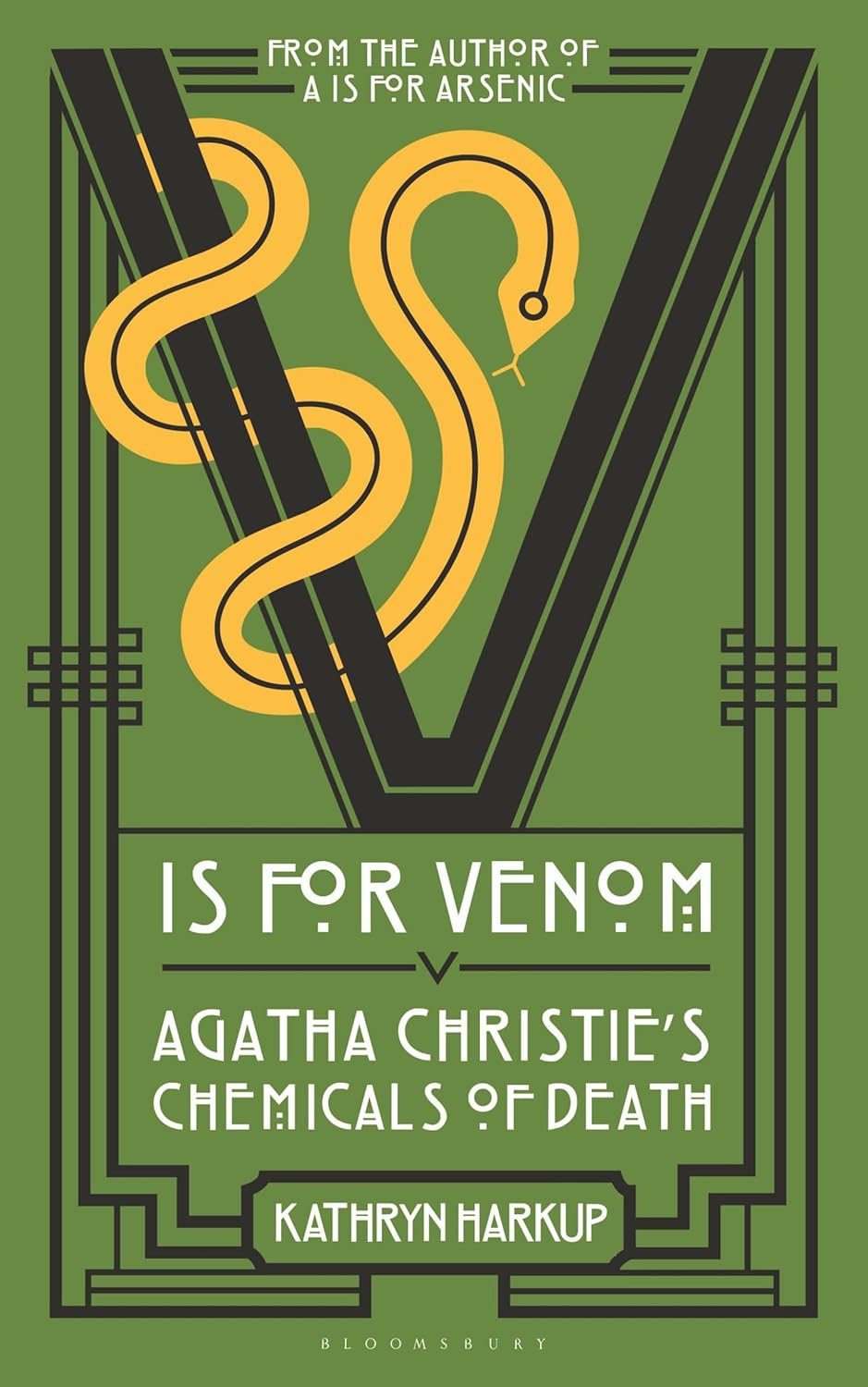
Kathryn Harkup’s V Is for Venom: Agatha Christie’s Chemicals of Death isn’t for the faint of heart. One chapter, about carbon-monoxide poisoning, got me up in the middle of the night to check on my gas stove, even though I live in a big, well-ventilated house.
Of course, the kind of gas used in Christie’s novels — coal gas — is now outdated. When improperly burned, coal produces carbon monoxide, which binds to blood cells and prevents them from transferring oxygen. Death quickly follows. Thousands of people perished annually from such poisoning up until the 1950s. Today, natural gas is used for heating and cooking. Because it is odorless — but still poisonous — utility companies put in a smelly additive to alert folks if there’s a leak.
In Dame Agatha’s time, coal gas was used in many suicides but few murders. Since, nowadays, most people rely on electric ranges and microwaves, any cop discovering a corpse with its head stuck in the oven would immediately be very suspicious (and probably confused). And needless to say, a body crammed into a microwave would raise the eyebrows even of Inspector Clouseau.
This is a book written for chemistry buffs — if there is such a thing — by an author who’s herself a former chemist. Harkup fills it with bacteria, acids, noxious flowers, toxins, and all sorts of other things that can kill you. Some of the substances require minimal doses to un-alive you quickly. Others work slowly, dragging out the homicide over time. The most pernicious may be the common substances — such as medicine-cabinet analgesics — that, when wielded improperly (and wildly inappropriately), can kill. Murderers especially enjoy them because nefariousness can be hard to detect; any resultant deaths are often passed off as a victim’s mistake or a suicide.
Christie was famous for ending people creatively, but Harkup points out that her whodunits were written in a time before forensic scientists had the extensive tools they now use to catch villains. She details how one early scientist discovered a poisoner by hitting a minute sample of his concoction with a hammer. Since the mixture contained nitroglycerine, the resulting explosive bang was proof of the murderer’s guilt.
Harkup rounds out her book with chemical diagrams, illustrations, and footnotes, as well as with an appendix — a Glossary of Death, if you will — that lists the many ways victims were dispatched in Christie’s stories. She also describes some of the actual murders that inspired the novelist’s imagination. Most of the real-life miscreants were eventually caught — with no help from Hercule Poirot or Miss Marple — and quickly executed. (Before Great Britain abolished capital punishment in the late 1960s, the hangman was a very busy fellow.)
Harkup’s first book was A Is for Arsenic: The Poisons of Agatha Christie, and her other works include Making the Monster: The Science of Mary Shelley’s Frankenstein, Death by Shakespeare: Snakebites, Stabbings and Broken Hearts, and Superspy Science: Science, Death and Tech in the World of James Bond. While she keeps her private life private (no wonder!), she must have delightful dinner conversations, though I doubt anyone’s eager to try her tea and crumpets.
As for me, I’ll be keeping a copy of V Is for Venom handy. It may be useful for my own mystery writing, although I hope it doesn’t make me a suspect every time somebody dies unexpectedly after leaving my house.
Since 2005, Lawrence De Maria has written more than 30 thrillers and mysteries on Amazon.