Wake Now in the Fire: A Story of Censorship, Action, Love, and Hope
- By Jarrett Dapier and AJ Dungo
- Ten Speed Graphic
- 464 pp.
- Reviewed by William Schwartz
- March 10, 2026
Chicago teens band together to defend Persepolis.
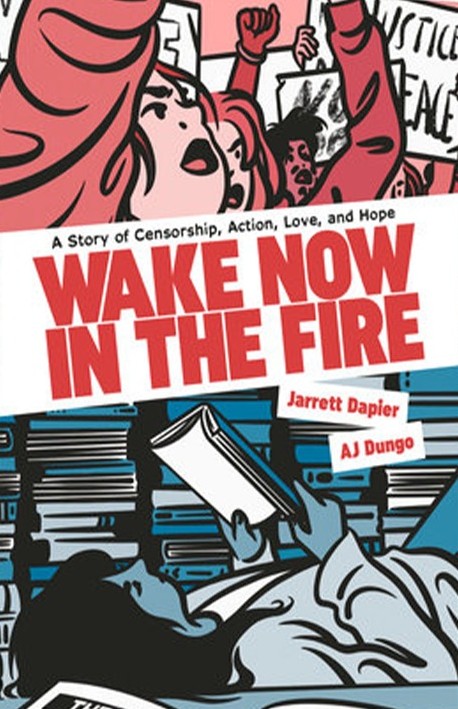
It’s easy to see the spate of book banning in public schools as being a recent phenomenon. But, sadly, there was plenty of precedent for it even before President Trump took office. Jarrett Dapier’s Wake Now in the Fire blends the author’s personal experiences as a librarian with direct research into the banning of the graphic memoir Persepolis in Chicago Public Schools (CPS) in 2013. As the semi-fictionalized, bewildered high-schoolers featured in the book note, it’s hard to make sense of a city government run by Democrats engaging in such activity.
Day by day, the students prepare their protest of Chicago’s targeting of Persepolis, Marjane Satrapi’s controversial, wildly popular recollection of growing up in Tehran during the Islamic Revolution. From limited information, the kids have deduced that the ban is more farce than ideology, with CPS administrators behaving arbitrarily and acting annoyed that their draconian actions might warrant some sort of explanation.
(That Wake Now in the Fire is itself a graphic work is appropriate not just because of its natural kinship with Persepolis, but also because so many banned books today are part of the same genre.)
In Dapier’s tale, the main theory the students come up with is that CPS CEO Barbara Byrd-Bennett and others simply glanced at Persepolis’ illustrations, ignored the accompanying prose that gave them context, and reflexively banned the book. Indeed, Persepolis does feature such disturbing imagery as a reporter getting hacked to pieces, yet the violence during Iran’s revolution was well documented.
The surrounding stories unfolding during the week leading up to the protest mostly involve teens dealing with personal drama and mental-health issues. In illustrating them, artist AJ Dungo avoids melodrama and is quite restrained; the point seems to be that high-schoolers are always dealing with their own crises, some more petty than others. While Wake Now in the Fire is a bit vague about the overall narrative arc of Persepolis, it’s easy to see why the latter’s banning affected these students so deeply. After all, much of Satrapi’s book portrays her struggles as a teenager slowly realizing that the adults around her don’t always know what’s best.
A broader point Dapier makes is that Persepolis was taught in the first place because teachers — the people responsible for actually connecting with kids — believed students would get a lot out of it. This altruistic motivation makes CPS’ deliberate censorship of the book feel Kafkaesque. (The author’s note doesn’t mention that Byrd-Bennett ultimately left office in disgrace and faced criminal prosecution for embezzlement, which isn’t surprising given her depiction here as an imperious figure shocked that anyone would even think of contravening her orders.)
Wake Now in the Fire has direct relevance to what’s happening in America today, which should make it required reading in modern classrooms. But it also features some surprisingly relatable adolescent angst and, more importantly, a reassuring account of teens directing their angry, hormonal energy toward something constructive.
William Schwartz is a freelance writer living in Southern Illinois. He has reviewed wide varieties of media, including South Korean dramas, upscale graphic novels, vintage videogame media, and much more.
.png)