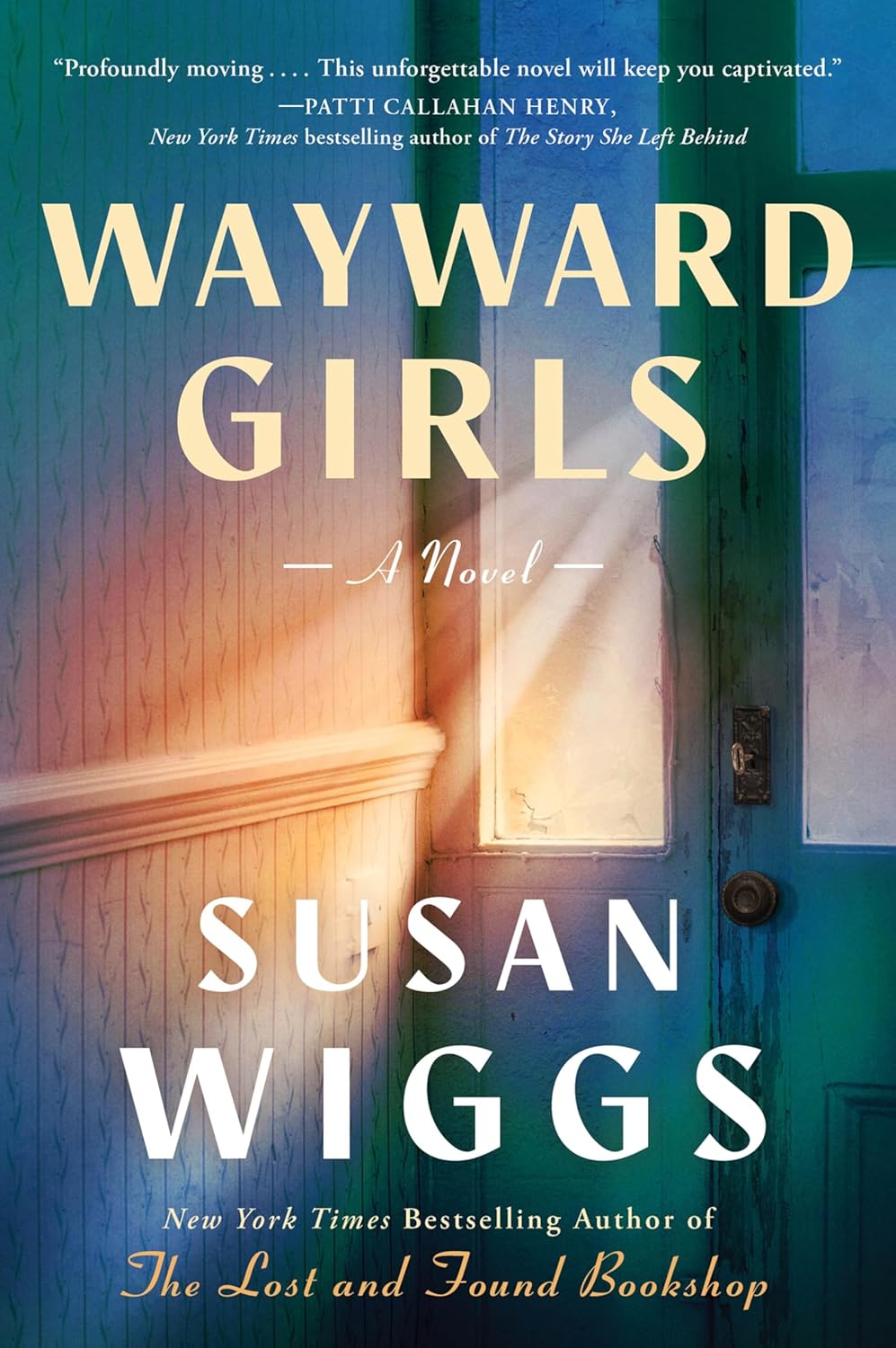
Wayward Girls: A Novel
- By Susan Wiggs
- William Morrow
- 400 pp.
- Reviewed by Marcie Geffner
- August 21, 2025
The classic “mean Irish nuns” story gets an Upstate New York reboot.
Susan Wiggs’ latest novel, Wayward Girls, isn’t the first about the Catholic Church’s notorious Magdalene laundries, where thousands of innocent women and girls were forced to perform years of unpaid labor. What’s different about Wiggs’ story, though, is that her fictional Home of the Good Shepherd isn’t located in 1800s Dublin. Instead, it’s in Buffalo, New York, in 1968, where a real-life Magdalene laundry once existed.
The contemporary setting heightens the contrast between the Good Shepherd, which operates in a “forbidding, stone-built Gothic structure,” and the outside world, where the Vietnam War, hippies, and rock ‘n’ roll dominate current events, conversations, and Wiggs’ characters’ lives.
After a prologue, the main narrative begins when Mairin O’Hara’s best friend, Fiona Gallagher, “puke[s] in the bushes” at a farm where the two teens are employed as apple pickers. As daughters from strict Catholic families and students at the all-girls St. Wilda’s, neither Mairin nor Fiona is sophisticated enough to realize that Fiona, who “did stuff” with a boy, is pregnant. When the truth is discovered, Fiona is forced to leave school and move in with a relative in another town until her baby is born and given up for adoption.
Mairin’s fate is also awful. After she sneaks out for a date, causes a ruckus in church, and fights off unwelcome attention from her alcoholic stepfather, Colm, she’s packed off to the Good Shepherd by him and her mother, Deidre.
To Deidre, the Magdalene laundry is the best place for her daughter. To Mairin, it’s a catastrophe:
“The betrayal by her mother moved through Mairin like a sudden frost…She wasn’t a bad girl. She didn’t need to be reformed or turned from a sinful past. They were leaving her at this place because Colm couldn’t be trusted to leave her alone.”
Despite her conservative upbringing, she’s a spirited girl who needs only a few minutes alone with the facility’s vicious nun-in-chief, Sister Rotrude, to earn a sharp rebuke and a stinging face-slap.
Rotrude’s partner in crime, the young, beautiful, and violet-eyed novice, Sister Bernadette, harbors doubts about some of the Good Shepherd’s practices but does nothing to prevent the abuse or malfeasance in which she’s complicit. Rather, she romanticizes the place to which she’s dedicated her life:
“The girls, waifs and strays from Buffalo’s harsh streets, labored in the laundry, their youth spent amid steam and suds, their small hands scrubbing away sins as if they could be cleansed with soap and water.”
As if they’ve done something wrong. They haven’t.
To cope with the hardships, Mairin makes friends and attempts to escape. When she’s caught and locked in a closet as punishment, she discovers some of the nuns’ secrets, which she’ll later leverage in a way that leaves them shocked and upset but unable to respond fully without risking exposure of their mismanagement.
What Wiggs does especially well is shine light and throw shade on the sisters’ bizarre beliefs. To them, strict discipline, physical labor, and a diet of thin soup aren’t inhumane; they’re “the way to salvation” for their pregnant wards. A baby born to an unwed mother will “suffer eternity in purgatory” unless it’s adopted by “proper” (i.e., married Catholic) parents. The Church’s prohibition against active, reliable contraception, reinforced by Pope Paul VI in 1968, is somehow morally compatible with the imprisonment of young women who accidentally (if inevitably) become pregnant.
Although Mairin tries to support her new friends, a little sex education and personal autonomy would’ve done more to protect them from needless suffering. The problem at the Good Shepherd isn’t just that the nuns are cruel — it’s that they brandish their harmful religious beliefs to justify their actions.
Despite the difficult subject matter, some cliched characters, and a jarring time leap to 2018 (after which the novel’s pace slows), there’s a lot for readers to appreciate in Wayward Girls. Wiggs’ story shows that not all of the abuse at the Magdalene laundries happened long ago or far away, and that questions about the beliefs underpinning that abuse are still relevant today.
Marcie Geffner is a journalist, writer, and literary critic in Ventura, California.