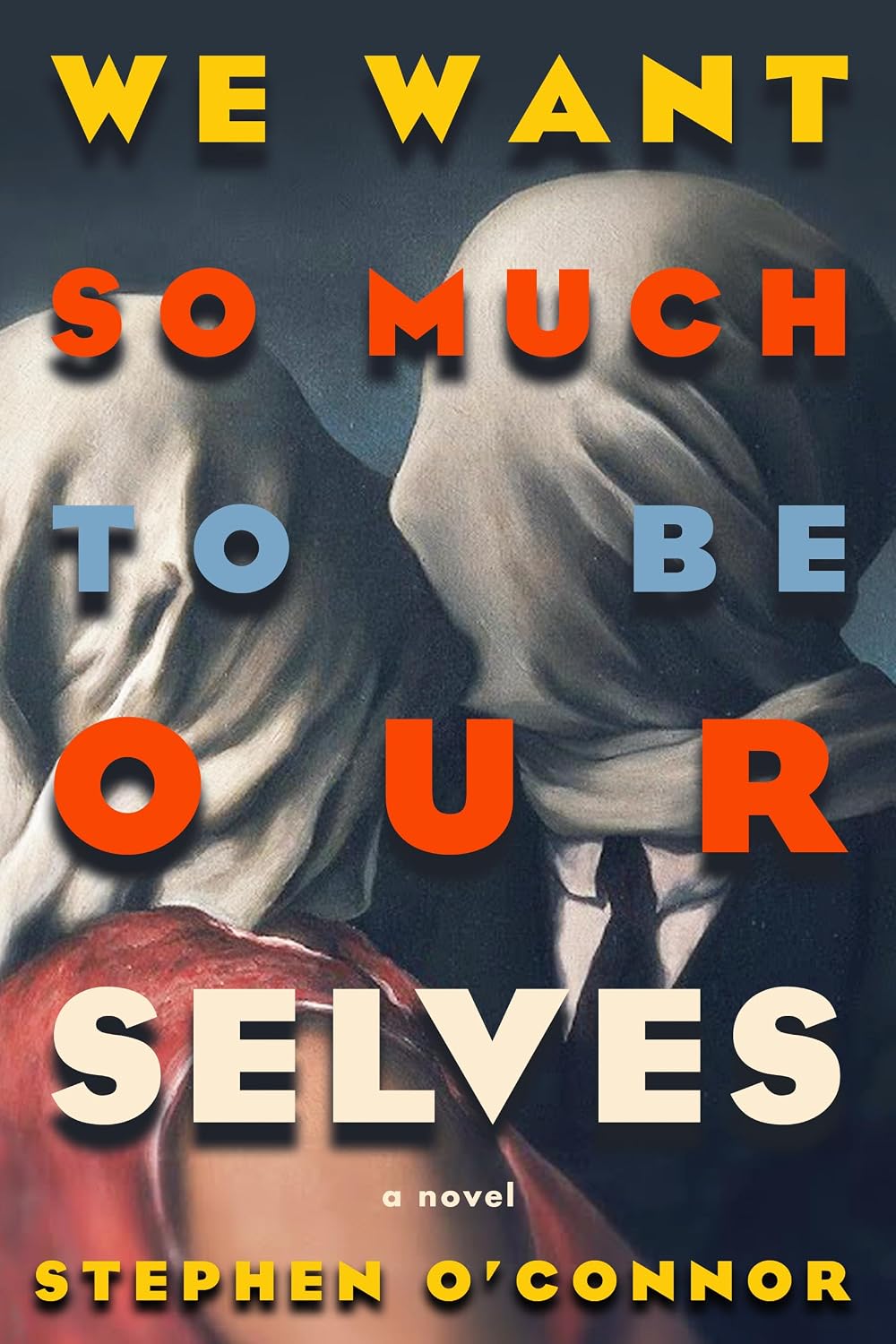
We Want So Much to Be Ourselves: A Novel
- By Stephen O’Connor
- Bellevue Literary Press
- 496 pp.
- Reviewed by Alyson Foster
- August 4, 2026
In prewar Berlin, ordinary citizens confront (or ignore) rising fascism.
If you’ve been on social media since Donald Trump returned to the White House last year, there’s a good chance you’ve noticed a certain meme popping up frequently in your feed. “If you’ve ever asked yourself what you’d be doing in 1930s Germany,” it says, “Congratulations: you’re doing it right now.”
The comparison may be intended to serve as a call to action, but in reality, it just points out an uncomfortable truth. What are most Americans doing while our government becomes increasingly repressive and lawless? Not much. We’re going to work. We’re dropping off our children at soccer practice. We’re meeting friends for dinner. We’re cutting back on doomscrolling in order to protect our mental health.
The startling mundaneness of fascism, the subtle way it infiltrates people’s lives while they’re distracted by more pressing problems, is explored in Stephen O’Connor’s haunting and extremely timely We Want So Much to Be Ourselves. The novel, set in Berlin during Hitler’s rise to power, offers a nuanced portrayal of its protagonist, Günter Zeitz, a psychoanalyst who detests the Nazis’ policies but finds himself reluctantly working on their behalf.
This dark era of history has been thoroughly explored; yellow stars and brown shirts have become an almost lazy shorthand for the dangers of unchecked state-sponsored persecution and violence. But O’Connor avoids retreading familiar ground by absorbing us in the drama of Günter’s early life, which is as compelling as it unremarkable. We observe his romance with, and marriage to, a brilliant and impetuous Jewish woman named Josine, his introduction to fatherhood, his tutelage by Sigmund Freud, and his successful career at the real-life Berlin Psychoanalytic Institute.
(One of the book’s nice details is O’Connor’s use of historical figures in supporting roles, including psychoanalyst Edith Jacobson and resistance fighter John Rittmeister, both of whom make appearances as Günter’s colleagues.)
Politics remains on the periphery in the early pages, appearing mostly as a subject for the characters to rant about. Günter despises Hitler. “He’s a troglodyte!” he complains to his brother-in-law. “His entire program is based upon lies, so it is guaranteed to fail.” As Josine’s behavior grows ever more unstable, Günter is preoccupied by the unraveling of his marriage and the subsequent battle for custody of his daughter, Hannah. But the madness, both at home and across the country, only proliferates, and he is increasingly unable to fight it.
At school, Hannah is ostracized alongside her fellow Jewish classmates. And at the institute, Günter and the other clinicians are forced to debate whether — and then how much — to comply with the National Socialists’ interference in their work. (The field of psychoanalysis, dominated by Freud’s influence, was regarded with suspicion by the Nazis as a “Jewish science.”)
Complicity can be caused by moral failure, but O’Connor shows us how it can also be brought about by confusion, as well-intentioned people make flawed calculations without the benefit of hindsight. Günter and his colleagues gradually acquiesce to the Nazis’ demands because they care deeply about the well-being of their patients and fear they’ll lose the ability to treat them. At least one doctor attempts to fight back: the doomed Rittmeister, who tries and fails to get Günther to attend a political meeting of intellectuals opposed to the Nazis. “The stakes have gotten so much higher — which makes our work all the more important, of course,” he tells Günter. “Also dangerous.”
But as the pressure ratchets up, Günter remains paralyzed, trapped in a state of cognitive dissonance. After a meeting in which institute staff vote on whether to implement an “Aryanization” program, an anxious intern asks Günter to tell her what’s going on. “Nothing,” he replies. “Or almost nothing. I think we may be in the midst of an absolute catastrophe.”
The actual nature of the catastrophe only becomes undeniable during a terrifying session when Günter’s patient, a young SS soldier named Max who has recently been pulled from military service after a suicide attempt, holds Günter at gunpoint and forces him to listen to a confession about his participation in the liquidation of a Jewish ghetto in Poland.
Is this too much for you?” Max asks mockingly as he watches Günter’s reaction. “Too much truth?”
“That’s not it,” Günter responds. But it is. Max’s account of the German government’s atrocities precipitates a moment of crisis, one so destabilizing that Günter can finally no longer pretend to function as though everything is normal. After the session ends, he confronts his colleagues at a staff meeting.
Günter’s honesty comes with grave and life-altering consequences, but it also brings desperately needed salvation. “He feels better as he shouts — ever better, as if he is becoming himself again,” O’Connor tells us. It’s this idea that redeems the novel’s bleakness, and one that speaks to our current moment: The power of truth has the potential to save us, if only from ourselves.
Alyson Foster is an editor and the author of the novel God Is an Astronaut and the short-story collection Heart Attack Watch.