Western Star: The Life and Legends of Larry McMurtry
- By David Streitfeld
- Mariner Books
- 464 pp.
- Reviewed by Eugene L. Meyer
- March 25, 2026
An intelligent ode to the prolific author and devoted bookseller.
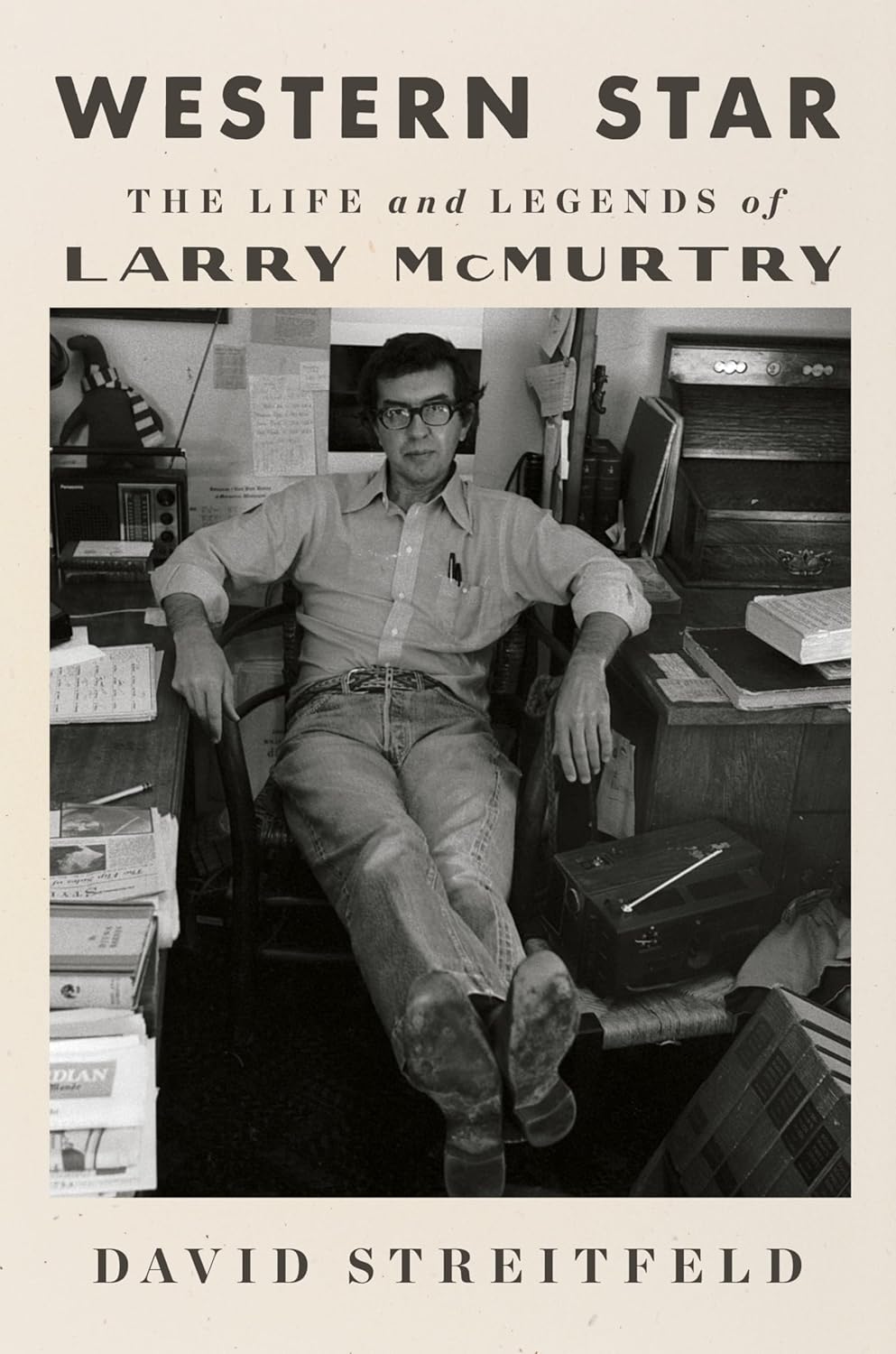
My wife’s grandfather was a used-book dealer for half a century until, twice ejected from his store by redevelopment, he moved his remaining stock into his DC rowhouse. There, he died in 1971 alongside all his books. As journalist David Streitfeld writes in Western Star, his affectionate biography of Larry McMurtry, all book dealers want to die with their books, and his subject was no exception. Indeed, he went to extremes to fulfill his destiny.
McMurtry, an Oscar- and Pulitzer Prize-winning author, screenwriter, and used-book dealer, died with his entire stock of 228,000 books crammed into five houses in his hometown of Archer City — barely a city at all — on the high plains of the North Texas panhandle. (Some of them would go on to decorate a Waco hotel being restored by Chip and Joanna Gaines of HGTV fame.)
The author of nearly 50 books, he is perhaps best remembered for the 1989 TV miniseries “Lonesome Dove,” based on his episodic novel of the same name about a cattle drive to Montana that earned him the Pulitzer. Hailing from a family of ranchers, McMurtry drew on his own ancestors’ story to make the vanishing Old West of wide-open spaces come alive.
McMurtry’s fame also stemmed from his trio of books that were turned into Oscar-winning films: The Last Picture Show, his 1966 novel, was made into a 1971 black-and-white homage to a fading West Texas town much like his own and garnered three Oscars. His 1975 novel, Terms of Endearment, became a 1983 tearjerker that earned five Academy Awards. And the 1963 film “Hud,” based on McMurtry’s 1961 debut novel, Horseman, Pass By, starred Paul Newman and snagged three Oscars.
McMurtry was quirky and, at times, discouraged, but he was ultimately determined and dedicated to both his craft and to his side hustle as a bookseller. Throughout Western Star, Streitfeld ably and lovingly tells his story.
As a child, McMurtry grew up in a house with no books, yet his lifelong passion was books — not merely those he was writing or selling but all books — ranging across eras and genres. The first of the several used-book stores he owned was in Georgetown in Washington, DC. He called it Booked Up. The role of a bookstore, according to McMurtry, was “to preserve what was created in the past but ignored or shunned in the present and bring it forward into the future.”
His Archer City emporium, also dubbed Booked Up, turned his modest hometown into an offbeat tourist attraction. It was, Streitfeld writes, “a monument to the bookless boy he had been.” There, after downsizing, McMurtry still had 200,000 volumes in four houses, plus another 28,000 in the home where he’d grown up. “I’ve got more books in the bathroom than there were in every house in Archer City when I was growing up,” he told Streitfeld more than once.
Much like those treasures McMurtry sought in random bookshops and thrift stores, Western Star is itself a treasure, though it’s not a hagiography. Rather, the biography is a heartfelt testimonial to the joys of finding tarnished gems hidden on the kind of musty shelves that only a true bibliophile could love.
Streitfeld, himself an unapologetic book collector, first met his subject while on assignment to profile the man. As sometimes happens when like attracts like in journalism, they became friends. McMurtry was at first a reluctant subject for a full-fledged biography, but Streitfeld kept notes and persisted, eventually gaining McMurtry’s grudging consent. Good thing he did.
As Streitfeld walks us through McMurtry’s serial adventures, through the making of films and the writing of books, he reveals the backstories that contemporaneous reviewers had somehow missed. “The Last Picture Show,” for instance, was a hotbed of, well, hot beds as the casting couch took on new meaning on and off the set. During filming, McMurtry, Streitfeld writes, had an affair with debut actress Cybill Shepherd. But then, Shepherd slept with Jeff Bridges, too, who played her boyfriend in the movie. (There’s enough here for another film, “Backstage at the Last Picture Show.”)
McMurtry’s most enduring female relationship, we learn, was a strictly professional one with Diana Ossana, 13 years his junior, with whom he co-habited in Tucson and co-authored the 2006 Academy Award-winning screenplay adaptation of Annie Proulx’s short story “Brokeback Mountain.” (Streitfeld wrote recently in the New York Times about McMurtry’s and Proulx’s fortuitous experiences with the Washington Post’s now-defunct Book World.)
“They were friends for thirty-six years,” Streitfeld writes of McMurtry and Ossana, “on and off housemates for about twenty-five, collaborators for about twenty-seven. She kept him going, and in return, he took her from legal secretary to the Oscars.”
McMurtry was, Streitfeld writes, a stubbornly analog man in an increasingly digital world. His biography is in a way a wistful tribute to those bygone days. (For his part, Streitfeld inhabits both worlds; he’s an old-school book lover who also covers technology for the Times.)
Over his lifetime, McMurtry transcended his rural roots but never abandoned them. In the end, his ashes were buried in Archer City two years after his 2021 death. Following the interment there was, inevitably, a book sale, which McMurtry himself would’ve surely haunted for hidden treasures.
Eugene L. Meyer, a member of the board of the Independent, is a journalist and author of, among other books, Five for Freedom: The African American Soldiers in John Brown’s Army. He is currently writing a biography of his musical polymath cousin, André Previn, and has been featured in the Biographers International Organization’s podcast series.