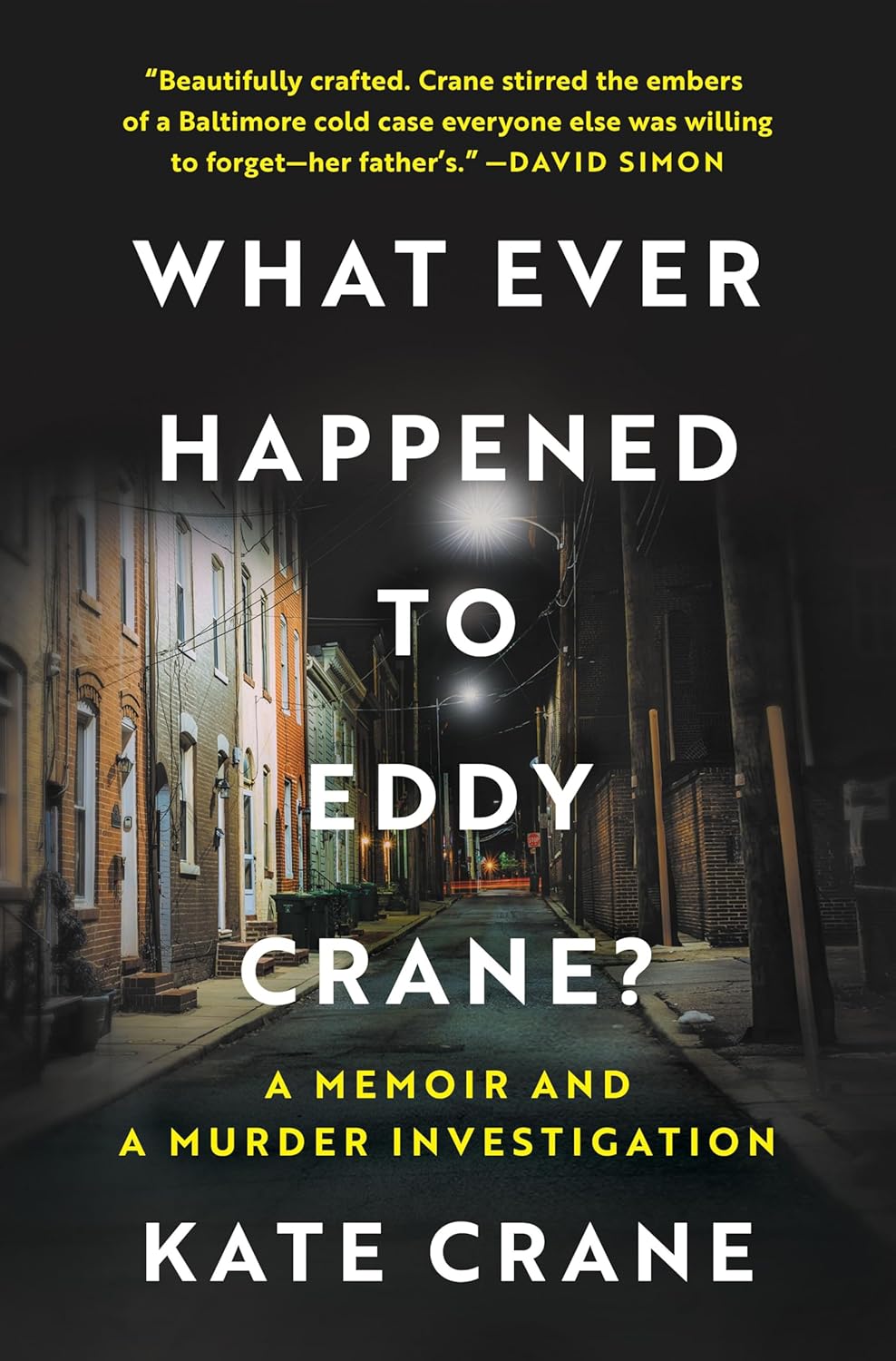
What Ever Happened to Eddy Crane?: A Memoir and a Murder Investigation
- By Kate Crane
- Hanover Square Press
- 304 pp.
- Reviewed by Diane Kiesel
- April 27, 2026
A man’s unsolved disappearance wreaks havoc on his family.
On September 10, 1987, Eddy Crane walked out of his home in working-class Baltimore with the family Rottweiler for another day at E&M Machinery, his trucking-parts business, and was never seen again. “That’s the night our family of four became a family of three, as if the kitchen table dropped a leg,” Kate Crane writes in What Ever Happened to Eddy Crane?
Michael Jackson, Prince, and Gloria Estefan were at the top of the pop charts, “The Untouchables” was playing at the multiplex, and phones were in houses, not handbags. Nearly 40 years later, Baltimore police still listed Eddy Crane as a “missing person,” but at the time, 12-year-old Kate had immediately known otherwise:
“I knew Daddy was dead because he always came home.”
Part true-crime saga and larger part coming-of-age memoir, Crane’s book explores her father’s disappearance and the wreck it left in its wake. Although she grew up to be an accomplished author and writes about her life in the shadow of her father’s death was clarity and care, his loss took its toll. Crane suffered depression and other health issues. Her mother retreated into a shell of silence, her sister smoldered with anger, and her grandmother cried a vat of tears.
Crane’s early responses to her father’s disappearance were the natural reactions of a child. As to Grandmom’s constant crying: “Her tears made me hate her.” Soon after Dad’s departure, his car and his dog, Sherlock, surface near BWI Airport, probably abandoned by Eddy’s abductor or killer. Perhaps fearing a trap, Crane’s mother won’t let her respond to a newspaper ad placed by whoever found the car, seeking its owner. Crane writes, “Inside me, anger pooled like gasoline.”
(Detectives, however, do answer the ad. They take Eddy’s brother, Bob, to retrieve Sherlock, and the dog is so happy to see him that it knocks him over and licks him everywhere. “You think that’s the right dog?” one of the cops asks facetiously.)
Three months later, when her mother signs Crane’s birthday card, “Love, Mom,” the girl is livid because her father’s name is left off. In turn, her sister is angry because Crane is angry at their mother — a continuing theme throughout the book. Clearly, each daughter has a favorite parent.
Crane, who has been secretly cutting herself, is a misfit in school. “Mom, am I going to college?” she asks. Her mother replies indifferently, “I guess you’ll go to Towson,” the local state university. Time passes; Crane gets involved with the area punk-rock scene, harbors suicidal thoughts, and enters relationships with men and women that don’t last. She moves to New York and strings together temporary and part-time writing and editing jobs and crafts a journalism career.
Meanwhile, in 1992, the Baltimore Sun ran a story on Eddy’s disappearance in which it described a rift with his business partner, William Walter “Augie” Augustin Jr., over Eddy’s suspicions that Augie was stealing from the company. To her surprise, Crane learns from the article that her mother — whom she’d angrily thought had forgotten about Eddy — was regularly pressing detectives to look harder into his disappearance. The article pointed to Augie, who’d once been like family to the Cranes, as a suspect. Augie, in turn, suggested that Eddy had embezzled company money and run off.
As the 20th anniversary of her father’s vanishing loomed, the adult journalist Crane was ready to find out for herself what happened. Using a $500 savings bond Augie had given her as a baby, she hired a private investigator. Her family was not supportive. Her mother worried that the killer was still out there and wanted no part of it. “I don’t want to feel threatened again,” she said. Crane’s sister agreed:
“You don’t have to live here and be afraid! You left!”
Crane’s description of her tepid, four-year investigation of her father’s disappearance isn’t as riveting as her chronicle of the toll it took on her and her family. She connects with detectives from the Baltimore Cold Case Squad who are initially enthusiastic to re-open the investigation. But when it gets stalled again, they give her the cold shoulder. Through them, however, Crane learns that important evidence was destroyed and that an early push to prosecute the E&M night watchman in the hope he’d implicate the mastermind of the plot was vetoed by the local district attorney. Was the decision political?
When Crane learns the night watchman died in 1997, she decides to phone Augie to ask what happened but gets nowhere. Three years later, he commits suicide without having ever spoken to her about Eddy’s vanishing. The entire endeavor loses steam and peters out.
In 1996, edgy crime-fiction writer James Ellroy reinvestigated the unsolved murder of his mother, Geneva, who disappeared while on a date in 1958 when he was 10 years old. The result, a book called My Dark Places, was an unsparing, harrowing memoir of his subsequent life with his loser-father and a meticulous police procedural about how Ellroy and an investigator went back over every inch of the crime, step-by-step, in the hope of solving it.
Those hopes were dashed when it became apparent the likely suspects were probably dead. Nonetheless, the dogged efforts of Ellroy, and the grittiness of the investigation and what it revealed, made the book impossible to put down. Toward the end of Crane’s book, as her own haphazard study of her father’s disappearance and probable murder draws to an unsatisfying close, she writes, “I was not James Ellroy.” Indeed.
Diane Kiesel is a former judge of the Supreme Court of New York. Her latest book, When Charlie Met Joan: The Tragedy of the Chaplin Trials and the Failings of American Law, was published last year by the University of Michigan Press.