what’s with baum?: a novel
- By Woody Allen
- Post Hill Press
- 192 pp.
- Reviewed by Michael Maiello
- November 7, 2025
Miss his yearly movies? The director’s debut novel is for you.
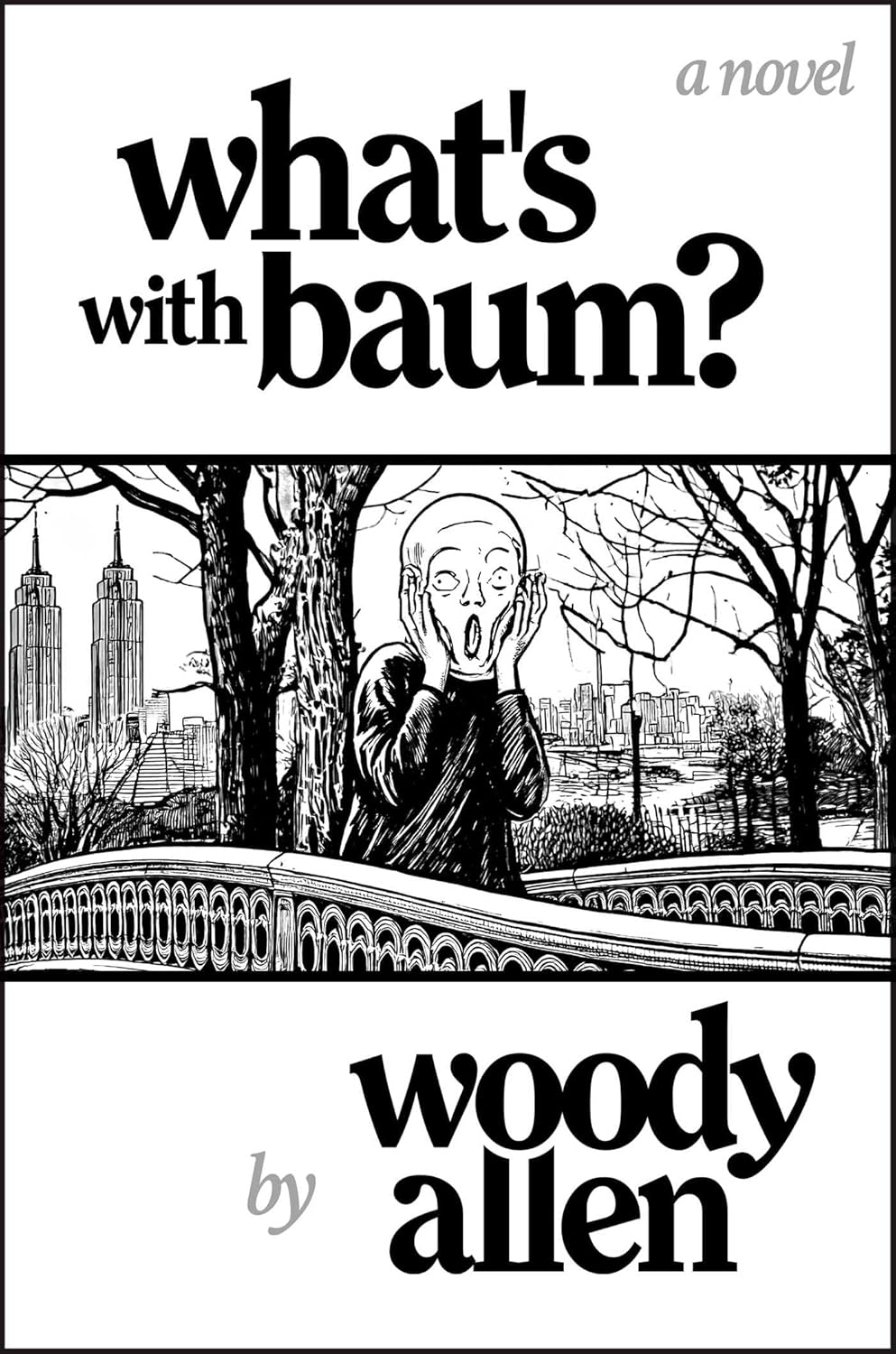
Since writing the screenplay for “What’s New Pussycat?” in 1965, Woody Allen has proven one of the America’s most prolific artists. IMDb lists nearly 60 directing credits between film and television. He’s also written half a dozen plays, five collections of short humor pieces, a memoir, and now, at 89, his first novel, what’s with baum?
While the book was originally conceived as either a movie or stage play, Allen switched mediums at a time when lingering personal scandal (including claims of child sexual abuse), changing tastes, and a very different cinema landscape have made it difficult, though far from impossible, for him to finance new movies. To keep working, he has had to stay creative, shooting his last film, “Coup de Chance,” in France — and entirely in French — to take advantage of his continued warm reception in Europe.
Allen’s novel, told in a single, continuous chapter, is about Asher Baum, a struggling novelist and playwright working through his shaky third marriage to Connie, a beautiful and wealthy Connecticut woman obsessed with the genius of her son, Thane, who disdains Baum as both a stepfather and an artist, dismissing him as a nudnik without knowing the word.
Thane has just published his first novel, which is immediately celebrated and shortlisted for the National Book Award. Baum, consumed with a jealousy he struggles to rise above, has a breakdown and starts talking to himself, to the point that people give him a wide berth on the street and a waiter has to tell him to lower his voice at Bemelmans Bar in Manhattan’s Carlyle Hotel.
For fans of Allen’s movies, this is a familiar setup, placing what’s with baum? among his other stories about neurotic artists, including “Stardust Memories” (1980), “Crimes and Misdemeanors” (1989), “Husbands and Wives” (1992), and “Deconstructing Harry” (1997). In the latter two, Allen cast himself as a writer, and the in-movie inventions were part of the plot. If Allen’s character Gabe Roth had stepped out of the screen like the hero in “The Purple Rose of Cairo” (1985), he’d have written what’s with baum?
In a sense, prose is a perfect form for the near-nonagenarian, since one of the knocks on his later films is that he’s too old to play his own signature characters, forcing the younger actors he casts in his place — from Jesse Eisenberg to Timothée Chalamet — to build their work off of what is essentially an imitation of Allen’s performance style. With the advantage of the mind’s eye of the reader, Allen doesn’t need a surrogate here; it’s easy to envision Baum’s wiry frame romping through New York and Connecticut, observing the world from behind a pair of horn-rimmed Foster Grants.
The plot is also classic Allen. Baum suspects Connie is cheating on him with just about everybody, from his brother, Josh, an adventurous military veteran who rafts the Amazon for fun, to the TV producer working on a short documentary about Thane, to maybe even Thane himself (there are a few Jocasta jokes). Baum, meanwhile, is obsessed with his past relationships, especially with a woman named Tyler, the great love of his life, who left him for a rock drummer from New Zealand, who took her away to raise sheep outside of Auckland:
“This new feeling that had come over her was almost like finding religion, she explained.”
What comes through in the prose is Allen’s philosophy about how love happens and how it drives us. In his universe, love is not a choice. One of the tensions in Baum’s life is that he made a clumsy pass at a young reporter after she fawned over his work. It wasn’t a choice: He was overtaken, just like when Titania falls for ass-headed Bottom after swallowing Oberon’s love potion in Shakespeare’s A Midsummer Night’s Dream. (Readers’ discomfort with Allen’s reasoning will likely be in proportion to their discomfort with the abuse charges against him.)
When Baum recalls meeting and instantly falling in love with Tyler, to the point that he follows her from her bodega to her apartment and rings her bell, Allen writes:
“It occurred to him he was behaving like a frantic idiot. But what does a man do when he falls in love at first sight; when he goes to buy a ham sandwich and sees a woman he’d like to spend the rest of his life looking at every morning, be cremated with and share an urn for eternity?”
All of the mixed romantic obsessions and professional jealousies come to a head when Baum happens upon a startling discovery and has to decide whether to reveal a life-ruining truth that could destroy Thane and Connie, or keep the issue to himself to preserve grace and harmony.
Ultimately, what’s with baum? is a classic Woody Allen tale about whether intelligent people, driven by desire, can overcome their impulses or whether it really all boils down to the infamous observation he once made about his own egregious personal behavior, quoting Emily Dickinson: “The heart wants what it wants.”
Michael Maiello is an author, journalist, and playwright. He worked for 10 years as a writer and editor at Forbes, and his work has appeared in McSweeney’s, the New Yorker, the New York Times, and other publications. Find his free Substack here.