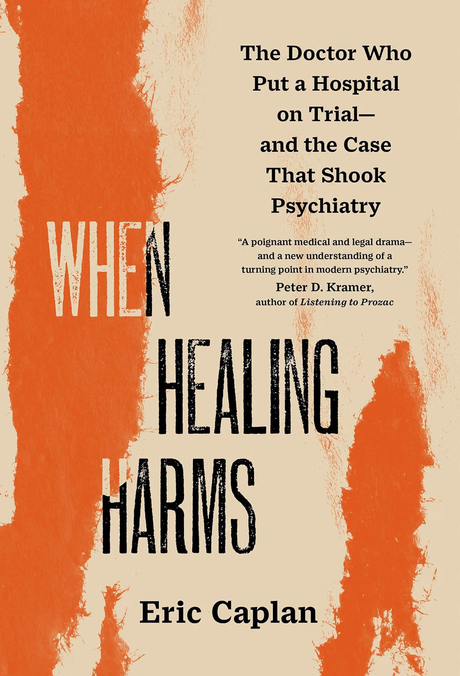
When Healing Harms: The Doctor Who Put a Hospital on Trial — and the Case that Shook Psychiatry
- By Eric Caplan
- University of California Press
- 360 pp.
- Reviewed by Sara Polsky
- September 28, 2026
Medication and therapy weren’t always a popular couple.
Contemporary readers may be familiar with Raphael Osheroff’s name from Rachel Aviv’s 2022 Strangers to Ourselves. In Aviv’s telling, Osheroff is a man who, caught between the competing psychiatric philosophies of psychoanalysis and medication, failed to find the narrative that would help him make peace with his complicated history of mental-health treatment.
When Healing Harms, by historian of psychiatry Eric Caplan, fills in the layers of Osheroff’s story using primary sources — such as trial transcripts — that previous tellings have largely ignored. The result is a book not only about the disputes among different schools of psychiatry but also about what happens when institutions prioritize the preservation of their own power above all else.
Osheroff, a nephrologist, admitted himself to Maryland’s Chestnut Lodge treatment facility in 1979 after a long stretch of depression. He chose it on a doctor’s recommendation, without knowing Chestnut Lodge’s philosophy: “that severe mental illness originated not in brain chemistry but in traumatic experience,” and that treatment should involve a years-long course of therapy rather than medication.
Instead of improving at Chestnut Lodge, Osheroff got worse. When his parents arrived to visit him a few months after his admission, they found that he was pacing the floors of the facility for 12 hours each day, unable to settle, and that he lived in what Caplan describes as “oppressive” conditions. Though Osheroff and his parents weren’t informed of the Lodge’s protocols, its doctors had decided that three years of inpatient treatment — followed by an additional two to seven years of outpatient treatment — might be what was required to help Osheroff, regardless of the life he wanted to get back to on the outside.
Caplan takes readers through the behind-the-scenes drama of Osheroff’s time at Chestnut Lodge, as his partner and friend Bob Greenspan launched an unexpected attempt to take over Osheroff’s dialysis practice and his parents fought to get him better care. Eventually, he left Chestnut Lodge for another facility, Silver Hill, where doctors had a different approach to treatment and were “acutely aware that [patients] had a life beyond the hospital” that they needed to resume. Once Osheroff began taking medication at Silver Hill, his symptoms improved.
But Osheroff’s experience is remembered for what happened after he was discharged: He decided to sue Chestnut Lodge for malpractice, a choice that would have long-term ramifications not just for his own life but for the entire field of psychiatry. The suit, for which Osheroff enlisted the era’s star civil-rights lawyer, Phil Hirschkop, pitted the “psychoanalytic orthodoxy” of Chestnut Hill against emerging “biological psychiatry” in a case that aimed to illustrate “the catastrophic gap between what Ray had suffered under [the Lodge’s] care and what proper treatment had restored.” What kinds of treatments should patients have access to, the case asked, and was it defensible for an institution to stick to certain practices when the results didn’t demonstrate success?
While Osheroff’s life circumstances were difficult even before his admission to Chestnut Lodge — Caplan devotes a good deal of space in the book to Osheroff’s troubled marriages, betrayal by his business partner, and estrangement from his children — it was the aftermath of the lawsuit that made me most invested in his story and angry on his behalf. Though Osheroff won his suit (and potential star witnesses whose research had previously endorsed the Lodge’s approach opted not to testify for the facility), the doctors who supported psychoanalysis over medication refused to publicly admit to changing their minds about how to treat severe mental illness. Ultimately, Caplan believes, “the Lodge’s insistence on exclusive psychological intervention represented not psychoanalytic orthodoxy but institutional extremism.” Chestnut Lodge’s focus on preserving itself cost many patients years of their lives.
The legal system was not an ideal mechanism for recouping those costs. Osheroff’s case was tried in Maryland, a state that was “notoriously conservative” in setting legal damages, and Osheroff himself struggled to put a price on his ordeal when given the opportunity to negotiate. Nor, because the settlement was private, was he able to tell his story more widely in the hope of changing psychiatric practices. Even as consultants and witnesses who’d participated in Osheroff’s treatment or legal case began to speak out, Osheroff’s own perspective was largely ignored by those who covered the case. Instead, as Caplan puts it:
“each side claimed exclusive access to truth while the real victims of these theoretical battles were patients caught between approaches that could not acknowledge the validity of alternatives.”
Here, Osheroff’s experience intersects with contemporary conversations about narrative medicine. Perhaps having more opportunities to tell his story would’ve given Osheroff more recourse than did the legal system and would’ve added much-needed nuance to a debate that was, for too long, black and white.
Sara Polsky is a writer, editor, and educator based in New York City. She is the author of the YA novel This Is How I Find Her.