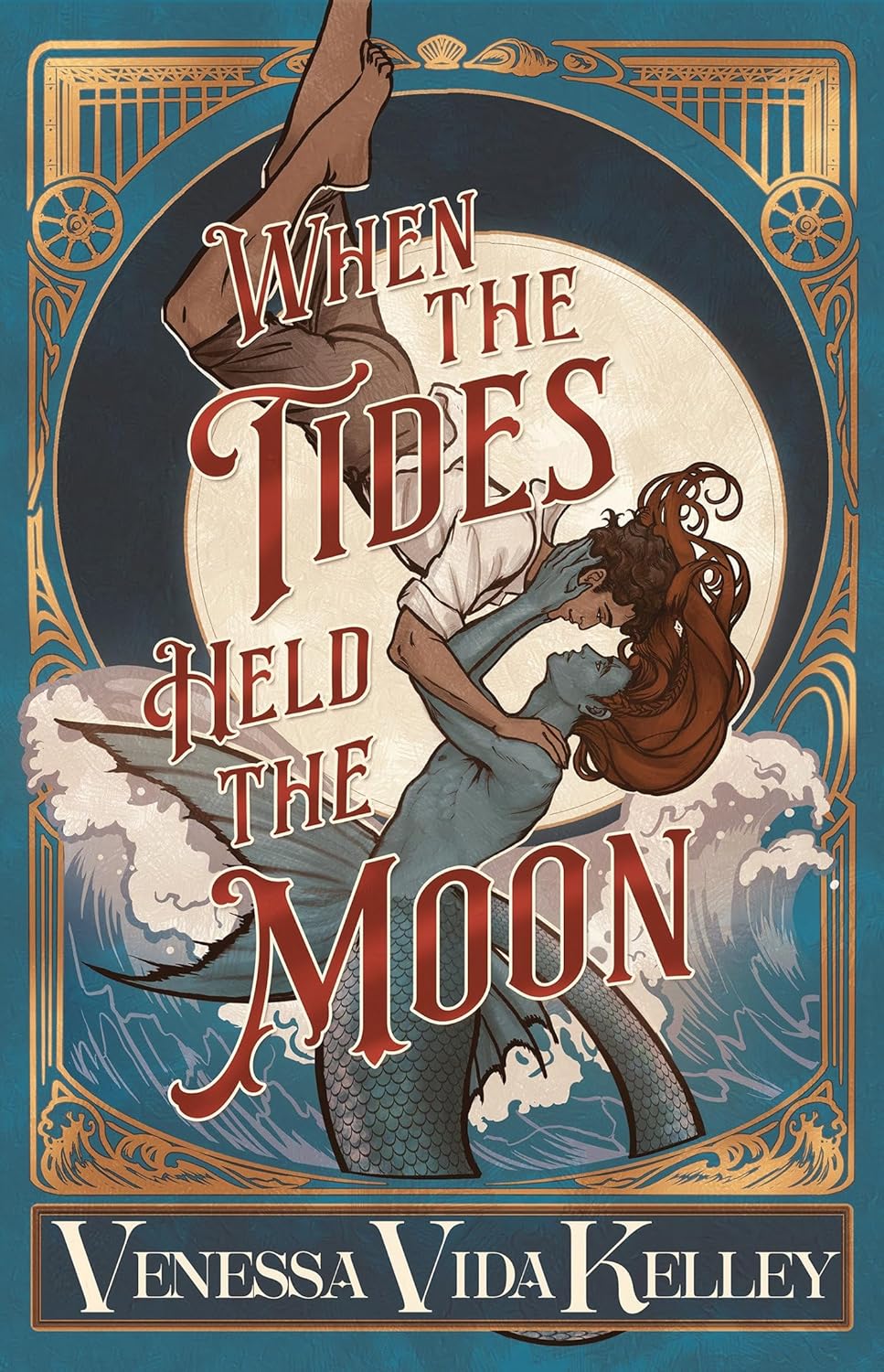
When the Tides Held the Moon
- By Venessa Vida Kelley
- Erewhon Books
- 464 pp.
- Reviewed by Emma Carbone
- May 16, 2025
A young Boricua man meets his not-quite-human soulmate at a 1910s Coney Island sideshow.
After his aunt’s death, Benigno “Benny” Caldera came to New York the way Tití Luz had wanted. “In her hard-boiled opinion, Nueva York was a stockpile of the freedom America had pledged to Puerto Rico,” and immigrating there would help Benny find a new community. Except that, four years later, in 1911, he’s still toiling away alone at the first job he could land — as an ironworker in Red Hook, Brooklyn, where the smoke wreaks havoc on his asthmatic lungs.
When Benny has a chance to work on a complex artistic job known as a “head-smelter” because such “commissions were troublesome, technical puzzles, so named for being a legitimate dolor de cabeza to deliver on time,” he jumps at it. After all, unlike the smiths like him in Structural, “no one in Ornamental had to breathe black air.”
Building a tank for this head-smelter is easy enough and gives Benny plenty of space to demonstrate his creative ability and technical skill — until his supervisor takes the credit, that is. Instead of getting into Ornamental, Benny is out of a job and has to start over once again.
Following his creation — the iron tank — to its destination in a Coney Island sideshow, Benny finds an unlikely landscape amidst “a wide vein of boardwalk lined with empty storefronts and hibernating attractions,” including “a drained lake, a building-sized slide, and other mechanical wonders that towered overhead with goofy names like ‘The Teaser,’ ‘The Tickler,’ and ‘Whirl the Whirl.’” Even more unlikely, Benny finds a place for himself among the members of Morgan’s Menagerie of Human Oddities as they work to capture an actual merman in the East River.
Haunted by the impossibility of both the capture and his role in it, Benny reluctantly accepts a job maintaining the tank. Meanwhile, he slowly befriends the members of the sideshow, including Black strongman and aspiring writer Matthias Martin, “Flexible Fräulein” Sonia Kutzler, and others, all of whom expand Benny’s worldview as they welcome him. But once the team succeeds in its mission and Benny learns more about the now-imprisoned merman, Río, he begins to understand how deeply wrong everything is.
Still, it’s taken years to find a real home for himself in New York, let alone someone who understands and cares for him like Río does (a feeling that’s clearly mutual, even if Benny is initially afraid to admit it). How can Benny help the merman escape without losing everything — and everyone — he’s come to love?
When the Tides Held the Moon is Venessa Vida Kelley’s debut novel, and their Puerto Rican heritage informs both the story and their accompanying illustrations. Benny’s prose narration is interspersed with spot, full-page, and double-page drawings, and the fine lines and crosshatch texturing go well with the 1910s setting, as does the border art delineating each chapter.
At the back of the book, readers will find an author’s note titled “Puerto Rico, Colonialism, and Hybridity,” in which Kelley discusses their inspiration for the story, along with some of the historical context for actual events featured in it. There’s also a glossary of the words and phrases used (many in Puerto Rican Spanish or various characters’ other languages), an explanation of historical terms, and the lyrics to two songs featured in the narrative.
More than anything, When the Tides Held the Moon is a love story, with the compelling queer attraction between Benny and Río quickly growing into mutual respect and empathy. At the same time, the book demonstrates how vital it is to find your tribe — something Benny didn’t realize he needed. Accepted as he is by the sideshow performers, he takes their credo, “With it, for it, never against it,” to heart as he tries to figure out how to save Río without betraying his new friends, who have their own choices to make. (A cleverly presented epilogue outlines just what these choices are.)
Evocative illustrations, a little-represented moment in history, and lyrical prose mark When the Tides Held the Moon as a standout debut and Kelley as an author to watch.
Emma Carbone is a librarian and reviewer. She has been blogging about books since 2007.