Why Everyone Hates White Liberals (Including White Liberals): A History
- By Kevin M. Schultz
- University of Chicago Press
- 256 pp.
- Reviewed by William Rice
- May 19, 2025
Haven’t we mostly retired the L-word already?
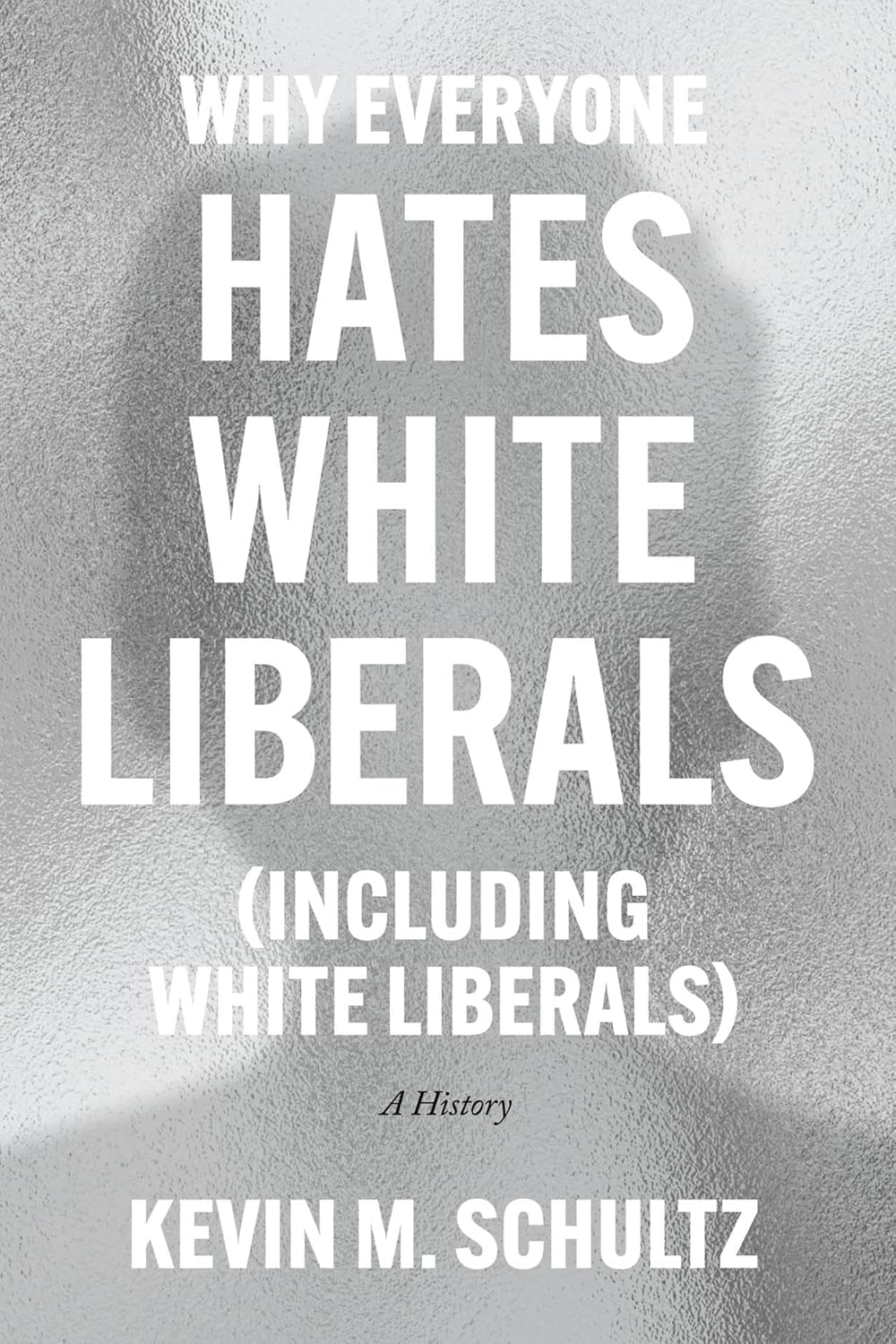
It feels strange to review a political obituary of myself — or rather, of the kind of political person I am (and if I’m not very mistaken in my demographic estimate, the kind many of you are, too). Yet that’s the task at hand in offering my observations of Kevin M. Schultz’s Why Everyone Hates White Liberals (Including White Liberals).
Though he never explicitly says so, it’s clear Schultz is one of the liberal tribe as well. His book’s title could be mistaken for one of the myriad liberal-bashing conservative screeds he describes in its pages, but the text is actually a rather bitter complaint about how an admirable ideology has been, in his word, “assassinated.”
The label “liberal” had to be thoroughly discredited by its political opponents, he persuasively argues, because the policies behind it — acceptance of social differences, well-regulated and adequately taxed private enterprise, collective action to round off the sharp corners of personal misfortune — are all widely popular. The only way to kill the message was to kill the messenger.
Schultz explains that, as the term was understood in the middle of the 20th century, “liberal” was a middle way between the extremism of fascism and communism. And it was a popular political brand: The author tells us — as hard as it may be to believe now — that “roughly half of Americans surveyed from the 1930s to the early 1960s claimed to be a ‘liberal.’” The book quotes public intellectual Lionel Trilling proclaiming in 1950, “In the United States at this time, liberalism is not only the dominant but even the sole intellectual tradition.”
It’s been pretty much all downhill since. Part of the reason is that liberalism is by its very nature a fat target. Because one of the dictionary definitions of liberal is “broad-minded,” and because one of political liberalism’s virtues is supposed to be the absence of a rigid ideology, it’s been easy to tag liberals as wishy-washy, weak, value-less.
As Schultz notes, for all the damage done to the liberal brand by its conservative critics over the past 70 years, they were not the only ones on the attack. Just as our strongest emotions are generally reserved for those we’re closest to, so some of the most biting criticism of white liberals has traditionally come not from their opponents on the Right but from those who should be their natural allies: radicals and others on the Left. Socialists, for instance, detested liberals for trying to improve capitalism rather than abolishing it.
Schultz adds the racial descriptor to his subject because Black Americans who may espouse liberal ideas have in general never been hated for that reason, and because such Black liberals have often been among white liberals’ sharpest critics. At the core of Black anger toward their white counterparts has been a sense of betrayal. The Black psychologist Kenneth Clark, in 1963, called white liberals “more insidious than the out-and-out bigot.” Though sympathizing with the emotion, Schultz rightly pushes back on this idea born more of pain than logic.
The book’s prose is generally straightforward and effective, if at times repetitious. The history seems solid, with a few exceptions. Schultz helpfully locates the modern origin of “liberalism” in the words and deeds of Franklin D. Roosevelt, but his brief recap of FDR’s presidency is strangely jumbled. And the author’s dismissal of Ted Kennedy’s 1980 presidential campaign as having “nothing to say about the legacy or future of liberalism” is belied by Kennedy’s speech to the Democratic National Convention that summer — probably one of the clearest articulations of liberal values ever voiced.
Even though the book was published this year — and as helpful as it is in providing historical context — its central premise is seriously dated. Schultz urges liberals to stop trying to defend or resurrect the label and instead pursue their policies and ideals under a different banner. But I’m unaware of any politician in the past 50 years boasting of her liberalism. Schultz himself informs us that as early as 1968, undeniably liberal presidential candidates Hubert Humphrey, Robert F. Kennedy, and Eugene McCarthy already eschewed the word as toxic. Practically its only use for the past half-century has been in the ads of Republican office-seekers.
And that era is apparently over, too. Though they may occasionally throw in “liberal” as an afterthought, the Trump gang now tends to denounce the regime’s opponents with other words: “woke,” “socialist,” “radical,” or just “loony.” By comparison, liberal sounds fairly sane. So, paradoxically, its harshest opponents may have finally pushed the worn and battered word back to the ideological center, if anyone ever wants to use it again.
Despite its many virtues, I’m unsure how relevant this book is now. The death — by a thousand cuts from a thousand sides — of “liberal” as the descriptor of a respectable political outlook offers one explanation of how we’ve reached our bewildering historical moment. But it seems we’re past the point of inquiring into ideological debate. In this strange new world, the fight’s not between liberal and conservative. It’s between democracy and autocracy, sanity and madness, truth and darkness.
William Rice is a writer for political and policy-advocacy organizations.