America’s Future calls out to what we could be.
I don’t usually write in coffee shops. Still, here I am in Berkeley Springs, West Virginia, under a sign that says, “Thanks to Rev. Bob ‘The Soul Man’ Fairfax Coffee House is Soul-Powered!” Indie pop music sprinkles through the speakers overhead, and a mom repeats to her school-age daughter that she’s getting the best water, the best, right out of the tap.
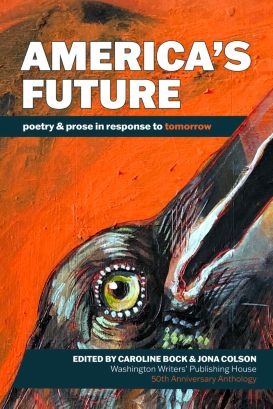
Amid it all, I’m pondering both America’s future and America’s Future: poetry & prose in response to tomorrow, the new anthology of which I am co-editor with Jona Colson, out in the world one month this week.
A year-and-a-half ago, when we started thinking about another anthology for the Washington Writers’ Publishing House, which is celebrating its 50th anniversary this year, I didn’t know I would be here in Berkeley Springs today, at an annual retreat with a small group of amazing women writers, editors, and literary citizens. I didn’t think America would be where it is, either, looking more backward than forward, the country infused with nostalgia for a past that was never as kind or generous to most of us as the nostalgia carnival barkers would like us to believe.
I wasn’t sure, however, what a “better” future might include. AI? Space travel? A decent job that offers healthcare? Peace on earth? Back then, I had a lot of questions. And if I had them, I was sure others did, too. I soon learned that many writers had even more questions after the last election, so Jona and I extended the submissions period for America’s Future into the beginning of 2025 and scrambled through over 500 submissions.
What did I learn? That there are still more questions than answers. I also discovered that the older the writer, the more they drew on history to frame their concern for the future. Ninety-five-year-old Marvin Kalb, the famed former CBS international correspondent and author of 18 books, including his most recent, A Different Russia: Khrushchev and Kennedy on a Collision Course, submitted an essay that’s a clarion call for national backbone.
“A Voice of Courage in a Time of Need” looks back at the example of Edward R. Murrow, the preeminent broadcaster of his era, and how he urged his fellow Americans to stand firm and affirm democracy, freedom of the press, and the sanctity of the courts. Kalb echoes that warning with his own — “The cupboard of political promise in America is if not bare, then cowed into polite submission” — and urges journalists, news organizations, and the people to stand up now.
In more personal pieces, several writers, primarily women, wrote of the next generation, of futuristic childbirth, of families facing the climate crisis, of a world with pregnant women on the run. I read the short stories of Alice Stephens (“Baby’s First Ovid™”), Joanna Urban (“Milankovitch Cycles and Other Stories”), and Danielle Stonehirsch (“The Walk”) with the excitement of an editor seeing a theme emerge and the foreboding of a mother with two twentysomething children of her own. The chilling story from Nicole Brazemore, “This Is Paradise,” was an especially exciting discovery in our Submittable queue — an Instagram story about Paradisefarm, a utopia that is not.
Other writers, again mostly women, wrote in lyrical essays of their great hope for their children or grandchildren. Annie Marhefka’s “Things My Daughter Is Learning in Kindergarten,” Bernardine (Dine) Watson’s “Three Generations of Black Women and a Look into America’s Future,” Adrienne Benson’s “Rebirth,” Bethanne Patrick’s “Sea Change,” and so many others left me heartened that the future is truly female.
Sometimes, though, the future can only be written with biting satire. Len Kruger’s “Child Psychiatrist: The Television Series,” Tara Campbell’s AI-infused flash-fiction holiday tribute, “Black Friday Eve,” and Adam Schwartz’s epistolary message to our dear leaders, “Now That DEI Is Dead, Things Are Looking Up for Me,” take on the powers-that-be. Kristina Tabor also uses black humor in her futuristic healthcare story, “Because Your Health Is the Most Important Thing.”
And since I’m here in West Virginia, I open my copy of America’s Future and reread, with delight, the story from Mark Brazaitis, a West Virginian, who resurrects the rebels from the past to speak sharply — and cleverly — to the now in his short story, “Confederates from Hell.”
While the 526-page anthology’s opening piece — the first printing of Congressman Jamie Raskin’s “Remarks as Delivered at the Hands Off! Rally on the National Mall” speech — is a call to collective action, the closing essay is Sean Murphy’s appeal to the individual, and its title sums up a key thought I had while editing and shaping this collection: “To Save Ourselves We Must Continue Telling Stories.”
I’m not even touching here on the wondrous and insightful poetry from 80+ poets that makes up over half the anthology — including works by David Keplinger, E. Ethelbert Miller & Miho Kinnas, Steven Leyva, David Ebenbach, Brandel France de Bravo, Greg Shapiro, Sunu P. Chandy, Dwayne Lawson-Brown, Dan Vera, Kim Roberts, Heather L. Davis, Raffi Joe Wartanian, Marceline White, Jayla Hart, Susan Bucci Mockler, and Grace Cavalieri. I give all the credit to Jona and his team of dedicated poet-press-mate-readers at the Washington Writers’ Publishing House for infusing the book with their powerful words. (Perhaps there’s another column I need to write just on the poetry in America’s Future.)
Here, in this West Virginia coffee shop, reading through America’s Future again, I only wish I had copies to hand out to all, that I could make every politician and first-year college student read this collection, that we could — as a small nonprofit press — do more to share its literary insights into our greatest fears, its dark humor, its bright hopes, and its thought-provoking questions. But for right now, in this moment, this column will have to do.
Caroline Bock writes stories — from micros to novels. She is the author of the novel The Other Beautiful People, forthcoming from Regal House Publishing in summer 2026. A graduate of Syracuse University, she studied creative writing with Raymond Carver and poetry with Jack Gilbert and Tess Gallagher. In 2011, after a 20-year career as a cable television executive, she earned an MFA in fiction from the City College of New York. She has short fiction forthcoming in the Hopkins Review. She is the co-president and prose editor at the Washington Writers’ Publishing House. She lives in Maryland with her family.