The professor talks “sort of” overcoming grief.
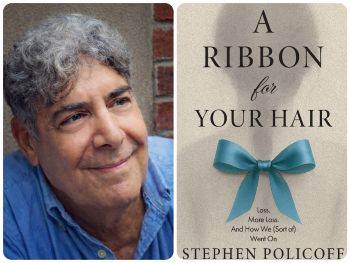
A Ribbon for Your Hair: Loss. More Loss. And How We (Sort of) Went On is a memoir of the unimaginable grief Stephen Policoff experienced with the loss of his wife to lung cancer and his elder daughter to the rare genetic disease Niemann-Pick type C (NPC). Policoff is the award-winning author of three novels — Beautiful Somewhere Else, Come Away, and Dangerous Blues — and a Clinical Professor of Writing in Liberal Studies at New York University, where he has taught for almost 40 years.
First of all, I’m so sorry you had to weather such heartbreak. In the midst of caring for your daughter, Anna, until her death at 20 years old, your wife, Kate, died of lung cancer. Thank you for writing this tribute to your family, an account I found both honest and helpful (if that’s appropriate to say).
It is a little odd, perhaps, for me to be sharing the calamities of my life, but as my daughter Jane points out, “That’s something you do.” I have some mild hopes that others suffering grief and loss might possibly find some solace in the book.
Hundreds gathered to commemorate Kate in 2012 and Anna in 2015. You understandably report that you remember nothing from either funeral. Well, you remember the “hugs I received, joyful anecdotes shared.” How were you able to excavate memories of your struggle and joys to write this book?
I started writing Ribbon during covid, so I had plenty of time to pore over my thoughts. I did a lot of roaming through the nearly empty streets of Greenwich Village (where I have lived for the past 30 years) thinking aloud. I also literally paced around my apartment, free-associating into my phone. Eventually, images and phrases and encounters started flowing back into my consciousness.
As many books on grief are a compendium of platitudes, I appreciated your writing that “sometimes I did not wish to be consoled, wished only to remind myself how sad I was.” You add, “Grief is like weather; you live in it, you notice it sometimes, and sometimes it is just there.” That struck me as insightful, and so I was amused to read the follow-up: “OK, I said that.” Can you talk about being wry and even funny or silly in these pages?
Well, humor has always gotten me through. And since the book is, to some extent, about finding a way back into semi-normal life, it was important to me to let some humor, some wry observations into the mix. I did not want this book to be merely bleak and sorrowful, because life is also absurd and even sometimes beautiful despite the darkness.
I scribbled on the top of page 94, “How I wish this were a novel.” I didn’t want this account to be nonfiction, let alone to have happened to you. Since the “horrible stupid” deaths of your loved ones, you wrote a novel, Dangerous Blues, that visited sorrow and ghosts. Did that inspire you to face the past head-on in nonfiction?
I am more attuned to writing fiction, but when I thought about Kate’s life and Anna’s life being cut so short, I knew I could not do it justice without actually writing what happened. Especially for Anna, whose sweet voice was obliterated by this dreadful and obscure illness. I wanted to be her voice, to illuminate her life truthfully. I like to think I have used my novelist’s instincts to capture details and give the story an arc, but I always sensed it would be a memoir.
You and Kate decided to adopt a second child from China, whom I can attest has grown into a lovely, engaging adult, a credit to Kate and you! Early in the book, you talk about guiding her through the “morass of loss” and describe how “helping her helped me.” Later, she says, “Despite Mommy and Anna dying, I sometimes think I have the least dysfunctional family of any of my friends.” How has she responded to the book, and do you think she might ever write about those years?
She has already told me that she probably won’t read the book. But she comes to all my readings and brings her friends, so I know she understands what I do and why I do it. I would not be completely surprised if she someday wanted to write her version of this difficult time in her life. But she is much less haunted by the past than I am (and thus a healthier person, no doubt), so maybe not. Of course, I hope that her life is happy enough that she won’t need to unearth this sorrow.
You and Kate went to the ends of the earth — and your budget — to help Anna. When she was diagnosed with NPC at 4 years old, the geneticist said, “Sorry about that,” and the Mayo Clinic specialist, who spoke of experimental drugs in the pipeline, said, “Positive thinking is what we all need right now.” Amid this grim prognosis, Anna attracts amazing friends and devoted helpers. Rather than railing against the healthcare system and lack of disability care, you wrote a patient-advocacy manual alongside a celebration of Anna’s uncanny ability to enjoy herself and others. Was that always your writing plan?
I certainly have railed about our healthcare system to friends and family, mostly about Kate’s care. Anna got fairly good care considering the obscurity of her illness. Sadly, patients with lung cancer are treated as if they have willed their own deaths, and Kate got pretty terrible care. But this was not the book I wanted to write. Anna was so much more than the terrible symptoms of Niemann-Pick C. The joy she found in life — even as she struggled to live — was inspiring. Kate and Anna were both larger-than-life personalities whose lives present the case that celebrating is better than mourning. I still mourn their deaths, but I also wanted to honor the beauty and delight they found in even the banal moments of everyday life.
What is the story behind the book’s title?
I struggled with that. At one point, I was going to call it Grief Collage, but various people told me that might not exactly draw readers in. I also considered Box of Rain, a Grateful Dead song beloved by both Kate and Anna, who frequently bellowed along when we played it. But that seemed too opaque. The final verse of that song suggests that life is somehow like a ribbon for your hair, which resonated because Anna loved sparkly ribbons and bows, and because the image seems profound — the ribbon of life, the ribbon of time. I added the subtitle, Loss. More Loss. And How We (Sort of) Went On, which sums up the story. The “(Sort of)” is one of the points the book makes: If you survive grief and loss, it is always only sort of.
Mary Kay Zuravleff is the author of four novels, including American Ending, an Oprah Spring Book Pick, and Man Alive!, a Washington Post Notable Book.