Let From the Belly sate your poetic hunger.
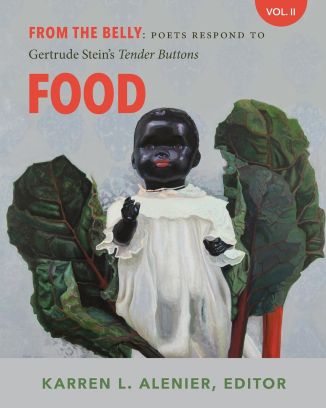
In the series of anthologies she edits, From the Belly, Karren L. Alenier illuminates the work of Gertrude Stein by envisioning the unconventional 20th-century writer’s seminal Tender Buttons as a conversation with the reader. To that end, Alenier has enlisted a company of contemporary poets and asked them to respond, each in their own voice, to curated excerpts from Stein’s book.
When completed, the series will comprise three volumes, each corresponding to one of the three sections of Stein’s original work. The first volume was published in 2023; publication of the final volume is anticipated later this year. Volume two, subtitled FOOD, was released in 2024, and it is indeed a feast for the mind, a potluck to which 38 different poets have contributed.
Picture entering a banquet hall with seating for a multitude. At the head of the table sits Gertrude herself — her oracular voice rings out, and one by one, the assembled guests reply, serving up one delectable course after another. The reader may do well to imagine Alice B. Toklas, her cookbook in hand, hovering by Gertrude’s elbow.
Alenier has compiled here a menu of varying tastes and textures, with the aim of introducing to the reader Stein’s complex range. The excerpts from Tender Buttons are juxtaposed with the responses of the poets. Stein’s text originally stood on its own, and it is tempting to suggest that in the present volume, each poet’s response might also be read alone. But to do so would subvert the work as a whole, for this is a conversation, after all, and a conversation is always greater than its individual voices. It is a process, not a product.
Alenier recounts Stein’s early strategy of “simultaneously talking and listening,” thereby inviting active engagement from the audience. This process of interaction, Alenier says, is necessary in order to keep language from ossifying. And more to the point, interaction and interrogation are critical to understanding what Stein herself was all about. “Do not go into the Steinian woods alone,” Alenier cautions us. Take a friend. Take several. Take a multitude.
This review poses the conceit of viewing From the Belly as a banquet, but the collection is really much more. Alenier points out that in the “Food” section of Tender Buttons, Stein is really writing not so much as a gourmand but as a lover, with all the complex emotions love must entail. For Stein is a moody lover — there are tempests as much as tenderness, gulfs and broad seas that agitate and separate. Distinction is as much a part of love as unity. And the same must be said of any good conversation.
With so many fine speakers at the table, it is difficult for this reviewer to single out any one voice to the exclusion of others. Still, brevity demands focus; the reader will discover the broader expanse. Some of the included authors respond by starting close to Stein’s apparent topic before spinning in new directions. Where Stein speaks of artichokes, for example, Michael Gushue also discusses the artichoke, albeit from a different perspective. In his poem “undressing the artichoke,” he zooms in to examine the vegetable’s component parts, then veers slantwise to rise “on transparent wings of utterance.” The Steinian forest contains many paths and speaks with many tongues.
In her response to a brief excerpt entitled “cream,” Majda Gama plays with connotations, using the off-white shade of an abandoned T-shirt to unpack the complicated emotions the image evokes. And this suits, since Stein’s words are also oblique. Neither Gama’s response nor the original text have much to do with the stuff some people add to their coffee.
A.L. Nielsen leans into Stein’s cryptic wordplay with his eponymous response to “Asparagus.” In the process, he conjures martyred Spanish poet Federico García Lorca, posits the act of cooking asparagus as an act of resistance, and cautions, “if you can’t stand the heat, get out of the poem.”
Editor Alenier also stands close to Stein’s text in “Tryst,” at the same time pushing past the nominal topic of the original poem (“Lunch”) to explore underlying themes of love and longing. Stein wrote that “Necessity is a silk under wear.” In reply, Alenier speculates about Gertrude’s “noonish fantasy,” who “couldn’t put her toe in silken panties,” and concludes, “sex is electric.”
This anthology, too, is electric — all lit up like the steamer Louise, as my grandmother used to say, brilliant with stars, carrying glimmering torches. And if there is anything we need in these perilous times, it is more light. Seek out this volume and feast on the light within.
W. Luther Jett is the author of Flying to America and six chapbooks of poetry.