Finding grace in surprising (and dusty) places.
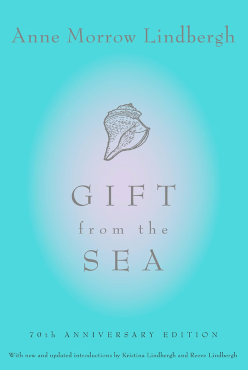
In 1955, the book at the top of many bestseller lists was a slender hardback titled Gift from the Sea by Anne Morrow Lindbergh. Today, we might call it “inspirational” or self-help, as the book details the author’s meditations on life and acceptance while she vacations at the beach and offers thoughts about how to find a good life amid modernity’s bustle.
Of course, that harried life she refers to is from the 1950s, a time we are supposed to idealize now. Lindbergh — yes, mother of the baby kidnapped and murdered 20 years earlier and wife of the famed aviator — writes:
“For life today in America is based on the premise of ever-widening circles of contact and communication. It involves not only family demands, but community demands, national demands, international demands on the good citizen, through social and cultural pressures, through newspapers, magazines, radio programs, political drives, charitable appeals, and so on. My mind reels with it.”
Replace “radio programs” with “social media,” and this list of distractions sounds remarkably modern.
I’m an historical novelist, so I am often casting my mind back to the past, reading books that were once popular but now have been forgotten. (Though one gift from the internet, its own sort of sea, is the creation of niches for the preservation and discussion of many of these gems.) I’m often struck by how contemporary are the concerns of long-dead writers. Which is to say, maybe humans are all still grappling with the same eternal problems.
Lindbergh herself makes the same argument:
“Plotinus was preaching the dangers of multiplicity of the world [i.e., the pull of competing demands] back in the third century.”
So maybe, if we are struggling with the same problems, we can turn to some of our predecessors’ suggestions. Maybe history is a scribble, with recursive loops mixed in with the progress of social advances.
Lindbergh looks to the natural metaphors offered by the ocean and seashore for her instruction. The female paper nautilus, she writes, uses her fragile shell as a cradle for her young, then departs it to wander the ocean. That departure, Lindbergh suggests, offers a beautiful symbol for middle-aged women ready to leave the security of home and journey afar.
(Interestingly, it was a 19th-century woman, Jeanne Villepreux-Power, who first investigated the means by which paper nautiluses create their shells, and in doing so, she helped invent the modern aquarium. And Lindbergh became the first certified female glider pilot when she was in her 20s, so it seems she didn’t need to wait until midlife for the courage to soar!)
Lindbergh’s paper nautilus doesn’t only offer lessons for women, though. She suggests “both men and women in America may hunger, in our material, outward, active, masculine culture, for the supposedly feminine qualities of heart, mind and spirit — qualities which are actually neither masculine nor feminine, but simply human qualities that have been neglected.”
I find this message from the past comforting. Yet I find it disconcerting to be comforted by gentle wisdom from a woman who was, in 1936, a personal guest of Hermann Göring at the Summer Olympics in Berlin. In her later-published collection of diary entries and letters from the time, Lindbergh wrote that she found Nazi-run Germany “thrilling.”
Presumably, she repented of those beliefs. Maybe it was even the burden of her disillusionment and chastening that offered her grace later in life. Her frustrations with her marriage to Charles, who had pushed Lindbergh toward fascism, prompted her journey to the Captiva Island seashore and her writing about grappling with her identity as a woman. And though her book counsels patience and faith, the year after its publication, Lindbergh began a long affair with her family doctor.
The past is complicated because people are complicated — which is all the more reason to roll up our sleeves and dive in.
Carrie Callaghan is the author of the historical novels A Light of Her Own and Salt the Snow. She lives in Maryland with her family and four ridiculous cats. You can keep up with her and her future columns on Instagram or Substack.