A new collection features recently uncovered works by Lucille Clifton, Maryland’s late poet laureate.
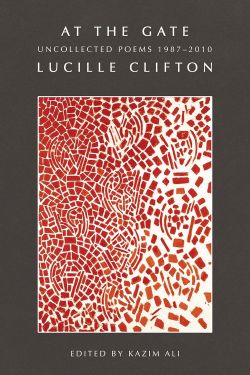
We’ve reached the era when researchers may find more unpublished poems on a late poet’s hard drives than in her papers. American poet Lucille Clifton left us in 2010, but scholars continue to seek out her work, discovering new poems and drafts that acted as a “rich seed-bed for multiple other poems,” says editor Kazim Ali, who has gathered both in At the Gate.
Themes that occupied Clifton during her long career — such as motherhood, Adam and Eve, and her experience as a Black woman — reverberate in this new collection. Edgy and never sentimental, Clifton’s poetry is equally never clinical. Her eye is searching but not cold.
This is borne out by comparing versions of poems on the same topic — in one case, “children lost during Middle Passage, some cast into the seas by their own mothers as a last desperate act of maternal agency,” as Ali puts it in his end notes. Clifton published her poem “atlantic is a sea of bones” in 1987, but this posthumous collection contains the poem “la Llorona,” a lament of:
…the cursed ships that stole away
my waterlost children oh the years
on their fading faces oh the terrible sea
of their names
The suffering of children, along with the sacrifices they demand, are themes that recur throughout Clifton’s work. In books published in her lifetime, she wisely left out certain political poems tied to specific events. But some poems in At the Gate, including “postcards,” age disturbingly well:
our side did not see them
in the search for someone else
an enemy we did not see the
children nine
our national pastime....
how we have made their people
hate us our national pastime
Some of this book’s poems add little to what Clifton published before. Certain fragments are too slight; we can understand why she may not have wanted them made public. In this volume, a poem about a mirror has longer lines than the final version, published in 2008’s Voices, which has shorter ones and more white space. But, otherwise, the draft and the published poem are almost identical. In “the dead do dream,” Ali provides three additional end lines from Clifton’s drafts:
…some of them are sure
they are sleeping on ordinary pillows
they rise in their dream to haunt the lives
of their heedless kin
they are furious when they call
our names
and we pretend not to hear
In Voices, Clifton cut the last three lines. Ali rightly notes that these make the poem “a little snakier, a little spikier.”
At the Gate does contain some work that is hard to find elsewhere. Some of Clifton’s most poignant poems question her capacity for resilience:
i am learning that even
one such as i
loses hope
i am learning that i
would forget about love
if i could
i am learning
i can not
Others, like “shadow,” sketch her alter egos:
she is silent in the way
that clouds are silent,
something ominous
in her moving.
she has no children.
she cherishes only me.
there are days
when she follows me everywhere
weeping at who i am.
If the poems exploring her identity as a woman are strong, those that explore her identity as a writer are even more so. At the Gate includes a poem already picked up on the web, one in which the poet’s plea to “use me” is, indeed, terrifying:
poets in their bassinets
dream a splendid woman
holding over their baby eyes
a globe, shining with
possibility. someone,
she smiles, has to see this
and report it, and they
in their innocence
believing that all will be
as beautiful as she is,
whimper use me, use me
and oh how terrifying
that she does.
Someone does have to see this and report it. We are grateful that Clifton did.
Laura Sheahen is a Maryland poet who spends part of her time in Tunisia.