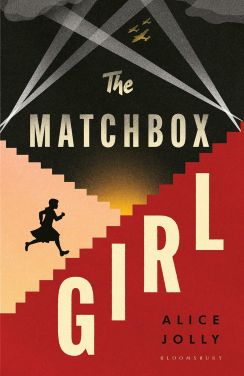
Set in the 1930s, The Matchbox Girl feels alarmingly resonant today.
I’m writing from the 42nd parallel south latitude in Tasmania at the beginning of summer. The Port of Hobart teems with sailboats and fishing vessels. From the balcony of my son’s home in Sandy Bay, we see cruise ships gliding up the Derwent River and ice-breakers heading for Antarctica. Gusts of wind and rain showers pepper the sunniest days, and cockatoos fly over Long Beach, where my grandchildren play after school. It feels like a parallel universe.
Hobart’s vibrant cultural life includes a number of independent bookstores. I’ve loved browsing through the tiny Books and Wine, the Hobart Bookshop in Salamanca Square, and Fullers, whose frontlist features many U.K. and Australian authors unavailable back home.
So, I thought I’d draw your attention to one standout selection: The Matchbox Girl by Alice Jolly. It’s the fifth novel from this critically acclaimed British author, and full disclosure: I’ve known her personally since the 1990s, when, together, we ran a writer’s group in Brussels. Her work has flown under the U.S. radar so far, but you’ll want to keep an eye out for the American release of this one in January.
“Nature never draws a line without smudging it,” reads one of the novel’s epigraphs, from psychiatrist and autism researcher Lorna Wing, which sets us up for an examination of several disturbingly smudged lines: How do we distinguish normal from abnormal behavior, or self-preservation from complicity? What amounts to lying and what is just pretending?
The story begins in 1934 at the Old Vienna Children’s Hospital in Austria, where Dr. Hans Asperger and his team are conducting research on autism. Our narrator is a neurodivergent 12-year-old named Adelheid Brunner. She refuses to speak but has a compulsive need to organize and write things down, and she’s obsessed with collecting matchboxes.
Her voice, with its tautonyms and random capitalizations, takes getting used to. She’s scrappy and defiant and (for the first part of the book) carries a pet rat in her pocket that she occasionally springs on people. But since she’s unsoftened by the biases that empathy provides the ordinary person, we gradually come to trust her.
Given the city’s Nazi occupation, many on the hospital staff pretend not to see the things that disturb them, while Adelheid’s perspective remains stark and unflinching. When files go missing, she notices. When a Jewish nurse disappears from her post and no one asks questions, Adelheid remembers it. I slowly came to admire her and inexplicably found my eyes welling with tears at the end of her story.
Adelheid’s narrative is particularly compelling in moments of pandemonium, when things for her become crystal clear. “The problem is not that I discovered new Information. No. What I discovered is Information which I always knew,” she tells us at one stage. “They are all lying. I did know. I did. We are all stuffed full of feathers. The British are so stupid and yet they fly to Vienna to warn us of what we can already see.”
Some serious and meticulous research has gone into the writing of The Matchbox Girl, but it never overwhelms the story. In fact, Jolly’s insight into lesser-known players in this difficult history are especially intriguing. There are Drs. Hamburger and Jekelius, who become Nazi party members and head the infamous Am Spiegelgrund clinic, where almost 800 neurodivergent children lost their lives. There are Jewish doctors Georg Frankl and Anni Weiss Frankl, who flee Vienna for the United States. There’s Sister Viktorine Zak, a beloved nurse who works alongside Asperger (and whose contribution to autism research might be underrated). As Adelheid shrewdly observes, “They talk of the banality of Evil but what of the banality of Goodness.”
There are also fuzzy lines when it comes to Dr. Asperger’s legacy, which is currently in question. His research hinged on treating each child with an eye to their individual potential. He understood the value of these children, whom he sometimes called “little professors.”
At the same time, Asperger knowingly signed what amounted to death warrants for scores of children sent to Am Spiegelgrund. These included another real-life figure who makes an appearance in this book: little Herta Schreiber, who was committed to the clinic after contracting encephalitis and died three months after arriving.
But the most fascinating character in the novel has to be Dr. Josef Feldner, who, unlike Asperger, finds a way to continue his work without collaborating with the Nazis. He advises Adelheid:
“We are now in a World where you have to do the Wrong Thing in order to do the Right thing but everyone must also Pretend that they have not seen you doing the Wrong Thing. Should they happen to see you doing the Right Thing then they must tell you that you are doing the Wrong thing. Are you clear?”
It’s a portentous warning for us today, as the U.S. slides toward fascism. It’s true that 1930s Vienna feels like a universe away, but as I write from the safety of Australia, Trump’s America also seems far away. It isn’t.
The Matchbox Girl is powerfully unsettling, and I had a lot of questions when I finished reading it. We live in a world that has worn us down. We turn a blind eye to a lot of what’s around us because the struggle to keep going takes energy. We naturally want to focus on the good and so choose to disregard the bad. But one thing we can be sure of: History has a way of repeating itself.
Amanda Holmes Duffy is a columnist and poetry editor for the Independent and the voice of “Read Me a Poem,” a podcast of the American Scholar.