Another dispatch from my agonizing, edifying trip South.
A novelist, I welcome the compression of blogging. It’s nice to have a project I can get my mind around, one with a beginning, middle, and end. But finishing my previous column about the first leg of a recent trip with my daughter along a portion of the Civil Rights Trail in Alabama felt like self-interruption as much as relief. Now, for the first time in five years, I’m writing a sequel to a column — a continuation but not a conclusion. Reckoning with this history, reckoning with it now, is a complicated story without an end.
After our day in Selma and stops along Route 80, we took the Montgomery exit and followed the navigation to our lodgings in a neighborhood called Cloverdale, as shady and pretty as its name. We climbed the steps to a multi-unit house: two apartments side-by-side on ground level, two on the second floor, all sharing a central entry.
After unpacking in our upstairs apartment, my daughter and I relaxed on a small, screened porch off the living room. Sitting among the trees in the quiet neighborhood reminded us of porch-sitting in our longtime family (and now prior) home in Rockville, Maryland. Mostly known for unincorporated suburbs like the 1950s development where I grew up, Rockville is also an old town, the Montgomery County seat. A Border State in the Civil War, Maryland was blue-gray. Until a few years ago, a statue of an unnamed Confederate soldier stood tucked away behind Rockville’s old courthouse.
We walked to dinner along tree-lined streets past bungalows and grander late-19th- and early-20th-century houses not unlike those in our old neighborhood. Parents were chatting, kids were playing. Most everyone we saw was white, except at the intersection of a busy two-lane street, where young Black men were working at a carwash, kids darting in and out of a convenience store. After dinner in a local Italian place, we strolled back through the dusk. I fell asleep under the whirl of the bedroom’s ceiling fan, both comforted and disconcerted by the feeling of familiarity in a strange place, geographic and temporal drift.
The next morning, we drove downtown on a two-lane road lined with small brick ramblers behind chain-link fences to the Equal Justice Initiative’s Legacy Museum. A public-interest legal practice, EJI represents the incarcerated, both those sentenced to death and those sentenced to life, all of whom will die in prison. Dedicated to advocacy, education, and research about the history of enslavement, racism, and continuing injustice (such as that found in the penal system), EJI works with communities throughout the nation.
The Legacy Museum, an imposing modern building, occupies the site of a former cotton warehouse. Exhibits cover 400 years of history, from the slave trade to the present, brought to life through state-of-the-art displays of artifacts, photographs, news clippings, videos, and oral history.
One among many powerful galleries is dedicated to lynchings. In it, a towering glass display case dominates the dark space. Inside, row upon row of gleaming glass jars filled with soil collected from hundreds of known lynching sites represent some of the more than 4,000 African American deaths by lynching between 1877 and 1950.
I pressed a button on the exhibit’s interactive map of the nation, and lights lit up for the three known lynchings in Montgomery County, Maryland. Two men were lynched in Rockville: Mr. John Dorsey Diggs in 1880 and Mr. Sidney Randolph in 1886. Scanning the glittering jars, I found the one holding soil from the Montgomery County sites. I recognized the crumbly reddish earth — dirt like in the back yard of my suburban childhood home or around my kids’ sandbox.
The Montgomery County, Maryland, Lynching Memorial Project is one of the community coalitions working with EJI to memorialize its lynching victims. Though I’d known of the killings before, seeing that dirt closed a circuit. Lights lit up on my internal interactive map of home.
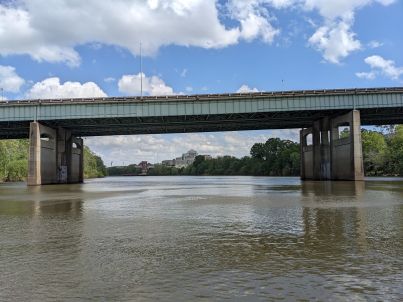
We’d entered the museum at opening time, departing in the early afternoon for the boat to the EJI Freedom Monument Sculpture Park. The short ride on the Alabama River follows the same route boats loaded with shackled men, women, and children once took to Montgomery’s slave market. Disembarking, we climbed a boardwalk up the bluff to the park. Paths lined with sculptures honoring the enslaved led to a vast wall inscribed with thousands of family surnames chosen by the formerly enslaved.
Back in town, our final destination of the day was the Legacy Memorial for Peace and Justice.
Late-afternoon sun blazed down on the hillside pavilion. We stepped inside and stood among hundreds of rectangular steel columns hanging from above, none anchored to the ground. Each represents a county and is inscribed with the names of its known lynching victims.
The suspended columns, six feet long, dangle like lifeless bodies. The visitor is in a grove of voiceless temple bells, a forest of mute organ pipes. The pendant columns sway slightly as people pass and pause to study the names in this vertical, aerial cemetery.
That evening, my daughter and I walked to dinner again past green lawns, the fading tissue blossoms of azaleas, rhododendrons, and crepe myrtle coming on. We strolled beneath tall, long-limbed trees. Such a familiar neighborhood. Such a web of history’s roots beneath linking Alabama to Maryland, Montgomery to Montgomery County.
“Love knows no borders,” signs at recent vigils at the U.S. Capitol in Washington, DC, say. “Hate has no home here,” neighborhood lawn signs proclaim.
Hate knows no borders, either. Hate recognizes neither geography nor chronology. Nor can there be personal distance anywhere from the hate manifest in racism and racial terror. Love must be strong to keep hate out, we used to sing in Unitarian Sunday school.
Returned from Alabama, I feel chastened, naïve. I went south looking for the Civil Rights Trail. But the trail isn’t confined to one zone or even one epoch. The trail of racism, and of defiant struggle against it, extends and branches everywhere. Keeping the latter open, especially through rough territory and seasons, requires continual work, tending, and protection.
Ellen Prentiss Campbell’s collection of love stories is Known By Heart. Her story collection Contents Under Pressure was nominated for the National Book Award, and her debut novel, The Bowl with Gold Seams, won the Indy Excellence Award for Historical Fiction. Her novel Frieda’s Song was a finalist for the Next Generation Indie Book Award, Historical Fiction. Her column, “Girl Writing,” appears in the Independent bi-monthly. For many years, Campbell practiced psychotherapy. She lives in Washington, DC, and is at work on another novel.