The poet talks about his long love affair with imagination.
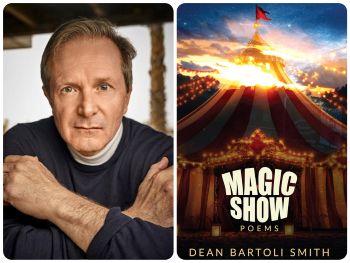
Dean Bartoli Smith’s third collection of poetry, Magic Show, invokes a world in which the sleights of hand that once produced wonder are no longer working, as he describes in the title poem: “The rabbit’s stuck in a bulging sleeve. / My top hat bears no doves tonight.” Despite the disappointment of the magic show, the poems are neither angry nor regretful. Instead, through an examination of losses ranging from failed ambitions to unsuccessful romances to the deaths of loved ones, Smith repeatedly returns to the redeeming power of art and of human connection.
Could you talk about the title of the collection?
What unfolds when a magician has lost touch with himself, a lover, society, the world? What happens when the top hat is empty? We shoot ourselves out of cannons, our mouths fill with ashes. We prepare faces to stave off the shadows. This book offers a meditation on my failures (as a writer, as a lover, as a husband and a parent) with love, not loathing. Our journeys burst through the darkness like the hole in the “Truman Show” ceiling. I’d been thinking a lot about Eliot’s line — “a lifetime’s death in love.” The American Dream increasingly resembles a failed magic show: wet fireworks and a dilapidated carnival midway. Pyrotechnics rule, and it’s a scary, purgatorial landscape we inhabit under the big top. I think about the ultimate magic trick — has humanity come this far before? Each time we evolve and evolve into an “ecstasy of dust.”
There is a wonderful cast of characters in the collection, including family members, friends and lovers, and artists and writers who have had an impact on you. In what ways does an exploration of other people help you understand your own experience?
People inspire the work. I can’t ignore the all-star circus performers I’ve known — many in my immediate family. I’ve always been struck by the epigraph in Campbell McGrath’s work Capitalism: “And my friends will be there too.” There is a poem in Magic Show, “I Saw You, Classifieds.” I was walking to work down 16th Street, and a young woman on a bike caught her tire in a bumper. The bike shot out, and she landed face first. I carried her to the curb and dabbed away blood with a Washington Post. Ten copies of my newly published first book, American Boy, served as a pillow in my satchel. I discovered the russet strands of her hair in the zipper teeth for years. I fell in love and never saw her again. I wonder if she survived.
In a few poems, you allude to your mother’s own love of poetry and efforts to write poems. How did her creative life influence your own?
It was never overt. My mother dropped hints in the form of poetry books on the table (Frost, Plath, Eliot, Dickinson). She scraped together money for me to have books from the Weekly Reader. I read passages to her about Native American massacres, something we talked about. Her temper flared in a Neapolitan way — zero to 100 miles an hour in seconds. On the day after RFK was shot, she forgot to pick me up at kindergarten. She showed up at dusk, crying in a cream-colored nightgown. That became a poem. During my drop-off drive to UVA, she scribbled a poem entitled “Eye of the Needle,” based on the Native American names on highway signs (Chickahominy, Lightfoot, Toano, Chesapeake…). She cried when we said goodbye, not because she was going to miss me. She wanted to attend a school like that. She loved writing poems. That story is told in “Coda: Vita” from Magic Show.
In some ways, the collection reads like a record of the ways poetry and creativity have shaped you and maybe even redeemed you. Did this arc emerge naturally, or did you set out to examine the role of the arts in your life?
I wanted to relive my journey into poetry. Imagination remains my longest love affair. There is a phrase in Italian: fare una scenata. It means to “make a scene.” I’ve always been a conjurer. Poetry, drugs, and the Grateful Dead crashed into my life at once, offering temporary refuge from the Reagan years until they almost killed me. It led to a lethal combination of experience and self-immolation. The arc flows from the poem “Welcome to Dreamland,” a Howitzer-like wheel of death, a carousel that keeps spinning. Death dominates the first section. Reflections on failed love consume the second section. Memories of childhood, music, and loss take up section three. My poems explore the self as shaped by the ecstatic collisions of youth and art.
In addition to loving poetry, you have a love of sports. What do you think is the connection between sports and creativity?
Sports mirror life. The initial fissure in my life occurred at age 7, when my father left. The Baltimore Orioles, Colts, and Bullets lost world championships. The Beatles broke up. Losses piled up. I latched onto the players. They became surrogate fathers. I was mesmerized by Paul Blair and Frank Robinson. I am perpetually running under a Johnny Unitas football pass. All my creativity flows from the schism of those years.
Place seems to be important in your poems — in this and your previous collection. How has setting informed your creative life?
Place provides what Stanley Kunitz referred to as the “psychic energy” of a poem. The idea of place in my work can entail reclaiming a vanished world, exploring elegy and loss, and mining cinematic repositories of memory. Baltimore drives the imagery of the first two collections, American Boy and Baltimore Sons. The new book branches out into amusement parks, seaside towns, the American West, and the great beyond. Italy claws its way into all three collections. Places become sites of encounter, giving me a way to move visually from love into loss and back again.
Elizabeth Hazen is a poet, essayist, and teacher. She is currently teaching poetry through the Goucher Prison Education Partnership. Her work has appeared in Best American Poetry, Epoch, Threepenny Review, and other journals. She has published three collections of poetry, most recently, The Sky Will Hold (2026). She lives in Baltimore with her family.