The novelist talks Morocco, WWI, and what horses can teach us about ourselves.
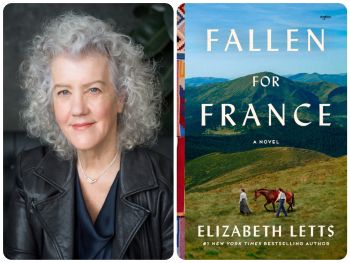
Acclaimed author Elizabeth Letts’ new novel, Fallen for France, is an expansive World War I epic that takes readers from Morocco to the battlefields of Europe. The author is best known for her horse books, and the new work stays firmly in her wheelhouse. In the novel, an Arabian mare named Tassa carries the plot on her back, but even if horses aren’t your thing, this riveting piece of historical fiction will keep you glued to the page.
Most of your books about horses have been nonfiction, but this one obviously isn’t. What are some of the differences and similarities between writing about real equines and imagined ones?
That’s a great question. It’s not so different. Tassa feels as real to me as the real horses I’ve written about. As I was writing, I would imagine Tassa in color against a grey landscape, her beauty serving as a sharp contrast to a world full of difficulty. Also, this is to reassure any readers who might be hesitant: My fictional horse Tassa does not come to any harm. I had to close my eyes during most of Steven Speilberg’s movie “War Horse.” Fallen for France is a wartime book, and there are some difficult scenes that leave no doubt what the war did to horses, but the war is offstage — no barbed wire, no horses in No Man’s Land, none stuck in the mud. I knew from the start that Tassa would be a survivor, and that is not a spoiler.
You stated in your author’s note that some of this book was inspired by a WWI pamphlet written by a horse vet. Can you say more about what was in it?
Yes! This book grew out of a pamphlet that I read, written by an English veterinarian just after the end of the war. Two things stood out — one was their motto, “Horses have no nationalities.” This seems self-evident, right? But back then, it took moral courage to treat the enemy’s horses because horses were also part of the machinery of war. The second thing that struck me was the list of horse breeds he’d treated at his hospital. It was lengthy, and at the end, he wrote, “And one Moroccan Arabian.” I was immediately intrigued. How did a horse from Morocco get to France? Who brought her? Did she ever make it home? These questions lit the spark that became my story and led me sideways into people whose lives were affected by the catastrophe of the Great War.
Morocco was an important part of your life long before you wrote Fallen for France; what was it like to write about it?
It was like opening up a floodgate that I didn’t know was closed before. The time I spent as a young woman in Morocco was incredibly transformative, and yet it was completely subterranean to my creative process until it erupted suddenly into my consciousness. It was as if this story had been percolating for almost 40 years, but so far below the surface that I didn’t even know it.
One thing I didn’t know about you is that you speak several languages. How many, and how do you think being multilingual impacts your writing?
I do speak several languages with varying degrees of fluency, but I don’t think of myself as multilingual in that I don’t speak any language besides English at a native level of fluency. I’m in awe of writers like Laila Lalami and Joseph Conrad who are able to write gorgeous literary fiction even though English isn’t their first language. I’m quite proficient in French, but I can’t imagine writing a novel in French. But in writing about Morocco, certainly I know the spoken cadences of Moroccan Arabic and Tamazight (Berber), and I hope that the flavor of the languages flows through.
There’s a common fantasy that we can somehow know the mysterious backstory of a beloved horse, but there’s also the reality that we usually cannot. What was it like writing this Arabian’s backstory?
There is much that these characters yearn to know about the fates of the people (and horses) that were torn away from them by war. In many instances, you’ll see characters whose only option is to wait, knowing that they may never get the answers that they want. In truth, the veterinarian whose pamphlet I read would have known nothing about the horses he treated — but you know he must have wondered, too. I think that impulse truly lies at the heart of this story — one Arabian mare on the battlefields of France.
You’ve said that one reason you write about horses is because you believe that to understand them is to understand ourselves. Today, like the WWI era, is a time of great upheaval and uncertainty. What do you think horses can teach us about living through difficult times?
There is so much violence and horror in the world all the time that I think, to survive, we often have to look away or numb ourselves so that we don’t walk around in a constant state of anguish and hopelessness. When you put a horse into a human-made disaster, like a war, it helps us strip away the layers of justification and mental protection we build up to tolerate the presence of these terrible things. It makes us look at the truth anew. That is the purpose of art — to allow us to peer cautiously at the most extreme situations so that we are reminded of how humans find hope. In comparison, the trenches of our own lives don’t seem quite so daunting.
Gretchen Lida is an essayist and an equestrian. She is a contributing writer to the Independent and Horse Network. Her work has appeared in the Washington Post, the Rumpus, the Los Angeles Review of Books, and many other outlets. She is also the 2024 Recipient of the Paul Somers Prize for Creative Prose from the Society for the Study of Midwestern Literature.