The British expat tells American tales.
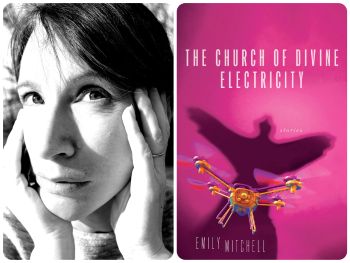
A full-time professor at the University of Maryland and editor at the New England Review, Emily Mitchell has written for Ploughshares, the Sun, the New York Times, Guernica, and many other outlets. Here, she explains her writing process, what inspired the stories in her new collection, The Church of Divine Electricity, and what she’s working on now.
Tell our readers about yourself and what led you to write the stories in The Church of Divine Electricity.
I grew up in London and moved to the U.S. when I was a teenager, and I’ve lived in lots of different places both here and abroad, so I’ve always felt like someone who didn’t quite belong anywhere. My interests as a writer were shaped by this transience: I write about experiences of displacement, characters who find themselves separated from their homes. Michael Ondaatje was an early influence, as is J.G. Ballard, the British science-fiction writer. Ballard looks at society with this outsider’s eye that lets him perceive how deeply strange all human culture tends to be. The stories in The Church of Divine Electricity were all written in the last decade, when it has felt like many of the familiar assumptions of our world have been breaking down: the international order, the norms of U.S. government, social progress, even the weather. The book channels some of the emotions evoked by all that.
Some of the stories deal with an unsettling future. “Life/Story,” for example, is about a reality show where the producers choose one person whose life is documented by tiny drones constantly circling above like flies. What was your inspiration here?
That story is, on one level, about the attention economy: the pressure for everyone to have some fascinating story that can be commodified and consumed. This is connected to American ideas about striving and success. Everyone is in a big contest to be the most interesting, to get the most likes and clicks. The protagonist has absolutely no desire for any of this. He likes his ordinary, unremarkable life. He’s the anti-Gatsby, which is one reason the story is set in New York. But he doesn’t have a choice because his ordinary, unremarkable life has become too precarious to sustain.
The title story deals with a situation that is quite disturbing. Is this the kind of future you envision?
I wanted to examine the question of how technology is changing people’s relationship to their physical existence. In the story, the troubled daughter of a middle-class family joins a new religion dedicated to transcending the human body. Members undergo body modification and somatic gene therapy to help achieve this goal. For the story to work, the reader has to be uncertain, like the characters, whether the religion is good or bad. Because, in reality, many people — I’m thinking of trans people, people with disabilities — modify their bodies in ways that liberate them. I agree with the feminist theorist Donna Haraway, who said we are all already cyborgs. Ultimately, I think the problem with the religion in the story is centralized control and the desire to abandon the body completely rather than finding new ways to live in and through and with it.
These stories aren’t quite dystopian, but they presume a future that’s not quite the norm. How would you describe what you’re doing in them?
I call them speculative and strange. I love the way that great sci-fi can defamiliarize the world, make you see it anew by introducing some element that sharpens and intensifies everything around it. Magical realism and stories of the supernatural can do something similar. That’s what I hope the stories might do: make readers see daily reality in a new way.
You seem to have a preference for writing in present tense.
Present tense feels immediate and urgent and brings the reader into the narrative present of the story very directly and vividly. I don’t choose it exactly. When I’m starting a new story, I’m looking for the voice that sounds right. For these stories, it was often the present tense. Of course, with any formal choice, you lose as well as gain possibilities. There are stories that require the characters to look back and reflect on events that have already transpired for their full meaning to be explored.
Some stories seem unresolved. “Mothers,” for one, leaves the reader with no clear idea of what will happen to the main character.
I believe you can end a story once a character has committed wholeheartedly to a particular path, even if they don’t know exactly what the outcome will be, because the important change, the interior change, has already taken place. In “Mothers,” the main character, who works as a cleaner for a company that sells giant therapy robots for the very rich, has decided to engage in an act of sabotage. She doesn’t know if she’ll be arrested or injured, and she doesn’t know whether what she’s about to do will make any difference. But she’s decided to take this risk. It doesn’t matter what happens because the characters have crossed over into a new realm of courage and commitment where their dignity and integrity are going to be alright no matter what.
What’s your writing process, and do you have any advice for young writers?
I write in the mornings. I usually sit and meditate for about 15 minutes before beginning. I found this was the only way to generate the courage to keep going with the novel I was working on, which scared the pants off me most days with how impossible it felt to complete. The most important thing for someone just starting out is to find those published writers whose work makes your own writing feel possible. Find your influences. Discover the writers who will grant you permission to proceed, a path forward into language and into narrative.
You’re both a novelist and a short-story writer. How do you know when an idea is right for one format or the other?
With short stories, I usually have a pretty good sense of the full arc before I start out, whereas novels are much more difficult to find my way through. I move between these two forms pretty frequently so that I don’t feel stuck in either one.
You grew up in England, yet your stories have a very American flavor to them.
I’ve lived in the U.S. for most of my life. But it still feels relevant that I grew up elsewhere. I still look at U.S. life as an outsider, amazed and appalled by some aspects (like medical care run for profit — how is that even allowed?). This sense definitely informs my writing. Some parts of my sensibility are quite British, too: my skepticism about technology, individual ambition, and heroism; my sense of the absurd; my disinterest in — and even dislike of — fame and glamour. I don’t think of myself as a U.S. writer especially, but I guess I am one by default.
What you are working on now?
I’m working on revisions to a novel, Far Ocean, about the 18th-century botanist and explorer Jeanne Baret, which won the 2025 Big Moose Prize for fiction and is forthcoming from Black Lawrence Press. I also have a novel-in-progress that is speculative climate fiction. I have an idea for another historical novel that I’ll start researching. Every time I finish a work of historical fiction, I swear I’ll never write another one. But then I get interested and can’t seem to stop myself. So, we’ll see!
Mike Maggio’s novel, Woman in the Abbey, won the Literary Titan Gold Book Award and is available from his website or through Amazon and other book outlets.