In the novelist’s debut, students aren’t the only ones being schooled.
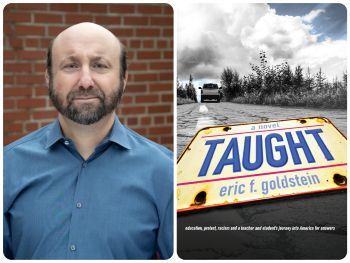
A longtime educator and founder of the student-literacy/social-justice nonprofit One World Education, Eric F. Goldstein is no stranger to the challenges faced by schoolkids in Washington, DC, and elsewhere. Out of his experience comes his debut novel, Taught, which was inspired in part by his many years in the District’s classrooms.
Your career as an educator obviously informed the narrative in Taught, but what was the actual moment that moved you from thinking about the story to writing it?
The shift from thinking about the story to writing it happened in the early months of 2020. The pandemic moved schools online, and my kids and their friends were taking virtual classes in our basement. Through my work, I was in regular conversation with principals and teachers while reading what educators were sharing online. Beneath the breakdown of our medical and education systems, there was a deeper collective grappling with authority, responsibility, grief, and moral clarity. I started writing to process these challenges.
At first, it was reflective, trying to make sense of what I was seeing and hearing. Over time, those early reflections faded, but the larger questions remained. What obligations come with authority? Where does accountability lie when harm occurs? What does it mean to be responsible for another person’s growth?
The novel, Taught, grew out of those questions. Writing became a way to explore these questions and topics without trying to resolve them. That sense of unresolved tension stayed with me throughout the story. While the work is informed by my experience in education, fiction allowed me to place characters in moral and emotional situations I haven’t personally lived through. That freedom, to move beyond reflection into story, is what ultimately shaped Taught.
You’re a white man, but one of your main characters, Malik, is Black. Did you feel a special responsibility to portray him and the other Black characters respectfully?
I think any time a writer steps into a character whose lived experience is different from their own, there’s a responsibility not just to be respectful, but to be honest and restrained. That responsibility isn’t unique to Malik. It applies across the novel.
The characters in Taught represent different races, backgrounds, ages, and political beliefs, and each of them carries a life I couldn’t fully see or explain. My goal wasn’t to define Malik, or any characters, exclusively by those categories. I wanted Malik, and every character in the novel, to be revealed through their choices, their relationships, and their contradictions, while recognizing how identity shapes their lived experiences.
With Malik, I was especially aware of not wanting to speak for him. I also wasn’t trying to reduce him to any single aspect of his identity but to write him as a young person wrestling with purpose, perspective, and his place in a world that doesn’t feel stable or fair. I was drawn to his growth, particularly as his questioning shifts from what he can rely on from the adults around him to what he must take responsibility for himself.
In shaping Malik, I stayed in conversation with former students, which helped ground the work in a way that felt more honest. So, yes, there was a responsibility in writing him. It’s the same responsibility I held for every character: to write each with care, complexity, and restraint, without reducing anyone to a single dimension.
Often, especially in older stories with white protagonists, there’s an uncomfortable “white savior” vibe at play wherever characters of color are involved. But your narrator, JB, who is white, doesn’t pretend to be anybody’s savior. Was it important to you that he have such self-awareness?
There’s been an important shift in how readers and writers think about those dynamics, and that awareness was with me throughout the writing. But I was careful not to let it define the story. I didn’t want that awareness to turn the novel into a response to a “white savior” trope or push the story toward easy conclusions. The novel isn’t trying to avoid discomfort. If anything, I think discomfort is necessary, especially when you’re writing about race, power, and responsibility.
With the protagonist, JB, it was important to me that he not see himself as a savior, nor be written as someone with complete self-awareness. That meant leaning into the messiness of his perspective, in what he understands, in what he misses, and how those gaps shape his relationships with his wife, his students, and Malik.
Like the other main characters in Taught, the goal wasn’t to position JB as good or bad, or to resolve those tensions neatly, but to let readers sit with a character navigating complex realities without fully understanding them. That felt like a more honest way to approach questions of responsibility and self-awareness.
Aside from your own, which novels do you feel handle social-justice issues and matters of race particularly well?
I’m not sure I think about novels in terms of whether they “handle” social justice or race well as a category. What I value most are books that expand my perspective and deepen my empathy. I’m drawn to books that allow me to inhabit lives and experiences I wouldn’t otherwise fully understand.
A few that stayed with me this year are A Particular Kind of Black Man by Tope Folarin, James by Percival Everett, and Razorblade Tears by S.A. Cosby. They’re very different books, but each creates space for reflection on how race, identity, and injustice shape people’s lives, without losing sight of vivid storytelling.
That balance is what I’m drawn to as a reader and a writer. With Taught, my goal wasn’t to deliver a message about race or social justice, though those themes are certainly present. I was drawn to writing characters who are trying, and often struggling, to understand themselves and the world around them. I’m interested in those moments of growth and self-discovery, whether they’re realized or still unfolding.
Finally, as a debut author, you know how difficult it is to bring a book into the world. Can you share something from your publishing journey that might give an aspiring novelist a little hope?
I think writing a book at its core is an act of hope, but bringing it into the world can test that hope in real ways. What helped me was clarity about my expectations and defining success early in the process. I didn’t begin Taught with the goal of getting it published. I started writing to process a complicated moment, and finishing the manuscript became meaningful on its own. That sense of accomplishment stayed with me as I moved into the complicated publishing phase.
At first, I pursued a traditional publishing path, and in one conversation, an agent told me she admired the writing but that her firm wasn’t looking for a novel like this from a middle-aged white man. It was an uncomfortably direct moment but an important one. It helped me better understand how the industry positions writers and books, and it forced me to clearly define my goals.
Ultimately, I chose a different route. I partnered with a colleague to launch an independent press, One Long Road, and we published Taught as its first title. That decision allowed me to stay aligned with what mattered most: my time, my family, and how I wanted the work to exist in my life. For me, hope came from having a clear plan rather than an endless push for more. Once I was clear about what I wanted from publishing, the process became more manageable. The uncertainty didn’t disappear, but it became easier to make decisions based on my priorities rather than external expectations.
Holly Smith is editor-in-chief of the Independent.