The journalist talks Watergate, the Pentagon Papers, and the summer when everything came to a head.
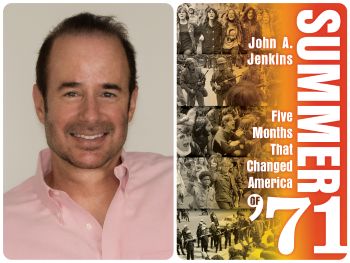
In Summer of ‘71: Five Months That Changed America, award-winning journalist John A. Jenkins returns to a tumultuous season early in his career to unearth unforgettable stories and striking parallels with the crises we now face — including never-published accounts of the wrangling behind the publication of the Pentagon Papers.
Jenkins, the former president/publisher of CQ Press and founder of Law Street Media, has written hundreds of features for major publications, including the New York Times Magazine, GQ, and Washington Monthly. His four books on power and partisanship include the first full biography of Supreme Court Chief Justice William Rehnquist.
For readers new to this remarkable moment in American history, Jenkins has written a page-turning account of a period of drama that was part Shakespeare, part opera, and part Mel Brooks. For those who lived through it, he has combed the archives to uncover previously untold stories from the leaders, reporters, and activists who drove the headlines. As events from half a century ago kept echoing in today’s headlines, what began as a memoir became something different.
Why was the year 1971 so important?
[It] set the stage for Watergate and the downfall of Richard Nixon — the breakdown, the hearings, and ultimately his resignation in 1974. In the book, you can read the transcript of Nixon first learning about the Pentagon Papers, and how he wasn’t that upset initially, but then Henry Kissinger tells him, in essence, “You’ve got to go after this.” [The year] 1971 also parallels many of the events that are happening in the Trump administration right now, including Russia and China as our adversaries, the economy in turmoil, Black lives at risk, abortion rights, and the freedom of the press.
You portray a moment when longstanding rules were being tested, stretched, and sometimes broken — not just by the government, but by lawyers and even reporters.
Daniel Ellsberg, a former hawk disillusioned with government lies about the Vietnam War, sneaks the 7,000-page Pentagon Papers out of the RAND Corporation one briefcase at a time. Neil Sheehan’s papers at the Library of Congress show him and his New York Times editors navigating complicated dilemmas and frequently asking, “Is this the right thing? What should I do?” Sheehan ultimately obtained three copies of the Pentagon Papers — but the first complete tranche was one he took from Ellsberg’s house without permission. For many weeks, Sheehan doesn’t tell Ellsberg he’s got them, but he keeps feeling a moral obligation to somehow get Ellsberg’s approval — though he’s very oblique in getting it.
After a while, Ellsberg decides that Sheehan should have the papers. So he gives him a set with his blessing — having no idea that they’re about to be published and that the story has already been typeset at the Times. I think Ellsberg ultimately felt that the right thing happened, but as a reporter, I saw how the Pentagon Papers story was full of interesting journalistic choices. And not all journalistic-ethics commentators would agree this was the right way for it to have happened.
You unearth conversations between Secretary of State William Rogers and Henry Kissinger that offer striking parallels to the Sheehan-Ellsberg dynamic, with each man withholding information from the other and sometimes lying.
And they all know in their heart of hearts that the other is lying.
Who did you envision writing this book for?
I’ve been getting early reactions from people who were around in 1971 but have forgotten a lot and want to relive this remarkable moment. For the 70 percent of Americans not yet born in 1971, I wanted to show that we’ve been through similar times before and we’ve survived it — and that hopefully our democracy remains as resilient as it was back then.
Tell me about your approach to sources, which stretch from government reports to oral histories to phone-call transcripts to People magazine to celebrity diaries.
My background is as a journalist working from documents, so the main sources are the public record and primary sources. I reviewed more than 100,000 documents from across those five months that were compiled with the help of a team of five researchers. Many were from the Library of Congress and the New York Public Library, including a treasure trove of internal New York Times memos. And because Neil Sheehan wrote so much down, I had to teach myself to decipher his cursive writing, which is a scrawl: how he formed certain letters, the abbreviations he used, and his shorthand-ish style of taking notes.
Which is why the book is chockful of unforgettable stories, some of them never public until now.
Like G. Gordon Liddy commandeering a fire truck and plotting the firebombing of the Brookings Institution. The midnight panic at the New York Times when editor Abe Rosenthal feared they’d been pranked by Attorney General John Mitchell into publishing a false story. The last visit of policy mandarin Averell Harriman with his mentor, LBJ, who revealed his private thoughts about the Kennedy assassination. The book also complicates the record about a critical conversation between Washington Post editor Ben Bradlee and power attorney Edward Bennett Williams — after which Bradlee counseled Post publisher Katharine Graham to start publishing their copy of the Pentagon Papers. I discovered that Ed Williams privately told a much different story about his conversation with Bradlee.
You said you began this book as a memoir, and it became something else. Can you explain?
The book tells the stories of some heroes who made a difference in 1971. I don’t yet know who all the heroes will be today, but there already are some lower-court judges who are standing up. So, I do have confidence that they will be there. One of my goals was to provide some hope to people.
[Editor’s note: John A. Jenkins will speak about Summer of ’71 at Politics and Prose Bookstore in Washington, DC, tonight at 7 p.m. Learn more here.]
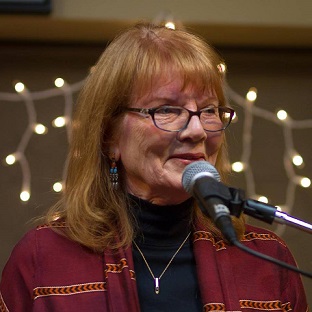
[Photo by David Guy Ottalini.]
Bert Brandenburg, who served as director of public affairs for the U.S. Department of Justice, lives in Silver Spring, Maryland.