The epidemiologist-turned-biographer gives an unsung polio conqueror his due.
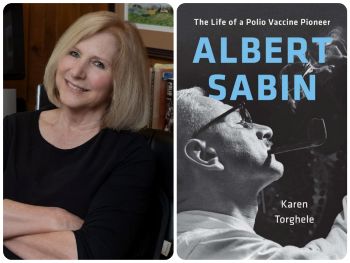
If you’re old enough to remember lining up in grade school to have a bitter-tasting sugar cube placed on your tongue to protect you against polio, you probably also remember all the words to the Mary Poppins earworm, “A Spoonful of Sugar,” which was inspired by the clever medicine-delivery method. What you might not realize is that those cubes weren’t coated with the vaccine developed by the famous Jonas Salk but with a different one discovered by his lesser-known colleague and sometime rival Albert Sabin.
In Albert Sabin: The Life of a Polio Vaccine Pioneer, the first definitive biography of the brilliant but irascible scientist, Karen Torghele explores the complicated legacy of a man who propelled the global eradication of poliomyelitis and yet was, to put it politely, “a fierce joy.”
How did you come to the story of Albert Sabin — or, rather, how did the story find you?
I worked on a project called the Global Health Chronicles in which I interviewed scientists who worked at the Centers for Disease Control and Prevention (CDC) during various times, including during the polio years before and after vaccines were available. In collecting research material to guide my guests for the oral histories of 1950s scientists, I discovered there was no biography of Albert Sabin, who developed the weakened live-virus oral vaccine, although there were at least six on Jonas Salk, who developed the killed-virus (injectable) vaccine. To me, that left a hole in the history of medicine and polio that needed to be addressed.
Why was Sabin’s legacy overshadowed by Salk’s?
Salk had the advantage of being first to develop a polio vaccine, so Sabin was kind of like the second man on the moon. Sabin’s fame later grew worldwide when his vaccine was shown to stop active polio epidemics because it worked at the gut level where polioviruses replicate. His vaccine was known as the “oral polio vaccine” rather than the “Sabin vaccine,” so his name was not remembered by some.
It didn’t help that Sabin could be prickly to the point of explosive temper tantrums. Some fellow scientists even nicknamed him “S.O.B.” How did that square with his humanitarian side?
I was very curious about why Sabin behaved badly, especially towards his family and coworkers. I detail incidents in which his temper plays a part, but I don’t editorialize about what made him so difficult or why he seemed to give himself permission to unleash his anger on others. Readers can form their own opinions.
Even though you have a background in public health, was it challenging to demystify complex science for readers?
I am an epidemiologist, not a virologist. The technical details of how vaccines are developed and work within the body included concepts that were difficult to write about in ways that would satisfy those who are vaccinologists or virologists and still be understandable to those who are not scientifically oriented. Fortunately, I have access to specialists in Atlanta, where I live, who patiently answered all my questions and edited the ways I wrote about vaccines so people at every level of understanding would get the main concepts.
Where did you start and what did you find?
I interviewed well over 100 people and read the interviews of many others who had firsthand experiences with Sabin. Most of the research I did was at the Cincinnati Children’s Hospital Library Archives, where there were 400 linear feet of boxes of papers, photos, slides, lab notebooks, newspaper articles, etc. I came to think of my writing process as being like an eight-year “pregnancy” with complications and which eventually produced a cranky baby.
In those eight years, how did you develop your writing chops?
A big help was Biographers International Organization (BIO), a group that meets once a year to exchange ideas and resources for work on all kinds of biographies. Through BIO, I joined two writing groups that each met monthly via Zoom.
What was your biggest scoop about Sabin?
There was plenty of information about Sabin’s processes and excellence as a scientist. But I uncovered 28 very personal letters that reveal his vulnerable side, which I didn’t find anywhere else. The letters, as well as some long-forgotten videocassettes, contained treasures that were keys to depicting who Sabin was as a person, not just what he accomplished or discovered.
You held your book launch at the Jimmy Carter Presidential Library and Museum in Atlanta. Why there?
Jimmy and Rosalynn Carter were heroes of mine because of the way they lived their lives and used their celebrity status to serve those in need of medications (like vaccines), housing, clean water, and methods to farm so they could feed their families. The Carter Presidential Library hosts regular book talks, and their personnel were delightful to work with — even permitting a string quartet composed of friends from the orchestra in which I play cello to perform some of Sabin’s favorite classical music pieces during the book signing.
What a perfect touch. What’s next for you?
I’m at that phase when I just went through labor and delivery and vow to never have another “child.” However, I did have the inkling of an idea to adapt the Sabin biography to books that children of varying ages would find interesting — and maybe inspire some to become medical researchers.
Laura Fisher Kaiser is a journalist and author based in Washington, DC, who is working on the first biography of Jazz Age novelist Elizabeth Dejeans (1868-1928).