In her new book, the author turns a gimlet eye toward the publishing industry.
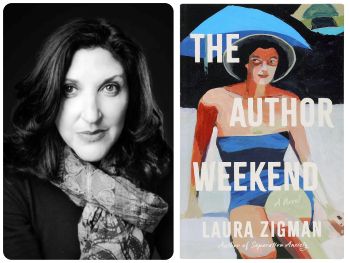
The Author Weekend is a romp, a takedown, and a sendup of the publishing world — or is it the most accurate portrait of the book business ever written? In the novel, Laura Zigman introduces us to mystery writer Faye Wader and those in her wake. Faye’s assistant, agent, publisher, publicist, and biggest fans are as dependent on her as she is on them. So, why not spend a weekend together on Great Misery Island toasting s’mores and drinking prosecco?
As the opening line of the book says, “It was supposed to be fun.”
I loved this book and your characters. Every time I thought you might dip into caricature, you instead went beyond to reveal a depth of great insight. How did you manage that?
I’m so glad you think that, because the point was to show the complicated aspects of writers’ worlds. When I started The Author Weekend, I was coming off a challenging time in my career — every time in my career has been challenging! I was frustrated that, at my age (I was 61 at the time), the glass always appeared empty to the gatekeepers in the business. You can publish books you’re happy with, but after each publication comes The Reckoning: the assessment of your sales figures. These days, every book can be your last — and often is your last — because most books don’t sell well. That struggle is at the heart of every character in the book and at the heart of every writer I know.
Talk about writing what you know! You were a publicist before you published your first book, Animal Husbandry, whose success translated into a movie, and you’ve had good and bad experiences with agents and editors. In these pages, everyone is flawed and self-serving even as they’re relatable, which gives the book a throughline of truth rather than exposé.
Launching a book used to be exciting and hopeful and fun (my first novel came out in 1998, just after yours). Now, the arc from submission to publication is one long stress test, because in addition to writing our books, we are responsible for their success. It’s a sad reality that most authors are spending more time self-promoting than writing.
No one’s having an easy time in publishing these days except the corporate overlords. Agents invest all this time working with writers and placing their books with publishers, but they work on commission. That means agents and editors buy books they not only love but can also sell. Everyone is trying to keep their jobs and not lose the people they’ve worked with for years. I wanted to show that the writer-agent and writer-editor relationships are genuine, but the process itself causes desperation, and desperation causes people to act badly. That said, no matter how much agents and editors suffer, make no mistake: Writers suffer the most!
What saves us is the community of writers we’re part of: friends who encourage and cheerlead us through the writing process, then show up at our events and help spread the word. A silver lining of the business being so tough is that it has made that community stronger. We need each other much more now, and we show up for each other in ways that industry people can’t anymore.
Your narrative rotates among four narrators, allowing you to show their public and private faces. I scrawled across the top of one page: “This is what Point of View was invented for!” Did that POV evolve, or did you know from the start that they’d take turns?
Somehow, this book poured out of me. One reason, which you mentioned, is that I have lived all these points of view. I’ve been the young, aspiring writer dealing with demanding writers when I worked as a publicist at Random House for a decade (traveling with Lauren Bacall for a month almost killed me). While I haven’t been an agent or an editor, I’ve had many of both over the course of my career and have known their struggles despite their flaws. And let’s face it: I am partly Faye, too. At 63, I’m trying to sell enough copies of this book to be able to sell another one, which is why I understand her. Faye imagines the weekend will increase her readership, and then, when things start going very wrong, she’s frantic to simply keep what she has without losing everything.
The Author Weekend covers the industry up one side and down the other, showing the ego and business behind publishing. Ultimately, writing quality is not the most important — or rewarded — part of the business. At the same time Faye made the careers of these people, they also made hers. Was it hard to take all sides?
Taking all sides doesn’t mean I like them! As much as we hate to see it that way, publishing is a business, it always has been, except that now it’s baldly and unapologetically so. I don’t like that we have to constantly wonder before we start a book: Will I be able to sell it? Will it fit into an existing and marketable genre? If a publisher buys it but it doesn’t earn out, will it be my last book? My last chance? Having to think about publishing and marketing has an adverse effect on the art of writing, and it takes a toll on the joy of creativity.
The book Faye has just submitted to her agent and editor is more honest and revealing than anything she’s written in the past. Of course, that makes her more vulnerable to rejection than ever. Her team has to make decisions based on what’s best for them. That’s business, but it doesn’t feel that way to Faye — or to me, or to any writer I know. To us, it feels personal.
Faye is inspired to host her author weekend because a successful rival — a romantasy author — stages huge fanfests in exotic locales. What would ever be enough for a writer?
For most writers, a modest turnout at a weeknight bookstore event is more than enough. But for mega-bestselling authors like Faye, the bar is higher and always rising. When her nemesis has fabulous fan weekends that sell out the minute they’re posted online, a mere New York Times bestseller isn’t enough. Suddenly, she needs that, too.
Faye’s signature L.L. Bean style, with her fleece vest and headlamp, is her charm as author and alter ego. Before Faye knows it, the people marketing her author weekend switch out her beer and fried clams to prosecco and small artisanal bites. They get her a stylist who wants her to wear statement necklaces! She agrees because of her desire to keep up with her nemesis, and once she starts, it’s hard for her to stop. What’s enough for a writer? I decided to follow her (our?) competitive, compulsive tendencies to the absolute limit!
[Photo by A. Mathiowetz.]
Mary Kay Zuravleff is the author of four novels, including American Ending, an Oprah Spring Book Pick, and Man Alive!, a Washington Post Notable Book.