The debut novelist talks Minnesota, identity, and the travails of the wealthy.
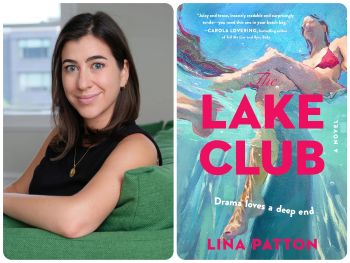
In Lina Patton’s debut novel, how much her Midwestern characters know and care about each other is a delicious mystery. Members of The Lake Club are swimming in ambition and lavish spending, resulting in a showdown between two women over a handsome male nanny whose secrets intertwine with theirs.
You know this town and its country club well. Right off the bat, you show socialite Danika Crawley deflecting praise of her fabulous outfit by saying, “‘Ninety-nine percent off’… making fun of the way Minnesotans downplayed compliments, shoving their humility toward you like a gift you didn’t want.” Give us tips on how to capture a place with all its quirks without being a brat.
Ah, what is life but an endless quest to be honest without being a brat! But in all seriousness, I spent a lot of time thinking about Minnesotans’ reactions. I knew people would be excited to see their home state represented, and I wanted to celebrate, not offend. I kept satire rooted in specific truths (people will laugh at even the worst traits if those traits are undeniable). Offering different character viewpoints allowed me more leeway, so it’s their social commentary, not mine. Of course, I also embraced the chance to bring Minnesota’s natural beauty (its landscape and its people!) to life.
Alongside Danika, we’re following two twentysomethings: Augie Elling, who has returned to town after an embarrassing misstep in New York, and Chat, the summer manny. What was it like to manage the revelations piling up in the lives of your three main characters?
Fun fact: I have a mild form of synesthesia, and I see numbers, letters, and certain objects as distinct colors — so each of my characters was rooted in a different color in my mind. This helped me map their backstories and secrets. Whenever I revealed new information about a character, I highlighted that section in their color. I also wrote in Scrivener, making it easy to toggle between chapters and scan for colors. That said, I wrote many, many drafts, and it was quite chaotic. I’m no savant!
Which was the most fun part to write and which was the most challenging?
I originally wrote the novel entirely from Augie’s point of view, but my agent and I agreed it felt too young. Adding Danika’s contrasting perspective opened up the story. This was both the most fun and the most challenging part of the writing process. It was a blast to bring this catty, complex character to life and elevate the narrative, but rearranging (and rewriting) every scene was a massive undertaking.
Young and talented Augie has slunk back home to live with her mother and work at the club. About two-thirds of the way through the book, she takes stock of her own behavior: “Augie didn’t recognize herself anymore — this pattern of failure. But maybe all her previous years had been the farce. Maybe this was who she really was.” Danika is equally self-critical. Are you partly interrogating why women are so hard on themselves?
Now more than ever in this attention economy, where you must know your “brand” as well as your middle name, our ideas of who we are/should be don’t always align with our white-hot centers. I wanted to explore this discord at two stages of life: your early 20s, when you think choosing the right city or job or path forward will unlock your true self, and your 30s, when you’re grappling with those choices and the identity you crafted. So, yes, I definitely wanted to show how women often lose themselves when they’re overly concerned with how they present to the world.
One of the themes of the novel is that you can make yourself remember something but you can’t make yourself forget. I especially loved how Danika describes the loss of her father: “When he died, he stuck a maypole in the ground. Every other memory, every other moment of his life, was tied to a ribbon, circling around it.” Did you have that theme in mind when you started the book?
I’ve always been obsessed with memory and how certain details stick with you for life, whether you like it or not. (I’ve actually written several poems about it, including this one.) I’m not sure I set out to explore this idea explicitly in the novel, but the power of memory tends to show up in my writing. And when characters have histories as complicated as those in The Lake Club, the past naturally seeps into the everyday, creating tension in a way I find compelling and relatable.
You revel in describing the homes of the rich, and I want to visit those properties. Did you study architecture?
I’m glad you felt transported! I have no real training in architecture or design, but I’ve moved a million times, both as a child and since marrying my Army husband. I’ve become attuned to home-planning and interior decorating. One of my most influential moves was also from Orono, Maine, to Orono, Minnesota, at age 13. As soon as I saw all those lakeside mansions, I was in awe (and wanted to go inside each one). Writing The Lake Club, I hoped to capture that same sense of wonder and surprise while bringing the jaw-dropping houses to life.
I arrived in DC to teach at a wealthy private boys’ school and was daily surprised at their limited options — namely, Ivy League college followed by law school. As I read about your country-club set, I was struck by our continuing naivete that the rich are relaxed, and that wealth brings satisfaction and freedom. Danika thinks at one point, “It’s better to feel mad than heartbroken.” The people in her circle are rife with bitterness, as well as unreasonable expectations.
These days, I think many of us fall into the trap of believing, “If I just have enough money to X, I’ll be content.” It’s understandable given how daily life — let alone life’s bigger challenges — requires hordes of cash. And yet, and yet...some of the wealthiest people I’ve known have also been the unhappiest or most stuck, as you allude to. It’s interesting because I do believe we all understand on some fundamental level that money doesn’t buy happiness, but its role and power are too significant to ignore. Maybe this is why we collectively eat up all the “rich people behaving badly” content. It’s fun to glimpse the other side’s luxury yachts and $1,000 sushi dinners, but it’s also nice to be reminded that we’re all miserable! Or, to put it more positively, that everyone is human, facing their own unique set of challenges — and that we must embrace what truly matters.
[Photo by Travis Marshall.]
Mary Kay Zuravleff is the author of four novels, including American Ending, an Oprah Spring Book Pick, and Man Alive!, a Washington Post Notable Book.