The debut novelist untangles complex Korean American family dynamics.
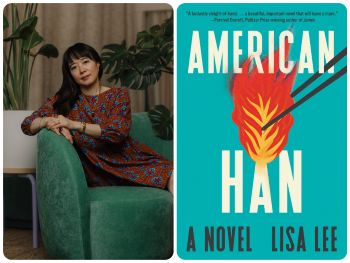
In Lisa Lee’s American Han, everybody in the Kim family is in a personal crisis. Protagonist Jane is skipping law-school classes; her father is abruptly embarking on a new career; her mother is shopping for houses she can’t afford; and her brother’s rigidity and rage have intensified since he ended his professional tennis career and became a cop. In this blunt and intelligent debut novel, everyone pays a different, costly price in pursuit of the American Dream.
Jane demonstrates a significant amount of empathy and understanding toward her mother, father, and brother Kevin, but they rarely even attempt to reciprocate. I wanted to pull my hair out every time they pointed fingers at her for things that couldn’t possibly be her fault. What do you think sets Jane up to bear the brunt of everything?
The Kim family is ruled by patriarchal gender norms so deeply ingrained, they’re mostly invisible to them. Jane is at the bottom of the hierarchy — she’s the youngest and she’s a girl — so her parents and brother instinctively and habitually blame her when anything goes wrong. To be clear, I’m speaking only about this one fictional family, not about Asian Americans or Korean Americans in general. I think people who grow up being victimized, and who are expected to always put the needs of others first, often end up being highly empathetic, able to see other people’s perspectives, and are very in tune with people’s emotions. Kids who’ve lived through trauma or abuse learn to read the room; they’re hyper-aware of their surroundings and the moods of others. It’s a survival instinct.
It’s also important to note that Jane’s perspective is her own. The whole book is told from her point of view, so it’s not really a full picture. Can we really know how true the story is? We never get to see either parent or Kevin’s perspectives, and they probably have completely different takes on everything.
I was intrigued by how you parse the specific indignation and misogyny that can be encountered in Korean American men. As an Asian American woman yourself, it can be touchy and complicated to speculate on that. What inspired you to write about this and how did you approach it as someone closely observing but not directly having that experience?
In an early draft, I thought I was writing a book about Jane and her mother and their difficult relationship, but I got a lot of feedback from male readers and writers who were intrigued by the father and brother. I realized that the book would be stronger if I made it a story about the whole family, that there was rich territory to explore with issues of masculinity and Korean American male identity.
The manifestation of Korean American masculinity in my novel is familiar to me from my own life, and I hadn’t yet seen it sufficiently represented in the canon of Korean American literature: the toxic patterns that arise when traditional Korean assumptions about gender come into conflict with racist American stereotypes that treat Asian men as inherently less masculine. I realized that trying to understand the men in my book was crucial because their experiences are inextricably linked to the women. The way the men experience the world directly affects the women in their lives — their anger, their frustration and pain, their achievements and their joy, are passed to the women, and the way they’re perceived and treated and how they process this is passed on to the women. The men have the authority, and that’s a lot of pressure because of expectations, but their power means that their experiences take precedence.
So, I think of Korean American male experience as a shared experience with the women in their lives. The father’s and brother’s anger and sorrow and their happiness become the mother’s and daughter’s, too. The women have to carry it. I know that I haven’t directly experienced what Korean American men experience, but I think it’s a shared experience, and it’s necessary to try to understand one to understand the other. I try to approach it with care and generosity.
Kevin becoming a policeman felt like such a “Chekhov’s gun” situation. Why was intersecting the Kim family’s dynamics and ambitions with police and policing important to you?
It’s funny that you mention Chekhov’s gun. After reading an early draft, Viet Thanh Nguyen exclaimed: “You can’t introduce all these guns and never fire one!” Well, I managed to get the book published without a gun going off, though the expected violence arrives in a slightly different form.
Policing gives Kevin control, authority, and masculinity, which are the things he craves and thinks he’s owed as a man, and which he’s been denied by his father and by America, from whom he seeks approval forever. The guns give him a feeling of power, and he thinks having them and the authority to use them, applying law and order, will make people admire him. I imagine that when he’s holding the shotgun and practicing with it in the parking lot, not shooting it, but aiming at targets and dancing around, he feels empowered and purposeful.
In his mind, he’s always preparing himself for some moment of confrontation in which he’ll finally be forced/allowed to prove himself worthy of the approval he craves. He approaches the task with the same focus and discipline he once did training to be a tennis star, which was his identity as a child and a young man. Being the best at tennis gave him confidence in a world that seemed to be against him. A bully could say what they wanted, but they’d never beat him at tennis. He carries over the same dedication and pride and feeling of empowerment from tennis to police work, but he becomes caught up in the violence inherent to the job.
The way that Jane’s mom wields other Korean American children and families as points of comparison and judgment was very familiar to me. Where do you think this impulse comes from?
Comparison is unfortunately a human instinct. I don’t know what motivates others, but when Jane’s mother compares other Korean American families and children against her own, it’s her way of having power. She doesn’t have power in her own life — she lacks social power, her own career and her own money, she can’t make her own choices about what her life looks like, her husband has the authority, the family she was born into doesn’t approve of her, Korea doesn’t approve of her, and America certainly doesn’t, but Americans are forever a mystery to her. Since she doesn’t have much control over her own life, she tries to manipulate and exert control over her children. She’s fearful for her own future and her children’s future, but if she can control the course of her children’s lives, and make sure they know that they owe her, that gives her some semblance of control. This is her way of looking out for her children, even though it’s often quite unhelpful.
American Han had me thinking a lot about regret, about time spent miserable and what it means to realize your misery is not inevitable and not indefinite. Even as Jane starts to change her life for the better, she’s still haunted by the past. How does one release themselves from all the rage they’re holding onto?
When I wrote the book, I was trying to understand the anger that had been running through me and my whole family all our lives. Understanding the sources of our anger gave me freedom, which is what everyone in the book is looking for. They all feel trapped, but they think it’s because they haven’t been able to do what they want with their lives. Freedom isn’t just being able to do what you want, it’s having the tools to understand your motivations and feelings. Understanding the systems that oppress us can keep us from misdirecting our anger at each other. The systems have less power over us when we understand how they work. But I’m not sure I’m the one to tell anyone how to release themselves from rage. I’m still holding onto plenty of rage myself. I think rage can be quite a useful emotion, so long as we direct it at the right targets.
[Photo by Huy Doan.]
Anson Tong (she/her) is a writer, photographer, and behavioral scientist based in Chicago. Her work has appeared in Chicago Review of Books, the Rumpus, the Brooklyn Rail, and other publications.