Thanks to the biographer, an unsung Motown powerhouse finally gets her due.
You may not recognize the name of the late Motown in-house songwriter and producer Sylvia Moy, but chances are you know the hits she helped create, including the songs she co-wrote with a young Stevie Wonder — “My Cherie Amour,” “I Was Made to Love Her,” “Uptight (Everything’s Alright),” and “Shoo-Be-Doo-Be-Doo-Da-Day” — as well as such other Motown classics as “This Old Heart of Mine (Is Weak for You),” “It Takes Two,” “Honey Chile,” “My Baby Loves Me,” and so many more.
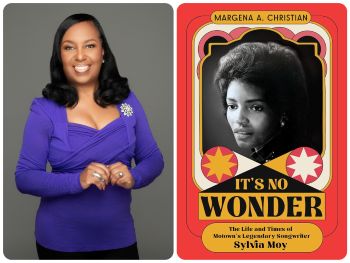
Author Margena A. Christian has captured Moy’s enduring musical legacy in her lively new biography, It’s No Wonder: The Life and Times of Motown’s Legendary Songwriter Sylvia Moy. Tirelessly researched and filled with fascinating behind-the-scenes Motown minutiae, Christian’s book chronicles the trials and tribulations that beset Moy throughout her esteemed career.
What inspired you to write this biography of Sylvia Moy?
It was a story that I had never heard; I had never heard of her before. I had a history of working at Ebony and Jet, and I went into their archives, and there wasn’t a story about her in those magazines that stood out to me. I couldn’t understand why: If she made history as this songwriter and producer, then why didn’t anyone know who she was, and why hadn’t anyone heard of her before? That’s what made me say, “I need to dig a little bit more.” The picture of her face was beckoning me to find out something more.
How long did it take you to get the book together?
I started working on it in 2022, and I would say it took about two-and-a-half years. I did most of the interviews within a year’s time. There were a lot of people I had to interview: Sylvia had a large family, and then there were the Motown folks I had to interview. I also had to do a lot of research: I had to purchase a lot of books and magazines, and many of them were hard to find, as well as costly. In some ways, I looked at it as a race against time, because these weren’t young people that I had to interview. I was fortunate that everyone was still here and in their right mind, because a lot of those Motown folks, very few of them were under the age of 75.
Tell me how you came up with the book’s title. It appears that you’re referencing Stevie Wonder…
It’s not just Stevie — it’s more than Stevie. “It’s no wonder” we never learned who Sylvia Moy was, because of all the things she did as a woman — as a Black woman — in the sixties. The music industry was a man’s world, and it was a white man and a white woman’s world. So, “It’s no wonder” we never heard of Sylvia. It’s a play on words: “It’s no wonder” we never head of her, and, of course, the obvious: It’s a play on Stevie Wonder, as well. But the title It’s No Wonder also [implies] that both Stevie and Sylvia made it because both had the odds stacked against them. So, “It’s no wonder” that, in a variety of ways, they defied the odds.
Why do you think Sylvia and Stevie worked so well together?
They both understood each other, and they both had the determination, the passion, and the desire for something when others did not believe in them. So, when you have each other, you believe in each other. Remember: He was a kid, and when you’re a child and you don’t have people believe in you, that can be devastating. And then, add on that this is a kid with a disability; you already feel like the world is against you. Then, here’s a woman who has the world against her, as well, simply because of her gender and her race. So, [their collaboration] just worked — it was meant to be.
Out of all the songs Sylvia wrote, which is your favorite?
As far as the songs she wrote with Stevie, “My Cherie Amour” is my favorite. When I was a small child, I remember hearing it, and the intro would always make me teary-eyed. As a kid, I didn’t know why; it wasn’t a sad song. But I wasn’t able to understand why my eyes would tear up until I got older and I understood the power of music. The music was so beautiful that it touched me deeply. My favorite Sylvia Moy song, though, is a song she wrote called “And This Is Love.” She wrote it with Frederick Long, also known as Shorty Long.
What would you consider to be Sylvia Moy’s musical legacy?
Sylvia’s legacy as both a songwriter and producer was that she was determined to fight for what was rightfully hers, which was the recognition of her work. She fought and fought, and she didn’t always get the credit that she deserved, and she wanted to raise awareness for others to get the credit for their work. You see, she’s not with us anymore [Moy died in 2017 at 78]. But now [with this book], the world will finally know what this woman did. Her legacy was to show that all things are possible.
Frank Halperin is a freelance writer based in South Jersey.