The journalist talks her new book and the beloved pup who inspired it.
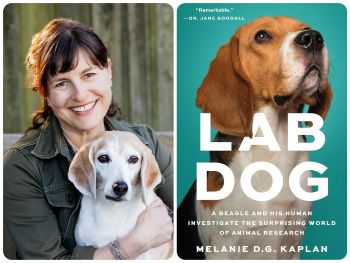
In July 2013, DC-based journalist Melanie D.G. Kaplan adopted a shy, velvet-eared beagle formerly known as CAICWZ, the identifier tattooed inside one of those velvet ears. Before Kaplan brought him home with her, the only other one he’d known was a locked cage. For four years, the beagle, renamed Hammy (short for Alexander Hamilton), was raised for the express purpose of being a laboratory rat.
As the bond between Kaplan and Hammy grew, she yearned to learn more about his past. How, she wondered, had her sweet dog ended up in a research facility? What happens to the animals living inside them? And, most importantly, why does animal testing still exist in today’s world of advanced technologies?
The answers are found in Kaplan’s new book, Lab Dog: A Beagle and His Human Investigate the Surprising World of Animal Research. Think Travels with Hammy but with heartbreaking glimpses through laboratory doors and sit-downs with researchers, ethicists, and the caring humans behind all sides of the animal-testing debate.
Below, a chat between an avowed cat person and a devoted dog lover.
What were the hardest aspects of writing this book? I can tell you the hardest aspects of reading it, for me, took place in the labs and in the experiments — the Atomic Energy Commission’s injecting puppies, for example, with plutonium, radium, and strontium. Were those scenes as tough to write as they were to read, or did you find something else more difficult?
I surprised myself by being able to read and write about this topic at all — it was definitely tough at times. And it should be tough — it’s not our best look as humans, what we do to animals in labs. But I put on my journalist’s hat and plowed ahead because I realized this story is really important. I also felt like, from my perch as a journalist — and because I loved Hammy so much — I didn’t have a choice. I had to tell this story. My mom, who is probably the most sensitive and squeamish person I know, said, “If these animals can go through what they go through in labs, the least we can do is read about it.”
Our current president is one of the few who didn’t bring a dog to the White House. Is his administration still dog-friendly when it comes to animal welfare?
Animal welfare seems to be a bipartisan issue. Actually, during Trump’s first administration, the EPA announced pretty bold commitments for reducing animals in research, which the Biden administration subsequently weakened. So far in Trump’s second term, the FDA and NIH have made groundbreaking statements about moving away from testing on animals — we know those tests are poor predictors of how a drug, for example, will act in the human body. (More than 95 percent of all drugs that show promise in animals fail in humans because they end up being toxic or simply not effective.) The Trump administration is pushing instead for more human-relevant testing methods such as computer modeling, AI, organ chips, and real-world human data. In short, I’m optimistic.
Between the books, articles, interviews, and travel, the research you’ve done here is staggering. How in the world did you organize it to be able to actually sit down and write?
I have no idea. I basically had disorganized piles of books, documents, index cards, and random sticky notes spread across my office floor for years. I’m thankful for some important guidance from author friends: 1) Start shopping around the book proposal before you feel ready and remember that it’s a sales pitch — you’re trying to convince agents (and then publishers) that you can write and structure a very long narrative and have ideas on how to market and sell it to readers. And 2) Embrace the chaotic, no good, very bad, messy draft. That was a big shift for me, sharing things that felt half-baked.
As you give readings and interviews like this one, what question do you think you’ll be asked most frequently?
I think people will want to know how they can make a difference. There are many ways! They can contact their representatives and ask them to support legislation that earmarks more funding for the development of non-animal testing methods. In many cases, people can purchase fewer products we know are tested on animals (pesticides and prescription and over-the-counter drugs, for starters). And they can talk to their friends about the issue. Let’s keep it out of the shadows. I also suspect I’ll be asked if I have another dog. The answer is that Hammy is still so very much in my life and my heart right now, he’d crowd out anyone else. I’m okay with that.
Now, a fun question: Who would you like to play you in the movie version of your book?
I’ve been waiting for someone to ask this question! Natalie Portman, please. Fun fact: She’s been vegan since she was 9 and several years ago co-produced “Eating Animals,” based on the book by Jonathan Safran Foer. One of my favorite Natalie Portman roles, still, is 13-year-old Marty in “Beautiful Girls,” a super sweet, underappreciated rom-com from 1996. I’m nostalgic for high school every time I watch it.
Lastly, what does D.G. stand for in your name? Dog Girl?
I’ve heard Dollar General and Darn Good, but Dog Girl is the best. I’m sticking with it.
[Photo by Hannele Lahti.]
Cathy Alter is a member of the Independent’s board of directors and the author, most recently, of CRUSH: Writers Reflect on Love, Longing, and the Power of Their First Celebrity Crush.