The professor talks college wrestling and building a meaningful life beyond it.
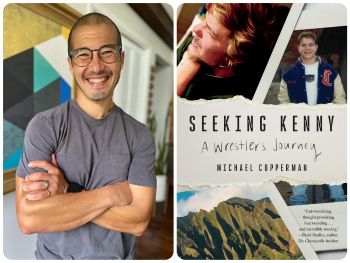
Before he was a writer, Michigan State University professor Michael Copperman was a wrestler — an elite one. But his friend and training partner Kenny Cox shined even brighter. After their careers ended, Copperman and Cox found themselves unmoored. When Cox died suddenly, Copperman’s sense of being adrift only grew. His timely new book, Seeking Kenny: A Wrestler’s Journey, is more than an exploration of his friend’s life; it’s a meditation on what it means to be a man in the 21st century.
You note that you wrote about what happened to Kenny to find out what happened to you. Can you expand on this?
Kenny Cox was once the most successful junior (19 and under) freestyle and Greco-Roman wrestler in United States history, and the winningest University of Oregon wrestler in collegiate style. That success came at a heavy cost that is paid in the mental and physical toll it took to cut weight, the starvation and dehydration practices used by wrestlers (and boxers and MMA fighters) to make the lowest possible weight class. I idolized Kenny Cox. Like Kenny, I won a wrestling scholarship to college in the Pac-12. Like him, my college career was a disappointment, which had a great deal to do with the toll of cutting weight.
After Kenny was done competing, he eventually went on vision quests — first, a barefoot walk the length of the Pacific coast from Oregon to Baja, Mexico, and back. Then, a 70-day pilgrimage into the jungle. He pushed further and harder, trying to heal from the hauntings of having disappointed as a wrestler and seeking balance, yet he was still driven to extremes.
Like him, I wasn’t sure who I was supposed to be once I stopped wrestling, having given myself so fully [to it] until the age of 22. I no longer wanted to believe I was nothing if I was not a wrestler. I wanted to be both beyond it and to recapture it. To understand what had happened to me in trying so hard to be like Kenny, I needed to understand what had happened to him and what led to his tragic death at the age of 31. I wanted to know what he was seeking — and what he found — so I could find peace with who I’d been and who I am now.
What are some of the similarities between writing and wrestling?
Wrestling demands absolute commitment and sacrifice. When you fail, you try again. When you’re on the mat, you’re alone before the world, and you answer only to yourself for the outcome: Your opponent may be better, but excuses are hard to come by. All of these qualities lend themselves well to the pursuit of writing, which requires long, long practice and a belief in yourself forged from something sturdier than extrinsic acclaim. Nobody is going to beg you to write. You have to want it — then earn the opportunities that come your way.
There are very few scenes in the book between you and Kenny. Why is that?
So much of my times with Kenny are repeated memories — things done again and again, like wrestling him in practice and getting beat, or running sprints (and getting beat), or watching him win and ascend a podium. I wanted to tell his story in the terms of those who knew him best — to find who he was in essence and refraction, drawn from the memories of his closest friends and loved ones. I already knew what I knew of Kenny — there was no discovery for me there. I was focused on letting this book tell his story above all.
High-level sports are all-consuming; when athletes can’t compete anymore, they often lose themselves. Is there anything they can do to prevent or lessen that loss of identity?
I wish I had a good answer and a constructive one. I watch boys at the gym putting in their thousand shots. I listen to sports podcasters talk about competition and athletes like commodities, only valuable for what they achieve with their bodies. I remember what it meant to be immersed in a small sports subculture like wrestling that most don’t even care about. With the intense dedication it takes, it’s always going to be hard to move on from an identity forged around high-level sports (or anything else immersive that gets tied to things like self-worth and masculinity). Should we teach athletes that no one thing defines their value, that it’s not just okay but necessary to be more than just who they are on a field of competition? Of course. But I’m not sure we’ve made much progress on this in the 25 years since I was competing.
What have been the reactions of other wrestlers to your book?
The response from both the national community (this book was embraced by USA Wrestling, the National Wrestling Hall of Fame, and FloWrestling) and the Oregon one has been tremendously positive. Wrestler after wrestler has written me emails and fallen into my DMs to tell me their experiences and memories of Kenny Cox and, too, to talk about cutting weight and their identity struggles once wrestling ended.
Whether it was his treks along the coast or his time in Hawaii, the ocean played a big role in Kenny’s life after wrestling. Why do you think this was?
I hadn’t thought about this question as one I would ever answer out loud, but I spent a large portion of the book asking it through imagination and story as I tried to recreate Kenny’s journey on the West Coast and Kauai both. I hesitate to try to give some sort of unembodied answer, but coasts — that space where the land meets the sea — are wondrous and dynamic in ways that ask us to think about our place in the natural world (and perhaps the spiritual world, as well). There’s so much more than what man makes of nature when you’re in that place where elements meet.
[Photo by Mashal Copperman.]
Gretchen Lida is an essayist and an equestrian. She is a contributing writer to the Independent and Horse Network. Her work has appeared in the Washington Post, the Rumpus, the Los Angeles Review of Books, and many other outlets. She is also the 2024 recipient of the Paul Somers Prize for Creative Prose from the Society for the Study of Midwestern Literature.
