The writer talks memoir, violence, and bearing witness to injustice.
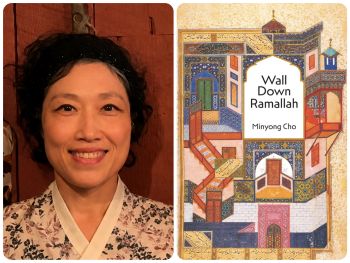
Through eyewitness testimony, Wall Down Ramallah, a slim memoir-in-vignettes, brings alive the decades-long suffering of Palestinians under Israeli rule. In this historical persecution of the Palestinians, author Minyong Cho recognized her own trauma as a child who was physically and mentally abused by her parents. While confronting her unsafe past in the dangerous present of an apartheid police state, Cho has a breakdown, during which she — along with the reader — is unsure what is real and what is not. This brave, heartbreaking book is unlike anything I’ve read, and I was eager to hear more from its author.
How would you classify Wall Down Ramallah? Is it a memoir, essays, travelogue, autofiction? Where would you shelve it in a bookstore?
I would classify it as a memoir and not autofiction, because the story is told as I remember, except for the people’s names. It’s not a collection of essays, because the chapters are closely strung together, leading to a cohesive ending. It’s not a travelogue, because I don’t “travel” in the story. I would say I “study” a lot more. I’d be curious to see, though, where booksellers would shelve Wall Down Ramallah if not in the memoir section. That might be a great conversation-starter.
You grew up in South Korea, immigrated to the U.S. as a teenager, then graduated from MIT with a degree in mathematics before getting a Ph.D. in Islamic art, for which you moved to the West Bank on a doctoral grant. What attracted you to that art?
I’d always been interested in humanities and art theories, in particular. My family emigrated from Korea to the U.S., disregarding my wishes. By the time I was applying to colleges, only two years after arriving in the U.S., my English wasn’t up to par, and I urgently needed to get the full scholarship to get away from my family in Southern California. MIT saved my life in that regard.
I enjoyed studying theoretical mathematics, but I also took architecture classes. In my junior year at MIT, I traveled to Cameroon, where I saw a mosque for the first time in my life. The textiles adorning those congregating at the mosque at the sound of azan, the call to prayer, left a lifelong impression on me. I decided to pursue a Ph.D. in Islamic art history.
A turning point in the book is a short chapter entitled “Israelis Love Walls.” Please talk more about walls and the title Wall Down Ramallah.
Wall Down Ramallah explores the connection between the personal and political and what it means to navigate the memories of personal trauma as an individual and the history of political oppression as a community. The “wall” is a metaphor for the isolation and abandonment that characterized my childhood and for the apartheid and injustice felt by the Palestinians in Ramallah. In Wall Down Ramallah, there is a scene where a man demolishes a wall in a house with a hammer. As chaotic and uncanny as this might seem, I felt a sense of relief that at least this wall was coming down. At the end of the book, I also bring down my personal wall by daring to ask the questions nobody wants to answer.
Imbued in the vignettes of your life as a student at Hebrew University in Jerusalem are themes of memory, childhood abuse, and mental illness. What about your time in Ramallah inspired you to confront your past?
It started with two events in Ramallah in 2007. [First,] a child was lost, and I saw a horror in his mother’s face that I never saw in my father when he told his favorite story of almost losing me at an outdoor market when I was a toddler. I saw triumph in him rather than despair. This made me realize that his abuse of me was not some random alcoholic outbursts resulting in physical blows. It ran deeper and was strategic and calculated.
[And second,] an Israeli soldier pointed a gun at me and Palestinians at the Qalandia checkpoint. The Palestinians seemed bored and unfazed, indicating that they had experienced this kind of terror many times in their lives. I saw myself in them. I was hardened, too, to a degree that nothing hurt me anymore, but what I was carrying with me under my composed face was driving me insane.
Can you describe your writing process?
My writing process went in the opposite direction, actually. I didn’t write the essays first but outlined the larger story I wanted to tell of the watershed moments I experienced in 2007-8, before which I thought obsessively about my childhood, and after which I stopped thinking about it almost overnight. I’m a visual thinker and remember the past in pictures, so when I began writing, all the images flooded onto the pages.
Alice Stephens is the author of the novel Famous Adopted People. Her historical novel, The Twain: A Tale of Nagasaki, is forthcoming in February 2027. She is currently working on a collection of autofictional short stories about her adoption.