The novelist talks unlikable characters, multiple POVs, and the need for humor.
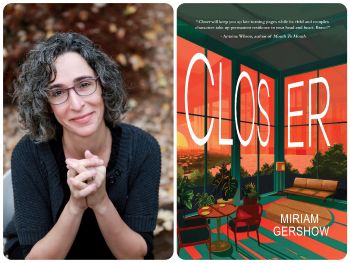
A recipient of writing fellowships in Wisconsin and Oregon, Miriam Gershow also organizes the annual 100 Notable Small Press Books list. Her works include the story collection Survival Tips, the novel The Local News, and, most recently, another novel, Closer. Gershow holds an MFA from the University of Oregon, where she teaches writing.
One of the many things that impressed me in Closer was that you drew a portrait of the whole community. Is it difficult to create so many characters?
I’m of the belief that every writer leads with their strengths, especially in early drafts. My biggest strength — my clearest way into the world of a story — is character. My previous novel and the stories in my story collection all feature a single point of view. Closer was the first time I took on multiple points of view, and honestly, it was like an embarrassment of riches. Structure is not a strength of mine, so it was helpful for me to pass the baton between the points of view to get the narrative figured out.
In early drafts, there were eight additional characters I handed the story to for just one chapter. Any time I got stuck on the plot or the forward momentum, this was my go-to: Give it to someone new! Revision, then, became a process of figuring out which of those “extra” points of view were for me, and which served the story. Between the early and final drafts, I cut out five of them.
Is it difficult to create empathy for so many points of view?
In a word: no. I never know what a story, whether it be flash fiction or a novel, is going to be. I figure that out by immersing myself deep in the character, inhabiting their point of view, and finding my way through. The downside to this approach is that I have plenty of failed flash fictions and novels where I could not get a handle on the characters, or they take me to a dead-end, so their worlds sputter out in my imagination.
But empathy is my writing fuel. If I finish a book and love it enough to want it published, it’s because I was aligned deeply with the characters. The world made sense to me through their eyes, even the deeply flawed ones. And there are deeply flawed ones aplenty in Closer.
When I talk to readers, one of the most common responses is: “I loved this book, but I hated Woody.” I understand this. Woody makes some terrible choices. But I love him — and understand him — as much as I do the more easily likable characters. He is the hero of his own story and is always justifying even the most unjustifiable actions in his own mind. I relate deeply to that.
While most of the novel is realistic, there are moments of satire here — especially when dealing with high-school bureaucracy and the “official” response to the racial incident that starts your plot. How did you manage to balance the two tones?
If I try to write funny, it’s often ham-fisted. But I naturally skew toward humor, even (or maybe especially) when writing about dark topics. I don’t work in a high school, but I’ve spent 20+ years at a large, public university. You cannot sit through two decades of faculty meetings without seeing the inherent nonsense in them. They’re so ripe for satire! The West High faculty meetings were some of the most amusing parts of writing Closer. Writing a novel can be a long, slow slog. I think amusing oneself is important!
While Closer begins with a racial incident, it’s really about the waves that ripple out from that incident, most of which have little to do with race. What made you choose that focus?
I appreciate this question because your distinction — an inciting incident about race but a novel not having a lot to do with race — matters to me. The risk of even broaching the topic of race in a novel, given our fraught history and culture, is that the book is immediately thought of as “about race.”
At the center of Closer is an interracial high-school couple who first meet when two white boys taunt a Black kid at the school library. Once I wrote the library scene, it was clear to me that it contained so much possibility for entangling a whole bunch of different characters from inside and outside the school. That’s a writer’s dream, to find the heat of a story. In that sense, Closer is about race. But as the “library incident” ripples out, it’s also about infidelity and disability and the burdens of the sandwich generation and coming of age and burgeoning sexuality and a community that fails one of its members.
As a white lady, I was aware of two things: I didn’t want to co-opt a story that was not my own. And I didn’t want to write the story of a community and be blind to race. I was not interested in writing about homogeneity, which I discuss at length here. Ultimately, I knew this was a story about a cross section of people who want to be closer to each other, often fail, and are forced to figure out how to do better. Race was a part of that story but not the story.
[Photo by Livia Fremouw.]
John P. Loonam has a Ph.D. in American literature from the City University of New York and taught English in New York City public schools for over 35 years. He has published fiction in various journals and anthologies, and his short plays have been featured by the Mottola Theater Project several times. He is married and the father of two sons; the four have lived in Brooklyn since before it was cool. His first novel, Music the World Makes, will be published by Frayed Edge Press in 2026, while a collection of his short stories, The Price of Their Toys, is forthcoming from Cornerstone Press this February.