In his debut novel, the writer conjures a provocative, South Africa-like country.
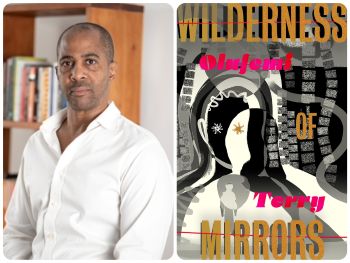
Olufemi Terry’s Wilderness of Mirrors is a smart, serious debut novel. Terry, a journalist, author, and winner of the 2010 Caine Prize for African Writing, was born in Sierra Leone and has lived around the world. He currently works in Cote D’Ivoire and travels frequently to Germany, where his wife and child reside.
Wilderness of Mirrors is set in a fictional country resembling South Africa. The story’s narrator, Emil, a medical student from a privileged family, takes a break to travel to his aunt in “Stadmutter,” a city mirroring Cape Town. This is not quite South Africa, however. Whereas the real-life African National Congress advocates redistributive welfare policies, Terry’s conjured ruling party is fiercely capitalist and centrist.
In Stadmutter, Emil falls in with a group of Creole activists on varying ends of the political spectrum. He engages with a male lover, Bolling, and a female lover, Tamsin. Things happen to and around him. As one character describes him, he’s “unformed,” or is that simply her impression? Emil’s passivity provides him with experiences that allow Terry to interrogate critical political and philosophical issues.
The result is a beautifully written, finely crafted novel that eerily taps into today’s anxious world, asking questions whose answers have eluded both the colonized and their colonizers. In Terry’s words, “The novel explores existential issues — alienation, desire, resentment, and the impulse to belong.”
How did you come to writing and to this novel in particular?
I began a New York novel while living there and worked on it without ever being convinced it was ready. While living in Nairobi in 2007, I wrote “Stickfighting Days,” the first of four short stories I’ve published, and resolved to move to Cape Town to pursue an M.A. in creative writing. Wilderness of Mirrors flows from many sources, including my time in Cape Town. It builds on my essay “Beautiful Ugly” and short story “Dark Triad.” The novel was also influenced by two distinct Cape Town novels: J.M. Coetzee’s Disgrace and K. Sello Duiker’s The Quiet Violence of Dreams.
What about the fictional places where the novel is set?
Stadmutter is a German twist on a nickname for Cape Town, the mother city, as it is the country’s oldest city. It’s called Moederstad in Afrikaans, and in German would be Mutterstad. Similarly, eGeld is a Europeanization of the Zulu name for Johannesburg, eGoli, or the place of gold. The title for my book comes from the T.S. Eliot poem “Gerontion.”
Tell me about the Creole political movement in this novel.
It comes from multiple sources. The first is African Americans’ efforts to secure reparations for slavery and marginalization. It also responds to the complaint expressed by some South African Creoles that the community was perceived during Apartheid as too Black yet is considered insufficiently Black in the post-Apartheid era. Finally, it reflects national identity fracturing into regional and tribal ones, seemingly underway in the U.S.
The Creole community in my novel is animist, with a reverence for the mountain and the sea around Stadmutter inherited from Indigenous ancestors, and [it is] also a point of tension with broadly Christianized Black Africans. These divergences are designed to drive the narrative by exaggerating the contrasts between Stadmutter and the rest of the country.
I consider it a philosophical novel whose protagonists represent types or responses to modernity. Emil starts out as an empiricist, while Tamsin is a skeptic about the limits of human comprehension. Bolling is Romantic and reactionary in the German sense, hostile to technocracy and the Enlightenment and, by extension, the U.S. Bolling’s critique echoes British philosopher John Gray’s observations about tensions inherent in America’s unwieldy syncretization of fundamentalism and Enlightenment ideology.
We see portions of Bolling’s journal. In one entry, he writes, “What lies beneath? We are palimpsests.” Can you say more?
This is one of many motifs in the novel. The journal is a window into Bolling’s worldview. His ideas are seductive to Emil because [Emil] can’t quite comprehend them. Tamsin, too, reads the journal but responds with indifference. The paradox of the words “wilderness” and “mirrors” feels apt. Emil begins to see himself — and the world — in a different light after arriving in Stadmutter. But what he sees doesn’t edify him; it undermines his understanding.
Racial politics and racism are all over this novel. Why?
Of all the places I’ve lived, I felt race most keenly in Cape Town. I feel the intricacy of the racial dynamics can partly be explained by its being so stratified. My white Afrikaner landlord in Cape Town treated me as he did because he perceived me to be American. Class tensions are also important. Early in the novel, Emil’s mother indignantly asks her husband, “Are you really asking him to throw himself on the hospitality of his less well-off relatives?”
Antisemitism is flagged early in the narrative, along with the BDS movement. What do you want readers to make of this throughline?
It’s a thread and one that ties Bolling, who is a German Haitian with reactionary tendencies, and Tamsin, who is a student of Sigmund Freud. It is also a prominent issue in South Africa, whose history is invoked in connection with perceptions about Israel’s behavior in the occupied territories. While always simmering below the surface, the Israel-Palestine issue flared around the time the novel came out. The thread interests me as someone who moves frequently between the Anglosphere (U.K. and U.S.) and Germany.
What writers do you admire, and which have influenced your work?
I admire Teju Cole’s prose certainly but don’t consider him an influence. J.M. Coetzee and V.S. Naipaul are some of my clearest influences. I’m also in awe of Cormac McCarthy and James Salter. Increasingly, I find myself emulating Jean Rhys’ capacity for pathos without sentimentality. Of contemporary writers, I like the British novelist Sophie Mackintosh and the Portuguese [author] Gonçalo Tavares. In terms of nonfiction writers, I’m an avid consumer of Pankaj Mishra’s work.
What projects are you working on now?
I’ll just say my next project is something that will take me in an entirely different direction.
Anything you’d like to add?
I suspect philosophy is my true love and wish I had studied it at university. I’m firmly with the pessimists: Cioran and Schopenhauer and John Gray. As a result, [I] feel quite out of step with the zeitgeist.
Martha Anne Toll is a literary and cultural critic and a novelist. Her second novel, Duet for One, a musical love story and a journey through grief, was published in spring 2025. Her prizewinning debut novel, Three Muses, was published in 2022.