The writer talks short stories and long lives.
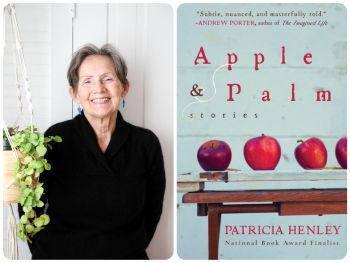
Author Patricia Henley returns to short stories with her latest collection, Apple & Palm. These eight tales dive sharply and deeply into the lives of her characters, many of whom are aging women considering the warp and weft of their own histories. Henley writes with psychological dexterity about these complex people and their community in a fictional Maryland town.
What do you love about short stories?
I love how compact they are. I enjoy limiting myself to that container. I love the way an entire life history can be compressed into a short story. I very much appreciate that there is no pressure to create a satisfying, sometimes moral, ending for the reader. I like for the reader to still have questions to mull over when the story is finished.
You begin the book with a moving quote by Virginia Woolf. Why did you choose that excerpt to open the door into the collection?
Many of the characters in Apple & Palm are withdrawing from the urge to be coupled up. That quote expresses solitariness without regret.
In the first story, “Currency,” an Australian woman living in the United States looks back on her complicated life, thinking that now she “lives in memory.” What does memory mean for these stories, and what do you want to prompt your readers to think about?
I’m not sure that I want the reader to think, but rather I want a reader mostly to feel. Memory in these stories is the process of making sense of a life. Piecing together the puzzle of decisions made early on, the outcomes of which may not be workable in the way the character thought they might be.
How do you build such vivid worlds within each story?
I pay attention. I take notes. Some non-writers may see that as vulture-like, as if we writers are always picking over any interaction or situation for details and story material. But it’s an ingrained habit. And a useful habit. Although I seldom reproduce a world exactly as I’ve observed it. Imagination must always come into play.
In the title story, “Apple & Palm,” what does the loss of Maddy’s front teeth mean for her? And why did you choose to name the book after that story?
Maddy, due to poverty, is forced to relinquish her wholeness, her smile, at an age where adolescents are keenly aware of how they are perceived. It’s not as if she’s been in a car accident; her loss is strictly due to poverty. She never gets over feeling not quite good enough, so she settles for Boone. I chose the title because so many characters, and possibly so many people, often find themselves at the intersection of two streets, two directions, without completely understanding how the choices they make or the beliefs they embrace will affect them throughout life. It seems like a good metaphor.
Can you tell us a little about the connections among the stories?
Jill appears in several stories. She is the embodiment of one feminist ideal: an independent woman who chooses a life free of romance, a businesswoman who loves her work. She has tremendous freedom to make decisions. For instance, she decides to invite the girls in the story “Apple & Palm” to live with her. Because she has no partner to consider, she can make this decision all on her own, without securing agreement from anyone else in her life. Some of the other women in the stories crave more agency, more independence. That is the thread that runs throughout most of the stories: women moving inexorably, if painfully, toward more and more autonomy.
Many of your characters live in or near Whistle Pig, Maryland, a town small enough that “word gets around.” Tell us about this place and why you chose it as your setting.
Of course, Whistle Pig is a fictional town. If you drove through it, you might think, “Typical small American town, near a small university.” You might think, “Backwater.” You might be eager to keep going to someplace shinier and more cool. But in many small towns, there are inhabitants who allow their creative impulses free rein. The women in Whistle Pig are not stereotypical. They might own a business, or be expert at some craft, or be women struggling to become more their best selves. Many of my women characters in or around Whistle Pig are emerging from the dormant period of having been molded by cultural norms they did not choose.
In the last story, Alex thinks that her friend Maria is “a thin thread connecting her to the person she was before, a person with possibilities.” It struck me that other characters are also dealing with the sense that their possibilities are circumscribed. Do you agree? And how do you tell these rich stories about people who worry that their own stories are over?
That is a complicated question. I think many women — no matter their upbringing or present circumstances — can, at one time or another, feel pinned down by their limited opportunities. Telling what you call “rich stories” about them requires letting go of pigeon-holing them. I am keenly interested in the lives of women, in particular, and how they figure out their lives as time goes on. Many women become more fascinating as they age.
Carrie Callaghan is the author of the historical novels A Light of Her Own and Salt the Snow. She lives in Maryland with her family and four ridiculous cats.