The novelist talks Sardinia, The Great Santini, and the publishing industry’s need to label everything.
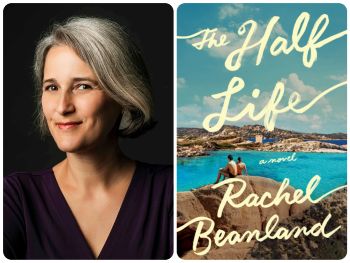
Rachel Beanland’s latest novel, The Half Life, explores the experiences of U.S. military dependents living abroad during the Cold War. Her story takes place in the mid-1970s, when controversy simmered over America’s role as an international peacekeeper.
The book opens with 23-year-old South Carolinian Eileen O’Malley impulsively marrying a U.S. Navy officer who has just received orders to serve on a nuclear-submarine tender moored in the La Maddalena Archipelago, a tiny group of islands off the coast of Sardinia, Italy. Moving with her new husband to the remote outpost, the naïve but intelligent bride navigates an ill-suited marriage, military protocol, and hostility to Americans from the local community.
Like you, I’m a former military brat. Having lived overseas in the 1970s, I immediately connected with the distinct corner of American life explored in The Half Life. Was the book inspired by your family history?
My dad was in the U.S. Navy for most of my childhood. He was a supply officer who got his start working on nuclear-powered subs. Our duty assignments abroad, including two years we spent on La Maddalena, had a huge impact on me.
A few years ago, I was in Italy with my husband, and we visited Sardinia to see where my family had lived. Although the Navy has since left the area, it was an incredible experience. I was standing on the grounds of my old elementary school, which was on a stunning piece of real estate overlooking the Strait of Bonifacio. The building had been abandoned more than a decade earlier, and it struck me that I had witnessed something, living in La Maddalena, that the average American has no idea about. As a writer, I thought, “I have to do something with that.”
But the book isn’t about my family or our time in La Maddalena in the 1980s. I decided instead to examine the Navy’s role in Sardinia in the 1970s, when there was open hostility to the American military and concerns about the environmental risks posed by the U.S. nuclear-submarine program. I wanted to write about the discrepancies between what the military said happened during this period and what really happened.
Although the book is set five decades ago, it feels very timely. As you were writing, did you envision that it would offer readers insight into today’s world?
Absolutely. The Half Life is not just a story about Sardinia. It’s a look at how the U.S. military has a long history of showing up in places where we aren’t entirely welcome. Many of the questions Sardinians — and some astute Americans — were asking in the 1970s are the same questions we’re asking today in other parts of the world.
Another issue from the novel that resonates today is whether it is unpatriotic to question the government.
I thought it was important to look at the military from two sides — that you can have affection for this community but also ask questions like, why were we there? And did we need to be there? I didn’t see how I would write about the U.S. Navy without considering some of those larger questions. Unfortunately, in today’s climate, the people who are asking questions of our government are sometimes labeled anti-American, but that’s just not true. You can interrogate the actions of our military while at the same time saying that what these military families do and what military personnel do is remarkable and selfless.
Why did you tell the story from the perspective of an American military wife as opposed to a serviceman or a Sardinian?
I wanted to celebrate what the military wives were doing on this tiny island, which was very isolated from the lives they knew in the U.S. They weren’t always perfect guests, but they were trying. They were doing something difficult, and they were doing it with a lot of love and dedication to their families and their country.
Do you consider The Half Life as being in conversation with Pat Conroy’s The Great Santini? Your book could be seen as a prequel of sorts as it addresses a new military marriage, while Conroy dealt with the aftermath of one.
The Great Santini was definitely a touchpoint for me as I was growing up, and I reread it as I was working on this book. I love the way Conroy wrote about the military — how he explored love and aggression in military families and the contrast between training people to be fighting machines and then expecting them to be tender and loving people at home.
I’ve seen The Half Life referred to as historical fiction or a summer read. Neither of those designations seems quite right to me. How do you categorize the book?
Unfortunately, I think there is a tendency in publishing to categorize and sub-categorize books by female writers. In my mind, The Half Life is straightforward literary fiction, same as The Great Santini. It’s set in the same era, roughly, as The Great Santini, but it just happens to have been written now as opposed to in the mid-70s.
I feel the same when people ask me if this book is a romance, which we often equate with escapism or “beach reads.” In this case, the novel takes place on a gorgeous Italian island, and there is sex and there is love, but there are also nuclear-powered submarines and Italian politics. It is a story about a woman who’s going through tremendous personal growth, and some of that growth happens within the context of a marriage and some of it doesn’t.
I guess, at the end of the day, if I had to describe The Half Life, I’d call it a Rachel Beanland book, meaning that it’s about the stuff I care about. I’m hoping that, three books in, I’ve gained the trust of readers, and that they’ll follow me where I want to go without regard to how my books are labeled.
Ellen F. Brown is a nonfiction writer whose work specializes in literary history. She is currently writing a biography of playwright Tennessee Williams, with a particular focus on the last 20 years of his life.