The journalist’s own “American in Paris” story involved navigating cancer abroad.
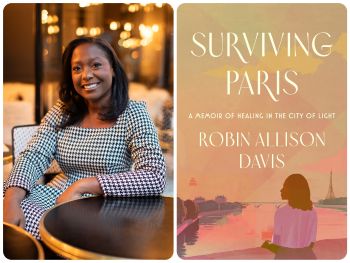
In Surviving Paris: A Memoir of Healing in the City of Light, journalist Robin Allison Davis takes the reader with her as she moves to France and deals with being diagnosed — twice — with breast cancer. But along with sharing the story of her illness and recovery, Davis reveals what it’s like to be a Black American expat navigating a language barrier, an unfamiliar healthcare system, and all the other challenges that come with starting a new life in a new place.
I really love the way you begin your memoir. You write, “All around me, families snapped smiling photos and lovers, hand in hand, secured locks on the nearby bridge.” This was such a beautiful picture. What inspired you to start your book this way?
One of my favorite things to do in Paris is walk along the Seine River — during my cancer journey, it became one of the most grounding activities for me. I loved walking throughout the city and trying to clear my mind while people-watching. It was natural for me to begin the book this way — to take the reader on a stroll through the city with me, something I’d done so many times.
You admit to having hated Paris when you first visited it as a preteen. When did you realize you actually love the city — even if it doesn’t always love you back?
Going through cancer twice in Paris really changed my perspective on the city. During the lowest points of my life, it was French doctors and nurses who cared for me and wiped my tears. When you go through something of that magnitude in a foreign country, the kindness of strangers will really pull you through — and it did. If I had to pinpoint a moment when it all changed for me, I would say my mastectomy recovery would be that moment.
When you recounted your first visit to France, I found myself both laughing and cringing at your description of falling down in a café full of people. How did you decide which moments from that ill-fated trip to include?
My first trip to Paris was such a comedy of errors! It was very easy to decide what to include and what not to include — those were stories I had been telling for years. I wish I could say the beauty of Paris stuck out to me the most on my trip, but it was more the ups and downs. It wasn’t until I went back as an adult in 2012 that I really took in the beauty of Paris.
You go into detail about the challenges of living abroad with cancer. Based on your experience, how would you compare healthcare in France to the U.S.?
In terms of cost, the healthcare in the U.S. is definitely more expensive, although I did struggle with my finances going through breast cancer in France. It isn’t 100 percent free, like everyone claims! Despite it all, I’m incredibly grateful for my experience in France versus the United States. I believe that my second cancer diagnosis would have come much later in the U.S. In France, my doctors ordered test after test without worrying about whether my insurance would deny it. The multiple, expensive tests and eventually a surgery got me my second breast-cancer diagnosis at an early stage. When I think of how people in the U.S. have to battle their insurance for essential exams, often delaying or even denying treatment, I’m so glad I wasn’t in that position.
Our health — whether it includes a cancer diagnosis or not — is often something we reflexively keep private. What made you decide to open up about your own situation and turn it into a memoir?
When I decided to move to Paris, I read several books about life there as an American expat. Most books focused on finding love and becoming a parent, and most authors looked nothing like me. After my cancer diagnoses, I felt it could be helpful to tell my story — an “American in Paris” story by a Black woman where things don’t turn out according to plan. Black women are getting diagnosed with breast cancer at an alarming rate — and are the most likely to die from it. My book was important to me on two fronts. If I could inspire just one person to take their health seriously or to move abroad or even stay abroad when things don’t come out picture-perfect, that would make me happy.
One of the many things that drew me to your book was its title. Where did it come from?
The book title was given to me by a friend. We brainstormed about the title one day, and she came up with the title Surviving IN Paris. I chose to change it to Surviving Paris. For me, the book is about more than just breast cancer; I survived all the various challenges that come with being an expat. It was important to me to show that not only did I survive breast cancer, but I survived Paris as well.
Among other topics, you write beautifully about some of the happy moments you experienced in the time leading up to your surgery. How did you maintain your optimism?
Before my diagnosis, I’d dealt with depression before. I knew how dangerous it could be to fall into a depression while coping with breast cancer, particularly living alone in a foreign country. I made it a priority to pour into myself — like traveling before my surgery, getting my hair done, doing all the things that I like — but also all the things that maybe I wouldn’t be able to do if the surgery didn’t go well. My faith, family, and friends also helped me keep a positive outlook on life. I felt I had no other choice!
Alexa Blanchard is a student at SUNY Oswego. She is majoring in creative writing and minoring in photography. She’s an avid reader as well as a writer who spends a lot of time daydreaming about her next story. She lives on Long Island, NY, with her parents, brother, and dog, Molly. This is her first publication.