The novelist talks trauma, visceral settings, and the allure of the sea.
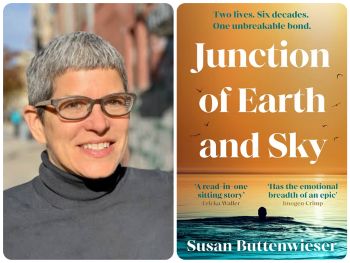
Junction of Earth and Sky, Susan Buttenwieser’s debut novel, came out in England in 2024 and will be released in the U.S. next month. Also the author of the short-story collection We Were Lucky with the Rain, Buttenwieser has been nominated for a Pushcart Prize and has had her writing anthologized and published in numerous literary outlets. Over the decades, she’s taught creative writing in middle schools, homeless shelters, public libraries, juvenile-detention facilities, and a women’s maximum-security prison.
The action of Junction of Earth and Sky takes place over nearly 60 years, yet it doesn’t flow chronologically but jumps forward and backward in time. Why did you choose that form of organization?
The novel details the pivotal moments in the lives of Alice and Marnie, the two main characters, their choices and decisions, as well as the events that changed them. It ping-pongs back and forth between the summer of 1940, when Alice is 14 and living in a small town on the south coast of England, and the 1970s and 1980s, when she is raising her granddaughter, Marnie, in Rhode Island. It also flips forward to the early 1990s, when Marnie is in her early 20s and living out of her boyfriend’s car and stealing and dealing to support her heroin addiction. These three timelines are braided together because everything that happens to Alice during her childhood directly impacts Marnie’s childhood, both the good things and the bad. And there’s a sense of mystery, since the novel opens with Marnie and her boyfriend about to hold up a drugstore in 1993, but then the next chapter is Alice during the summer of 1940, and hopefully it’s compelling and readers will want to find out how these two people are connected and why they ended up where they did.
Staying on the topic of setting, we travel from Brighton on the south coast of England to Nottingham in the north, then up and down the New England coast, with stops in Rhode Island, Provincetown, Worcester, and even a visit to Fenway Park. How did you imbue each of these places with such specific local detail?
These are all places I am familiar with, and I worked hard to make them feel real, even the fictional town where Alice is from, Spithandle, which is based on Worthing [in England]. I have taught writing for over two decades, and I put a big emphasis on sensory details with my students. It’s such an important literary device and, when done successfully, makes the writing visceral and vivid, and the reader can feel everything the characters are going through. And that’s my hope for my writing.
No matter where they travel, both Alice and Marnie are drawn to the ocean. Why?
The ocean is something that Alice loves, and she passes on her passion to Marnie. But it’s also what separates Alice from England, from Spithandle, from “home,” so it also contributes to her longing for England, something that she contends with every single day after she leaves Spithandle. The ocean is where Alice feels truly comfortable in a way that she doesn’t anywhere else. But it’s also a source of pain because when she looks at the ocean, she is reminded of just how far away she is from England, from “home.”
The tragedies that Alice faces in the dislocation of World War II England ultimately affect Marnie’s search for home 50 years later. Why is it important to understand that kind of intergenerational trauma?
Trauma lives in families and is passed down from one generation to another. I think every family is impacted by previous generations, even if they don’t realize it. Alice and Marnie’s family is no different.
Virtually every character faces the kinds of suffering that stem from prominent social issues, but the novel generally avoids sociology or systemic explanations. Why did you choose to focus on individual characters more than broader issues?
When I’m writing fiction, I’m always interested in the characters and trying to develop them, understand them. The more I worked on the novel, the more Marnie and Alice and the other characters started to feel like real people to me. Once I got to that point, I felt as if I was reporting on their lives, almost as if I had no choices anymore, that’s how real they felt and still feel to me. So the social issues that come up are just the facts about them. I have also done a lot of research for this novel, so I hope that I’ve created full, rounded characters and [that], through them, readers might gain a better understanding of social issues, such as addiction and trauma.
Are romantic relationships the source of trouble or salvation for women?
For every person, they can be both, sometimes even at the same time.
[Photo by Keith Summa.]
John P. Loonam has a Ph.D. in American literature from the City University of New York and taught English in New York City public schools for over 35 years. He has published fiction in various journals and anthologies, and his short plays have been featured by the Mottola Theater Project several times. He is married and the father of two sons; the four have lived in Brooklyn since before it was cool. His first novel, Music the World Makes, will be published by Frayed Edge Press in 2025, while a collection of his short stories, The Price of Their Toys, is forthcoming from Cornerstone Press.