The journalist spans continents and cultures in both her work and life.
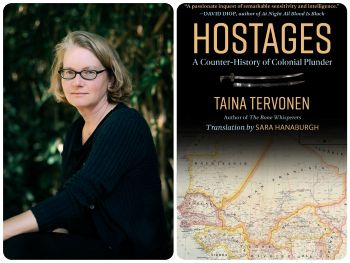
Taina Tervonen is a Finnish journalist and filmmaker who grew up in Senegal and has spent the last three decades based in Paris. A self-described “teller of true stories,” she has built a body of work focused on the silences and blind spots of official history — including her book-length investigation into mass graves in Bosnia-Herzegovina, The Bone Whisperers, which won the Jan Michalski Prize for Literature in 2022.
Her latest work to appear in English is Hostages: A Counter-History of Colonial Plunder, translated from the French by Sara Hanaburgh and published by Schaffner Press. It traces the fate of a group of culturally significant artifacts seized by the French army in West Africa in the late 19th century — among them a sword belonging to the Senegalese religious leader Cheik Oumar Tall, taken from his 9-year-old grandson Abdoulaye when he and his sister were abducted and sent to France. Tervonen’s investigation follows the long effort to bring these objects home and finds in the story a wider reckoning with what colonial plunder truly costs.
What first drew you to this story — the objects themselves, or the people behind them?
It started in 2017, when Emmanuel Macron made an unexpected statement in Burkina Faso, saying that within five years, all artifacts taken from Africa should be returned. Museum directors and curators were saying this was absolutely not possible, that African countries don’t have museums, that Africans would not be able to take care of these artifacts. You had all this colonial past rearing its head with absolutely no filter from people who knew what was politically correct to say, yet on this particular theme, there was no filter. They did not even realize that what they were saying was racist.
I grew up in Senegal and learned colonial history from that side — quite different from what my children have learned going to school in France. When I moved to France, I was surprised by how little the French know about their own history, so when the discussion about these artifacts began, I thought: Here is an angle to talk about colonial history with no filter.
I ended up with this particular group of artifacts for a simple reason — my own childhood. I knew the story of El Hadj Oumar Tall because I had learned it in primary school. I also knew the symbolic power of these objects, which is not at all the same in France. None of these objects are even shown to the public — they haven’t been shown for maybe 40 or 50 years — and yet France won’t return them, even though the Tall family has repeatedly and very officially requested they be returned.
How did you approach the research, given that records may have been destroyed, suppressed, or simply never existed?
It takes time and patience. I spent months in Senegal, starting at a very small library which supposedly had archives, albeit minimal ones. I just spent time and told people I was there to research this topic. I knew that if I did that for long enough, at some point somebody would ask, “Have you met the Tall family yet?” I was waiting for that moment. You can’t be in a hurry — but that felt like the right way. A lot of Westerners come to these places wanting everything explained in two days. That will never give you the full story. The real breakthrough for me was when I read the letters of Abdoulaye. Then I really had a voice from the past — not the voice of the colonizer or a military voice.
You’ve described yourself as a stranger in all of the places you’ve lived: Finland, France, and Senegal. How personal a story did this become?
When I sat down to write, I felt like a tightrope walker trying not to fall to one side or the other of this controversial topic. It was not about taking sides — it was about saying, “This is who I am, and this is the place I write from.” I wanted readers to know who is telling this story.
What I found interesting is how the same object can represent two completely different truths. Are we even talking about the same thing when we talk about this sword in France and in Senegal? This is also how I grew up. I’m a stranger in France. When I go to Finland, it doesn’t feel like home, either. When I go to Senegal, it does — but I’m not Black, I’m not Senegalese, so I have to deal with that, too. Having to navigate different truths because of the way I grew up — that might be the personal core of this story.
Is bringing readers somewhere they can’t — or wouldn’t — go themselves a guiding principle behind your work?
What I try to do is bring readers somewhere, let them sit on a bench beside me and listen to whoever is talking. In Europe right now, we live in a very polarized world, stuck in echo chambers with people who see the world the same way we do. We rarely meet people who are different from us, or talk to them — and I think that’s dangerous. If the books I write manage to enable an encounter between the reader and some other part of the world, then I am content. I hope the stories have the power to bring you into a world you don’t know and change you in the process.
You’ve put that philosophy into practice beyond the page, too. Can you talk about the writers’ residency you’ve set up?
I live part of the year in a small village in central France, and I’ve opened an artist residency in a nearby village of 1,500 people. Writers come to stay — mostly people who would never come to a place like this otherwise — and when they go out, they just meet the people there, in the café, on the street. We hold an open call once a year for writers working on true stories, and we’re now in our third year. It’s very small-scale, but this is the kind of thing I want to put my energy into. Even those on the political extremes are still curious about the world. People just need to meet each other. As a storyteller, I keep asking myself: How do I bring hope to readers, even when writing about things that are difficult and tragic? How do we write about them without just leaving people feeling helpless? This project gives me hope.
[Photo by Chloé Vollmer-Lo.]
Patrick Davies is a freelance writer based between Amman, Cairo, and London. He is concerned particularly with histories of displacement and (voluntary or forced) cultural transfer in the Middle East and North Africa.