The medium urges us to connect with ourselves.
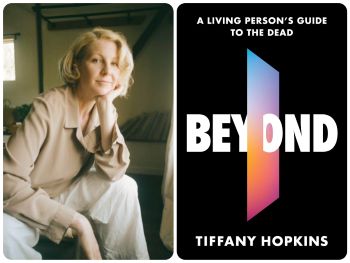
When I first got a copy of Beyond: A Living Person’s Guide to the Dead, I didn’t know what to think. Talking to dead people? Communicating with living pets from miles away? But I was drawn into this how-to book because of Tiffany Hopkins’ personal story and the words of advice she offers that apply to everyday life — chief among them, the reminder that we must learn to connect with ourselves before doing anything else, including communing with the deceased.
What is Lily Dale and what made you decide to move there?
Lily Dale is the world’s largest spiritualist community, located in New York State. My uncle’s house became available there as I was hardcore into my seeking phase, participating in a vision quest, training with an herbalist, doing tarot, practicing Buddhist meditation, etc. Until that point, the traditions I studied weren’t ones I grew up with. But Lily Dale was a part of my dad’s culture, and I was excited to pursue that link.
Some of what you do in this book is demystify — and define beyond ghost stories and psychics — what “mediumship” is. How do you define it?
Mediumship consists of two levels. First is the connection with the beyond, a two-way shared experience. Second is externalizing that connection somehow — through writing or art or talking. That externalizing is when I become the “medium” — the expression of the connection.
Why should people who don’t believe in mediumship read Beyond?
I was surprised to learn that the skills that you need for mediumship support so much of day-to-day life. Many people aren’t interested in mediumship because it’s so niche and because of how it’s portrayed in movies and the media. But talking to the dead is cool. I wanted to present a concrete way to learn to trust yourself and listen to your body, and it can present a spiritual life without the “traditional” sense of tradition.
You write, “Throughout my life, logic has been extremely important to me. I developed my intellect for many reasons, including not wanting to appear foolish, unreliable, or different. I relied personally and professionally on numbers, mathematics, the harder sciences, and data to counteract these fears. Mediumship put me back in direct contact with them. It asked me to do something that most people consider incredibly foolish: speak with — and for — the dead. It is notoriously unreliable. And most definitely not normal.” How do you compare your life of mathematics with your life of mediumship?
With mediumship, I feel pulled in; with mathematics, I often feel pushed out. But I love math so much. It’s so concrete. Linear algebra was always my favorite in school. It’s about how to understand multiple dimensions, i.e., how to conceptualize a world that doesn’t “exist.” Now, for example, I work with companies who have a sense about how people view their product. I use data to prove — or disprove — their hunches. When it comes down to it, I guess I’m always trying to prove everything, to show things are real, whether it is through math or what I’ve developed in mediumship: a focus on the body and additional sources of information since the dead are basically unprovable.
You discuss how the dominant culture has worked to keep us from heeding our intuition. How does mediumship require you to be in touch with yourself?
You would think, given our culture’s interest in individuality, we’d be really big on intuition as it refers to information coming from within ourselves. But intuition is the mechanism for determining our own needs and desires; the problem with a focus on individualism is that it can only be successful for a few at a time. The rest of us have to accommodate [in order] to survive. Most of us have been taught to ignore our feelings, and so it’s hard to figure out how we truly feel — things like “we eat lunch at noon,” while our bodies may say, “I’m hungry at 10:30.” The practice of mediumship requires the skill of being able to listen and discern in the moment.
When you’re giving a reading, why do you believe the received message is coming from the beyond rather than from the person in the room with you?
I don’t always. Lots comes from the other person. There have been examples of information coming through that the person didn’t know, which hints towards other sources. With time, I’ve also learned that information from the person sitting in front of me feels different in my body than information from the beyond. That being said, I can’t prove anything. The best I can do is give you the tools to try it yourself.
Why is it important to be connected with ourselves and others, here and beyond?
From the most simple perspective, it is a biological imperative. No politics there — it is what our entire physiology is wired for. Put a species that needs connection to survive into a culture where we are so rarely supported in that kind of connection and you get rampant mental and physical dis-ease. It is a matter of health. For the beyond part, it is only a small part of our existential crisis. However, if humans throughout the ages did it, and it is so obviously missing from our lives now, it seems like an easy place to start. We can’t change our culture overnight, suddenly not have to commute to a job we don’t like, get real healthcare, change the minds of the people making laws against our lives. But we can start right here, right now, widening our circle of available connection. And that changes everything.
[Photo by Kirby Stenger.]
Deidre Swesnik is a third-generation Washingtonian. When she isn’t reading or hanging with family and friends, she is a civil-rights and housing advocate.