The famed essayist died in September.
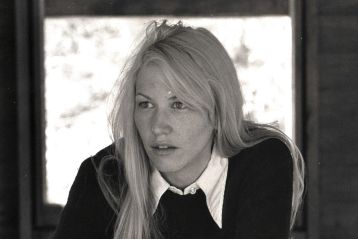
When author Annie Dillard died last month at the age of 81, I happened to be reading Michael Pollan’s A World Appears: A Journey into Consciousness. I was enjoying the book and noting how, though Pollan reviews plenty of scientific theories, he concludes with a visit to a Zen retreat. There are some concepts too slippery to be quantified; they can only be lived.
Dillard was a student of consciousness. She explored it by observing and pondering the world and her experiences, describing creeks, mountains, and a total eclipse of the sun in language urgent and true. She used her consciousness to enlarge ours.
When Dillard burst onto the scene with her nonfiction classic Pilgrim at Tinker Creek in 1974, she was compared to Henry David Thoreau. Like the bard of Walden Pond, she planted herself by a body of water to live more deeply by observing the natural world.
In one passage from Pilgrim, Dillard not only notices the sunset but notices herself noticing it:
“Overhead, great strips and chunks of cloud dash to the northwest in a gold rush. This is it, I think, this is it, right now, the present.”
Consciousness does not spoil the spectacle. “In fact, it is only to a heightened awareness that the great door to the present opens at all,” she continues.
Nature is not always pretty. It is not always serene. But we must pay attention:
“Beauty and grace are performed whether or not we will or sense them. The least we can do is try to be there.”
Dillard was there, and she leaves behind a precious record of her presence: Teaching a Stone to Talk, The Maytrees, The Writing Life, and others, plus her masterpieces Pilgrim at Tinker Creek, which won the Pulitzer, and An American Childhood, which won my heart.
I admired the latter, her memoir, so much that I dragged my family to Dillard’s hometown of Pittsburgh on a literary pilgrimage. Our first glimpse of the place came at dusk as we emerged from a tunnel to a magical visage of the city’s three rivers and their glittering bridges.
Was it the place itself that exerted the magic, or Dillard’s description of it? “I will see the city poured rolling down the mountain valleys like slag,” she writes, “and see the city lights sprinkled and curved around the hills’ curves, rows of bonfires winding.”
When An American Childhood opens, Dillard is 10, and her father is about to head downriver from Pittsburgh to New Orleans in his cabin cruiser. It’s an event a child would remember. But Dillard reaches farther back to capture snatches of earlier memories — stepping into a hot bath, watching a neighbor girl skate beneath a streetlight.
“I woke in bits, like all children, piecemeal over the years,” she writes. “I discovered myself and the world, and forgot them, and discovered them again.”
Isn’t that how it is — or how I’ve always thought of it since reading those words?
My favorite passage in An American Childhood comes at the end, when the grownup Dillard sits in her writer’s shed and recollects her past so intently that, for a moment, she feels like a kid again:
“Is it Mother coming for me, to carry me home?...Back to where I last knew all I needed, the way to her two strong arms?”
But, no, she realizes, “I am here now, with this my own dear family, up here at this high latitude, out here at the farthest exploratory tip of this my present bewildering age.”
Life bewilders, age bewilders, time bewilders. Some writers help us make sense of the bewilderment. Dillard did that and much, much more.
Anne Cassidy has been published in many national magazines and newspapers, including the Washington Post, the New York Times, and the Christian Science Monitor. She blogs daily at “A Walker in the Suburbs.”