A reading list for National Adoption Awareness Month.
November is National Adoption Awareness Month. Launched in 1988 as National Adoption Month, the initiative has been rebranded by adoptees to center our voices and to counter the self-serving narratives of private adoption agencies, religious groups, and adoptive parents.
The adoptee perspective is too often ignored, our authentic stories too often dismissed as the ungrateful complaints of a minority of malcontents. People with tangential connections to adoption have no reservations in refuting our lived testimony by pointing to the many manufactured narratives about adoption by non-adopted people that dominate.
But adopted people will not be silenced. Starting with books like Florence Fisher’s 1973 memoir on searching for her birth parents, The Search for Anna Fisher, we’ve been writing our stories in memoir, fiction, poetry, sociological guides, essays, op-eds, academic texts, screenplays, and more.
I am the proud owner of a growing collection of adoptee-authored books, and every year, I acquire more titles. These are the adoptee-authored books I’ve read in 2025 so far:
The Violence of Love: Race, Family, and Adoption in the United States by Kit W. Myers. A dense, exhaustively researched academic work, this vital addition to the expanding literature of adoptee-authored critical adoption studies is a unique resource that examines the political and cultural roots of the practice of transracial, intercountry adoption in America. It points the way to a better future for children and families. (Read my review here.)
When the World Explodes: Essays by Amy Lee Scott. Loss, grief, and natural disasters have played a big part in the life of the Korean-adoptee author. In poignant essays, Scott navigates the many losses she has experienced through a lens of natural catastrophes. (Here’s my review.)
Into the Light by Mark Oshiro. This dark, expertly told YA novel of foster care, adoption, Christian evangelicals, conversion camps, and split consciousness has made me a forever fan of the author.
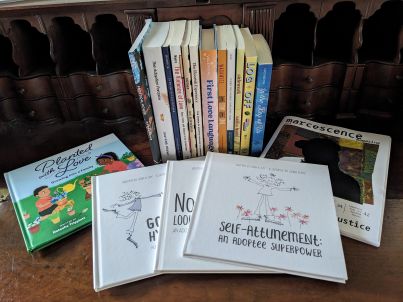
NoBODY Looks Likes Me: An Adoptee Experience, Goodbye Hypervigilance: Healing Adoptee Worry, and Self-Attunement: An Adoptee Superpower by Lora K. Joy, illustrated by Laura Foote. These three sweetly illustrated adult picture books explain adoptee coping mechanisms in order to validate our feelings and help us work toward loving self-affirmation.
Mother by m.s. RedCherries. In that liminal space between prose and poetry, in fragments and stories within stories, stories reported, stories overheard, stories lived, and stories imagined, this collection beautifully explores the historical implications of the story of a Cheyenne woman raised in a white family who finds her way back to her birth family, culture, and identity.
Planted with Love: Growing into a Family by Natasha Tripplett. Gorgeously illustrated by Adriana Pedroi, this book is an excellent addition to any children’s library, showing that families can be formed in many ways. With love and empathy, the author tells of the challenges and triumphs of growing love through patience, nurturing, and overcoming fearful emotions.
One Story, One Song by Richard Wagamese. This uncompromising collection of brief essays delivers hard-earned lessons from a life that included separation from the author’s Ojibway roots by adoption into a white family, homelessness, alcoholism, itinerancy, reconnection with the land and his people, and becoming a successful writer who shares the fruits of his success with others less fortunate.
Log-Off by Kristen Felicetti. Is Y2K too early to be called historical fiction? The author perfectly captures the teen voice of a millennial misfit abandoned by her Asian American mother to be raised by her mom’s white ex-boyfriend as she struggles to navigate high-school relationships.
Freedom House by KB Brookins. Writing themself into existence in a society that seeks to silence and erase them, the poet plays with form, words, convention, and expectations to convey the complexity, pain, anger, joy, and beauty of being a Black, queer, trans poet warrior for justice and freedom.
Marcescence Magazine, Vol. 1: Reproductive Justice. This first volume of what I hope will be many is a breathtaking treasure trove featuring adoptees’ prose, poetry, and artwork on family separation and reproductive justice.
In the Key of Us by Mariama J. Lockington. With poetic prose and a capacious heart, Lockington deftly captures the turmoil of adolescence, the power of creative expression, and the thrill of first love.
The Adoption Paradox: Putting Adoption in Perspective by Jean Kelly Widner. A labor of love for the adoption constellation, this hybrid history and manual for adoption in the U.S. includes extensive excerpts of the many interviews the author conducted with adoptees, foster-care youth and alums, birth parents, and adoptive parents.
First Love Language by Stefany Valentine. With sparkling prose and warm humor, the author portrays conflicting adoptee emotions of belonging and alienation, love for one mom and yearning to know the other one, and the frustration of studying a language that should be your mother tongue.
Sidework by Sasha Hom. This stunning autofictional novella takes us through one woman’s workday as a waitress in a popular restaurant in northern California, where climate change and late-stage capitalism are pushing out everyday folk. The narrator, a Korean adoptee, sees it all with an unflinching eye and world-weary wisdom.
The Flourish Experience: The Power of Adoptee Healing in Community, edited by Diane Shifflett. For one year, a group of adoptee writers gathered online every week to write in community. This stirring anthology presents some of their writing and reflections on what the project meant to them.
BIPOC Adoptees Zine, Volume 1. This online publication features poetry, prose, and artwork, including my humor piece, “Instructions for Your New Korean Child.” All proceeds go to BIPOC Adoptee VOICES.
In Praise of Late Wonder: New and Selected Poems by Lee Herrick. The author is the poet laureate of California and an unapologetic celebrant and elegist of the Korean adoptee. Over a career that spans decades, he writes with illuminating wonder about that which he finds sacred.
Alice Stephens is the author of the novel Famous Adopted People.